
2025 Nobel in Economics : How Innovation Fuels Sustained Growth
Context
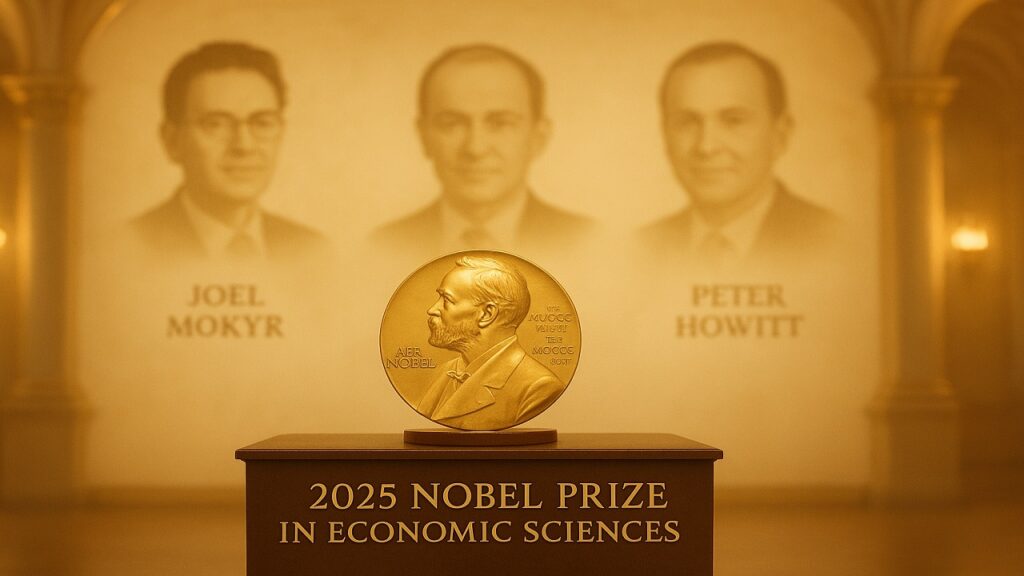
The 2025 Nobel Prize in Economic Sciences was awarded to Joel Mokyr, Philippe Aghion, and Peter Howitt for their groundbreaking research on how innovation and technological change drive sustained economic growth. Their work connects the lessons of economic history with the theories of modern growth, offering deep insights into how nations can achieve long-term prosperity through creativity and knowledge.
About the Nobel Prize in Economic Sciences
What it is:
Formally known as the Sveriges Riksbank Prize in Economic Sciences in Memory of Alfred Nobel, this prize recognizes outstanding contributions in economics that improve understanding of growth, markets, and human welfare.
Winners of 2025:
- Joel Mokyr (Northwestern University, USA): Awarded “for identifying the prerequisites for sustained growth through technological progress.”
- Philippe Aghion (Collège de France, INSEAD, and LSE) and Peter Howitt (Brown University, USA): Jointly awarded “for developing the theory of sustained growth through creative destruction.”
1. Joel Mokyr’s Contribution
- Highlighted the concept of “useful knowledge”, a combination of propositional (theoretical) and prescriptive (practical) understanding, as the foundation of the Industrial Revolution and modern economic growth.
- Explained that scientific experimentation, reproducibility, and skilled craftsmanship together created a feedback loop between science and technology, sustaining innovation across generations.
- Policy Insight: Emphasized that continuous investment in skills, technical education, and openness to change are vital for innovation-based growth.
- Example: Britain’s early industrial success was due to its network of skilled engineers and artisans who transformed new ideas into practical inventions and machinery.
2. Philippe Aghion and Peter Howitt’s Contribution
- Developed a mathematical model of “creative destruction”, explaining how innovation replaces old technologies with superior ones, propelling economic progress.
- Demonstrated that R&D investment drives growth but also leads to displacement of existing firms, requiring policies that ensure both innovation incentives and social balance.
- Their framework provides valuable insights for policymakers on:
- Designing optimal R&D subsidies.
- Formulating competition policies.
- Promoting long-term productivity strategies.
Significance of the 2025 Nobel Work
- Bridges economic history and modern growth theory, explaining why post-industrial societies achieved sustained prosperity.
- Offers practical policy lessons for nations — focusing on education, innovation, open markets, and fair competition.
- Reinforces that innovation is the core driver of productivity, employment, and living standards.
- Provides a framework for 21st-century economies, emphasizing inclusive, resilient, and sustainable growth through continuous innovation.
Conclusion
The 2025 Nobel laureates have profoundly advanced our understanding of how innovation sustains economic progress.
Their collective work proves that knowledge, creativity, and adaptability form the foundation of lasting prosperity. By linking historical experience with modern economic models, their research offers a blueprint for nations striving to build dynamic, innovation-driven, and inclusive economies in the decades ahead.
Source : The Economic Times