
23for23 Campaign: A Citizen Movement for Snow Leopard Conservation
Context
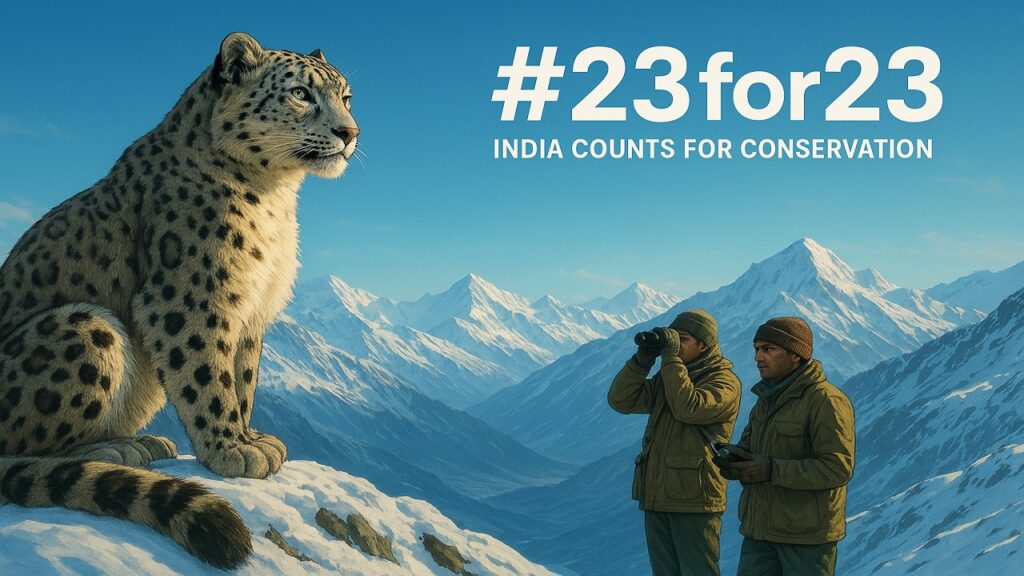
India celebrated International Snow Leopard Day on October 23, 2025, marking a major step in wildlife conservation with the launch of the ‘#23for23’ campaign.
On this occasion, the Ministry of Environment, Forest and Climate Change (MoEFCC) unveiled the first-ever National Snow Leopard Census, recording 718 individual snow leopards across the Indian Himalayas.
This milestone reflects India’s growing commitment to protecting its high-altitude ecosystems and conserving one of the world’s most elusive big cats.
About the ‘#23for23’ Initiative
- A nationwide awareness campaign launched by the MoEFCC.
- Designed to promote citizen engagement and community participation in snow leopard conservation.
- The campaign encourages “23 actions for 2023”, symbolizing practical steps for protecting the species and its habitat.
Objectives:
- To raise awareness about snow leopard habitats and conservation challenges.
- To inspire public involvement in safeguarding India’s high-altitude biodiversity.
- To support global conservation goals under the Global Snow Leopard and Ecosystem Protection Programme (GSLEP).
Key Findings of the Snow Leopard Census 2025
- Total Count: 718 individual snow leopards recorded — India’s first official nationwide estimate.
- Regional Distribution:
- Ladakh: 477 individuals (highest population).
- Uttarakhand: 71 individuals.
- Himachal Pradesh: 51 individuals.
- Arunachal Pradesh & Sikkim: 61 individuals combined.
- Jammu & Kashmir (excluding Ladakh): 58 individuals.
Collaborating Agencies:
- Led by MoEFCC, with support from WWF-India, Snow Leopard Trust, and local communities under Project Snow Leopard (PSL).
- The census represents a blend of scientific methods and community-based monitoring for accurate data collection.
About the Snow Leopard
- Scientific Name: Panthera uncia
- IUCN Status: Vulnerable
- Common Name: The “Ghost of the Mountains” — known for its stealth and rarity.
Habitat (Global):
- Found across 12 countries, including India, Nepal, China, Mongolia, Pakistan, Afghanistan, and Kazakhstan.
- Inhabits elevations between 3,000–5,000 meters, characterized by cold, arid, and rocky terrains.
Habitat (India):
- Distributed across the Himalayan and Trans-Himalayan regions — covering Ladakh, Jammu & Kashmir, Himachal Pradesh, Uttarakhand, Sikkim, and Arunachal Pradesh.
Physical & Behavioral Characteristics:
- Height: ~60 cm | Length: 100–130 cm | Weight: 35–55 kg.
- Fur: Smoky-grey coat with dark rosettes, enabling natural camouflage.
- Behavior: Solitary and crepuscular (active during dawn and dusk).
- Vocalization: Silent predator — cannot roar, unlike other big cats.
- Reproduction: Breeds once every two years, producing 1–2 cubs, leading to slow population recovery.
Conclusion
The #23for23 campaign and the National Snow Leopard Census 2025 represent a major leap in India’s biodiversity conservation efforts.
Through scientific monitoring, community involvement, and global partnerships, India has strengthened its role under the Global Snow Leopard and Ecosystem Protection Programme (GSLEP).
This initiative not only ensures the protection of the snow leopard, a vital keystone species, but also helps preserve the fragile Himalayan ecosystem that sustains millions of lives downstream.
Source : PIB