
India’s Blue Economy Vision: Economic Growth Through Deep-Sea Fisheries
Context:
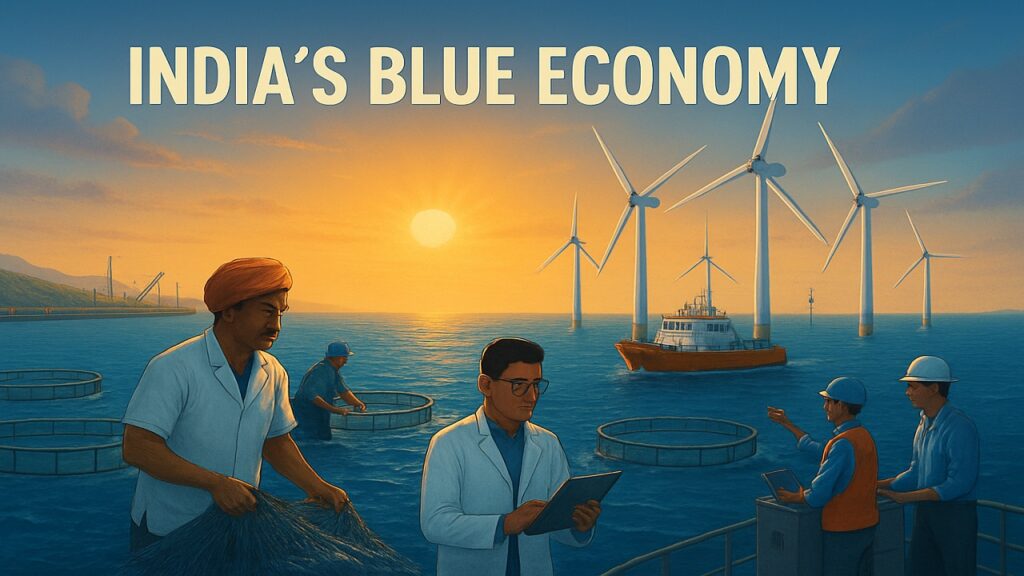
NITI Aayog released the report “India’s Blue Economy – Strategy for Harnessing Deep-Sea and Offshore Fisheries” to provide a scientific, sustainable, and inclusive roadmap for developing India’s deep-sea and offshore fisheries. The aim is to strengthen economic growth, create livelihoods, conserve marine resources, and enhance India’s maritime presence.
Current Status and Overview:
- Underdeveloped Sector: India’s deep-sea fishing is still nascent, despite an estimated 7.16 million tonnes (MT) potential within its Exclusive Economic Zone (EEZ).
- Limited International Presence: Only 4 Indian-flagged vessels operate in high seas compared to Sri Lanka (1,883) and Iran (1,216), reflecting weak global engagement.
- Regulatory Void: No dedicated law exists for fishing between 12–200 nautical miles, leading to Illegal, Unreported, and Unregulated (IUU) fishing and legal ambiguities.
- Jurisdictional Limitation: State governments can regulate only up to 12 nautical miles, restricting oversight of larger marine zones.
Opportunities and Potential:
- Economic Growth: Deep-sea expansion could increase exports beyond ₹60,523 crore in FY 2023–24.
- Livelihood Creation: A modern deep-sea vessel can yield ₹32 lakh annually, nearly 10× more than small motorised boats.
- Coastal Relief: Shifting fishing offshore reduces pressure on inshore fish stocks, supporting sustainability.
- Non-Conventional Resources: Untapped 1.847 MT of lanternfish, squids, and deep-sea shrimp presents new economic opportunities.
- Strategic Edge: Developing a robust offshore fleet enhances food security and India’s maritime presence in the Indian Ocean.
Major Challenges:
- Policy Gaps: Lack of a unified EEZ Fisheries Act and poor coordination among maritime, environmental, and defence agencies.
- Infrastructure Deficit: Only a few of the 90 fishing harbours can berth large vessels; absence of cold storage and processing units limits export competitiveness.
- High Costs: Deep-sea fishing requires high fuel, capital, and maintenance costs, making it unaffordable for small fishers.
- Data Deficiency: No central database for fish stock, species mapping, or catch trends, leading to poor planning and overfishing risks.
- Environmental Risks: Practices like bottom trawling, bycatch, and marine pollution degrade habitats and threaten species in fragile deep-sea ecosystems.
Global Best Practices:
- China: Operates large distant-water fleets and “motherships,” showing scale potential but also risks of overfishing.
- Spain: Uses Vessel Monitoring Systems (VMS), eco-friendly gear, and traceability tools for responsible fishing.
- New Zealand: Implements Quota Management System (QMS) to assign catch rights and balance economy and ecology.
NITI Aayog’s Key Recommendations:
- Policy Overhaul: Draft a national EEZ Fisheries Act aligned with UNCLOS; revise subsidies to reward sustainable practices.
- Institutional Strengthening: Create a Deep-Sea Fisheries Authority and invest in research, data systems, and scientific manpower.
- Fleet Modernisation: Promote modern vessels with GPS and cold storage, and encourage cooperative ownership models.
- Sustainable Management: Adopt ecosystem-based catch limits, enforce marine spatial planning, and enable real-time vessel tracking.
- Financing Mechanism: Establish a Deep-Sea Fishing Development Fund supported by PPPs, soft loans, and insurance schemes.
- Stakeholder Inclusion: Empower fishing communities in governance, capacity-building, and policy benefits, including small-scale fishers.
Conclusion:
The report charts a Blue Revolution 2.0, integrating economic growth with ecological balance. A regulated and sustainable deep-sea sector can:
- Boost exports,
- Secure livelihoods,
- Reduce pressure on coastal fisheries, and
- Strengthen India’s maritime strategic presence,
aligning with the vision of a sustainable Blue Economy.
Source : PIB