
ISRO’s Crew Escape System: Protecting Astronauts from Launch Emergencies
Context:
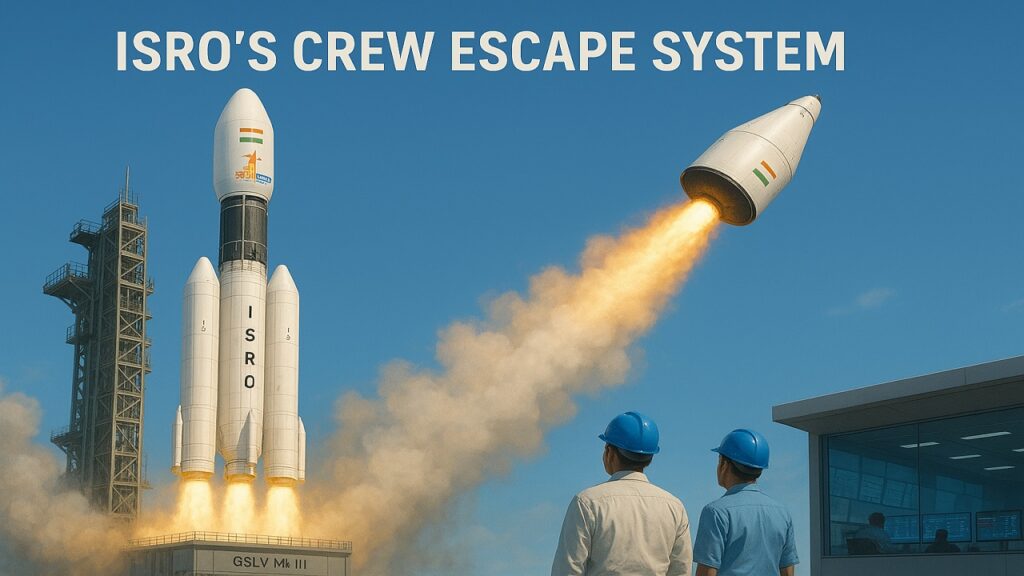
The Indian Space Research Organisation (ISRO) has recently demonstrated the functioning of the Crew Escape System (CES) — a critical safety mechanism of the Gaganyaan Mission, India’s ambitious human spaceflight programme. This system plays a vital role in ensuring astronaut safety by swiftly ejecting the crew module from the launch vehicle in the event of an emergency.
About Crew Escape System (CES):
- The Crew Escape System is a rapid-acting safety mechanism designed to eject the crew module, which carries astronauts, away from a malfunctioning launch vehicle during an emergency.
- It has been designed and developed by ISRO as part of the Gaganyaan human spaceflight programme.
- Objective: To ensure the survival of astronauts by separating the crew module to a safe distance within seconds, even before a catastrophic failure occurs.
How the System Works:
- The CES is positioned at the forward end of the LVM3 rocket.
- It consists of multiple high-burn solid motors that produce greater acceleration than the rocket itself.
- During launch, if the Integrated Vehicle Health Management (IVHM) system detects an anomaly, it automatically triggers the CES.
- Once triggered, the crew module is pulled away rapidly from the rocket.
- A multi-stage parachute deployment system ensures a controlled descent and safe sea splashdown of the module.
Types of Crew Escape Systems:
- Puller Type (used by ISRO):
- Uses solid motors to pull the crew module away.
- Adopted in Gaganyaan (India), Soyuz (Russia), and Saturn V (USA) missions.
- Pusher Type:
- Uses liquid-fuel engines to push the module away from the rocket.
- Employed in SpaceX Falcon 9 missions.
Significance of CES:
- Ensures astronaut safety even before lift-off or during early ascent, which are the most critical and risky phases of spaceflight.
- Marks India’s progress toward human-rated launch capability.
- Demonstrates ISRO’s adherence to global astronaut safety standards, followed by agencies like NASA and Roscosmos.
- Represents a major technological milestone in India’s preparation for future manned space missions.
Conclusion:
The Crew Escape System (CES) stands as a cornerstone of safety in ISRO’s Gaganyaan Mission, ensuring the protection of astronauts under any emergency condition. By mastering this complex mechanism, India reaffirms its capability to conduct safe and reliable human spaceflights, positioning itself among the leading spacefaring nations of the world.
Source : The Hindu