
IUCN Outlook 2025: Mounting Threats to India’s Natural World Heritage Sites
Context:
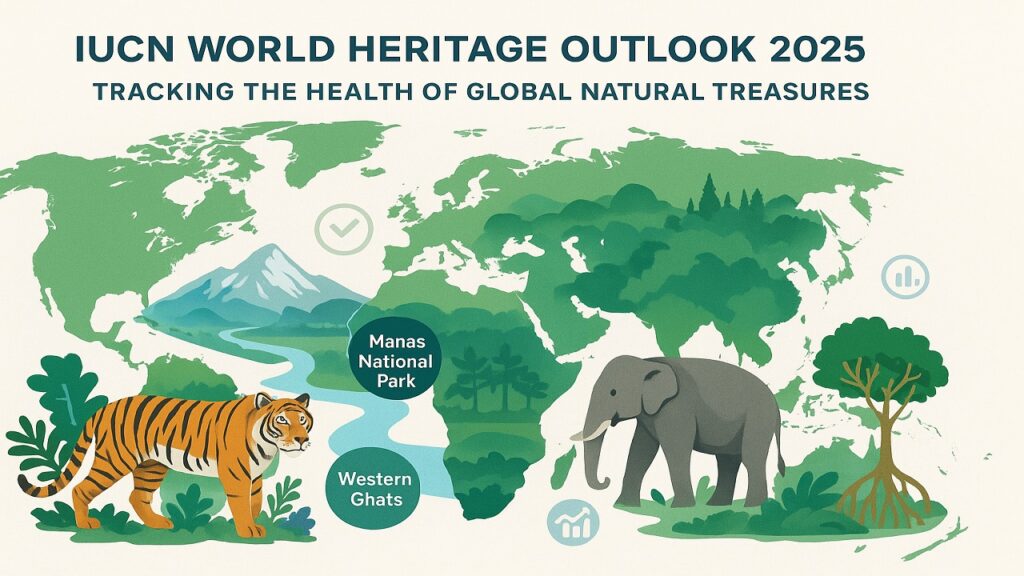
The International Union for Conservation of Nature (IUCN), in its latest World Heritage Outlook 4 (2025) report, has placed Western Ghats, Manas National Park, and Sundarbans National Park under the “Significant Concern” category. This classification reflects growing ecological stress, climate threats, and human-induced pressures on these critical ecosystems.
About the IUCN World Heritage Outlook
- The IUCN World Heritage Outlook is a global assessment published every 3–4 years to evaluate the conservation status of natural World Heritage sites.
- It aims to monitor how effectively these globally important sites are being protected and managed.
- The 2025 report assessed 63 natural sites across Asia, classifying them into four categories:
- Good
- Good with Some Concerns
- Significant Concern
- Critical
- The report observed that the proportion of sites with “Significant Concern” increased from 26% in 2020 to 30% in 2025, showing a worsening conservation scenario.
- The decline is attributed to climate change, uncontrolled tourism, and invasive species spreading across natural habitats.
Indian Sites under ‘Significant Concern’
| Site Name | Location | Key Issues |
|---|---|---|
| Western Ghats | Maharashtra, Goa, Karnataka, Kerala, Tamil Nadu | Loss of evergreen forests (−5%), rapid urbanisation, growing tourism, and multiple infrastructure projects. |
| Manas National Park | Assam (India–Bhutan transboundary park) | Habitat degradation, poaching, flood damage, and increasing presence of invasive species. |
| Sundarbans National Park | West Bengal (India–Bangladesh transboundary park) | Threatened by climate change, sea-level rise, coastal erosion, and tourism pressure. |
Key Observations from IUCN Outlook 2025
- India’s Conservation Status:
Out of 7 Indian natural World Heritage sites:- 1 site — Khangchendzonga National Park (Sikkim) — is rated “Good.”
- 4 sites — Kaziranga, Nanda Devi, Valley of Flowers, Keoladeo, and Great Himalayan National Park — are rated “Good with Some Concerns.”
- 3 sites — Western Ghats, Manas, and Sundarbans — are under “Significant Concern.”
- Top Threats Identified:
- Climate change has now replaced hunting as the most widespread threat to natural heritage sites in Asia.
- Tourism and invasive alien species are among the next most serious challenges.
- Infrastructure Risks:
- The entry of roads and railways into the top five threats highlights the growing impact of linear infrastructure on wildlife.
- These developments lead to habitat fragmentation, wildlife mortality, and disruption of ecological corridors.
Conclusion
The IUCN’s 2025 report serves as a critical warning for India’s conservation efforts. The inclusion of Western Ghats, Manas, and Sundarbans in the “Significant Concern” category underlines the urgent need for:
- Stronger conservation and restoration strategies,
- Sustainable tourism practices, and
- Effective climate adaptation and habitat protection policies.
Balancing development and ecological preservation is essential to ensure that India’s natural World Heritage sites continue to thrive as symbols of global biodiversity and environmental resilience.
Source : The Hindu