
Urban Fiscal Crisis in India: Cities Generating Wealth, Lacking Revenue
Context:
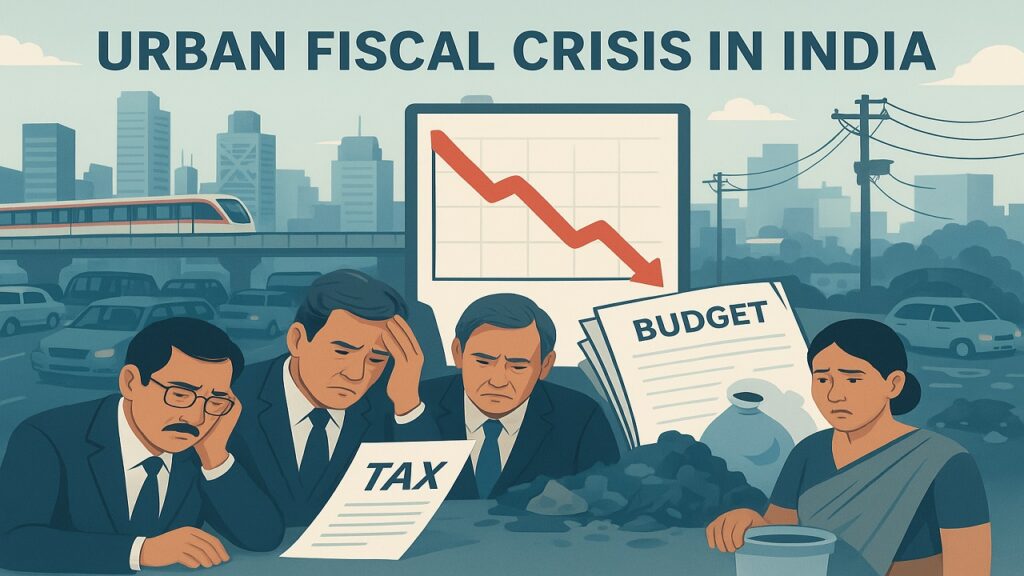
India’s municipalities are the backbone of urban economic activity, contributing nearly two-thirds of the national GDP. However, they control less than 1% of total tax revenue, creating a severe fiscal imbalance. The over-centralisation of taxes post-GST has further weakened city finances, making local governments dependent on state and central transfers to meet their obligations.
1. Structural Flaws in Urban Fiscal Architecture
- Revenue–Responsibility Mismatch:
Cities generate 66% of GDP but receive <1% of tax revenues, leading to a chronic fiscal gap.- Example: Municipal corporations rely on state and central transfers for over 75% of their budgets (CAG, 2024).
- Over-centralisation of Tax Powers:
Local taxes like octroi, entry tax, and surcharges were absorbed into GST, reducing fiscal autonomy.- Example: Mumbai lost ~₹7,000 crore annually post-GST due to octroi abolition.
- Dependence on Grants and Schemes:
Municipalities rely heavily on AMRUT, Smart Cities Mission, and State Finance Commissions, leading to tied and unpredictable funding.- Example: Over 70% of Smart City funds are centrally monitored, limiting city discretion.
- Weak Fiscal Autonomy:
Local bodies cannot revise taxes without state approval, restricting revenue mobilisation.- Example: Gujarat municipalities require state clearance to adjust property tax rates.
- Inversion of Democracy:
Fiscal powers are centralised while service delivery is decentralised, forcing cities to fund essential functions without adequate revenue control.- Example: Bengaluru faces a ₹3,000 crore annual gap between assigned duties and available resources (NITI Aayog, 2023).
2. Causes of Lost Revenue Autonomy
- Post-GST Revenue Loss:
GST subsumed 19% of municipal revenue sources, eliminating city-specific tax flexibility.- Example: Octroi, previously ~30% of Mumbai’s budget, was abolished overnight.
- Bypassing Municipal Compensation:
GST compensation flows to states, not directly to municipalities, widening fiscal gaps.- Example: No structured mechanism exists for direct municipal GST compensation, despite 15th Finance Commission recommendations.
- State Control Over Tax Instruments:
States retain authority over valuation, rates, and collection of local taxes.- Example: Kerala municipalities require state approval to alter property tax slabs.
- Administrative Weakness:
Limited digitalisation and outdated records reduce tax efficiency.- Example: Property tax coverage in Tier-II cities averages 60–65% of potential properties (MoHUA, 2024).
- Weak Fiscal Federalism:
The 74th Constitutional Amendment is poorly implemented in financial devolution.- Example: Only 10–12 states regularly constitute State Finance Commissions, causing uneven fiscal decentralisation.
3. Municipal Bonds: Promise and Pitfalls
- Policy Hype vs. Fiscal Reality:
Municipal bonds are promoted, but only 40+ cities have issued them, with limited success.- Example: Pune’s ₹200 crore municipal bond (2017) was pioneering, but similar efforts stagnated due to weak municipal balance sheets.
- Flawed Credibility Assessment:
Creditworthiness is judged mainly by “own revenue,” ignoring intergovernmental grants.- Example: Grants classified as “non-recurring” reinforce a false narrative of municipal dependency.
- Ideological Bias of Self-Reliance:
Institutions like World Bank and ADB emphasise property tax and user charges as the only sustainable revenue sources. - Need for Governance-Linked Credit Ratings:
Municipal creditworthiness should factor in transparency, audit compliance, and citizen participation, not only revenue figures.
4. Constitutional and Comparative Context
| Aspect | India | Scandinavian Model |
|---|---|---|
| Tax Powers | Highly centralised; GST absorbed local taxes | Municipalities can levy income taxes directly |
| Revenue Predictability | Dependent on transfers and grants | Stable, predictable, and localised |
| Citizen Accountability | Indirect; limited visibility | Citizens directly see use of local taxes |
| Fiscal Equity | Wide inter-city disparities | Shared ecosystem ensures fairness and efficiency |
5. Roadmap for Reforming Urban Fiscal Federalism
- Recognise Shared Taxes as Municipal Income:
Include grants and GST compensation in municipal balance sheets.- Example: 16th Finance Commission can implement formula-based transfers to ULBs.
- Reform Credit Rating Systems:
Incorporate governance, transparency, and citizen participation as rating parameters.- Example: RBI could adopt a governance-weighted index instead of revenue-only metrics.
- Create a Dedicated Urban Fiscal Fund:
Establish a Municipal Financing Authority to pool capital for low-cost loans.- Example: Modeled on Sweden’s Kommuninvest, funding over 90% of local projects.
- Legally Guarantee Fiscal Transfers:
Amend state acts to ensure predictable, untied grants under Article 280(3)(bb).- Example: Tamil Nadu releases devolution funds directly to ULBs via a digital dashboard.
- Empower Cities for Borrowing:
Allow ULBs to use GST compensation or state revenue share as bond collateral.- Example: Tier-II cities could attract private and multilateral financing via securitisation.
Conclusion
India’s urban future relies on fiscal decentralisation and justice. Municipalities must be empowered with predictable, independent, and equitable revenues to provide essential services effectively. Strengthening fiscal autonomy will transform cities from cost centres into engines of national economic growth, fulfilling the true intent of the 74th Constitutional Amendment.
Source : The Hindu