
The Silent Trade in Gender: How Son Preference Fuels Sex-Determination Rackets
The Silent Trade in Gender: How Son Preference Fuels Sex-Determination Rackets
Context
Fresh crackdowns across Karnataka–Andhra, Haryana–U.P., Gujarat, and Delhi have once again exposed cross-border sex-determination rackets. These revelations come three decades after the enactment of the PCPNDT Act, 1994, showing that despite legal prohibitions, illegal foetal sex testing and sex-selective abortions continue to operate through covert interstate networks.
1. About Son Meta Preference and Sex-Determination Rackets
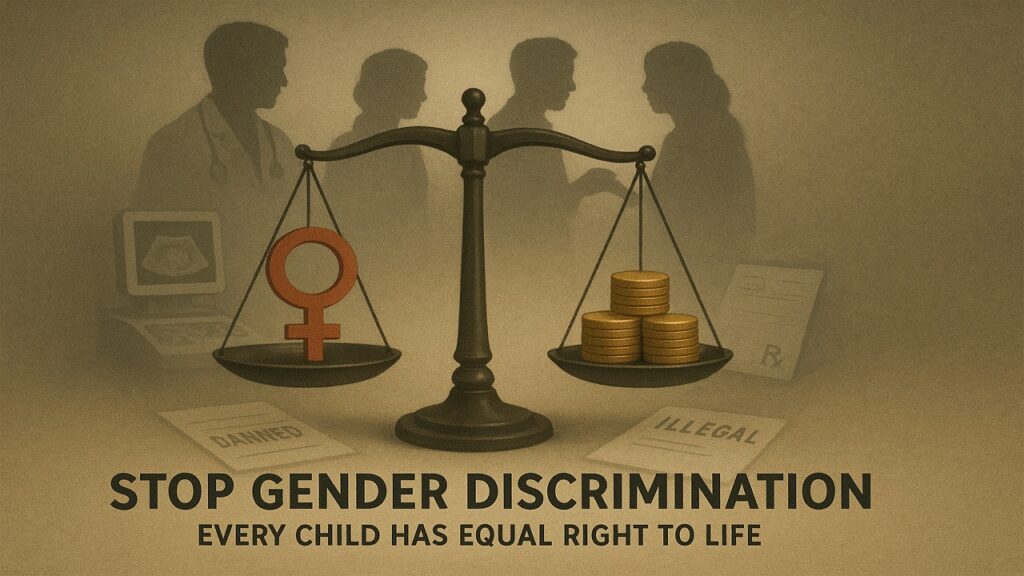
Sex-determination rackets are covert networks linking agents, diagnostic clinics, and pharmacies to provide illegal foetal sex tests and sex-selective abortions.
- They frequently shift operations across districts or States to avoid regulatory oversight.
- Such rackets are driven by deep-rooted patriarchal preferences and economic bias against daughters.
2. Current Trends and Data
- Sex Ratio at Birth (SRB) in Delhi has dropped from 933 (2020) to 920 (2024).
- SRS 2023: India’s SRB improved slightly to 917 females per 1,000 males (2021–23), still below the natural ratio of 952.
- CRS 2023: India’s overall SRB stands at 928 females per 1,000 males, with Arunachal Pradesh (1085) the highest and Jharkhand (899) the lowest.
- Nearly 5% of girls remain “missing” at birth, translating to over 8 lakh female foetuses lost annually.
3. Legal and Policy Framework
a. PCPNDT Act, 1994 (Amended 2003)
- Prohibits both pre- and post-conception sex selection.
- Regulates diagnostic equipment and mandates record-keeping.
- Provides for appeals against acquittals to strengthen deterrence.
b. Medical Termination of Pregnancy (MTP) Act, 1971 (Amended 2021)
- Legalises abortion under medical or humanitarian grounds.
- Criminalises abortions linked to sex determination to protect ethical limits.
c. Drugs and Cosmetics Act/Rules
- Controls the sale and distribution of abortion-inducing drugs.
- Targets unlicensed over-the-counter sales that enable illegal terminations.
d. ART Act, 2021 & Surrogacy Act, 2021
- Regulate assisted reproductive technologies and surrogacy.
- Explicitly ban embryo sex selection and mandate registration of IVF clinics and gamete banks.
e. Schemes and Advocacy
- Beti Bachao Beti Padhao, conditional cash transfers, and digital birth monitoring systems aim to change social attitudes and improve birth registration transparency.
4. Failure of Implementation
a. Weak Enforcement:
- District and State monitoring committees meet irregularly.
- Infrequent inspections allow illegal centres to resume operations unnoticed.
b. Poor Prosecution Quality:
- Weak investigations and failure to appeal acquittals lead to low conviction rates.
c. Medical Complicity:
- Some medical associations protect errant practitioners, dismissing violations as clerical errors, diluting accountability.
d. Technological Leapfrogging:
- Tools like Non-Invasive Prenatal Testing (NIPT) and portable ultrasounds outpace regulation, enabling discreet sex selection.
e. Market Leakage:
- Illegal abortion kit sales and referral networks thrive in rural and border areas, where monitoring capacity is weakest.
5. Social Implications
a. Skewed Birth Ratios:
- Reflect deep-rooted son preference, especially in families with multiple daughters.
b. Cycle of Violence:
- Gender bias begins before birth and continues as discrimination, neglect, and violence throughout life.
c. Economic Roots:
- Dowry, inheritance bias, and undervaluation of women’s labour reinforce the notion of daughters as economic liabilities.
d. Trust Deficit:
- Overly surveillance-driven enforcement targets women rather than clinics, weakening public trust in health systems.
e. Demographic Distortions:
- Surplus men lead to marriage imbalances, human trafficking, and social unrest, threatening long-term stability.
6. Way Forward
a. Strengthen Enforcement:
- Conduct monthly inspections, decoy operations, and asset freezes for repeat offenders.
- Introduce digital dashboards to track appeals and compliance.
b. Integrate Data Systems:
- Link PCPNDT–CRS–SRS–HMIS databases.
- Use anomaly detection (e.g., ultrasound density vs birth ratio).
c. Regulate Technology:
- License NIPT with strict indications, audit trails, and geo-tagged ultrasound tracking.
- Conduct random e-forensics of diagnostic devices.
d. Choke Supply Chains:
- Tighten e-pharmacy control, monitor drug distribution networks, and penalise illegal OTC sales.
e. Empower Communities:
- Encourage vigilance committees, provide cash incentives for girl-child welfare, promote property rights for daughters, and create education-to-skill pipelines.
f. Promote Medical Ethics:
- Mandate ethics training and publish blacklists of convicted doctors.
- Link compliance with clinic empanelment and insurance payouts.
g. Reform Messaging:
- Move from symbolic posters to behavioural-change campaigns featuring local influencers and fatherhood champions.
Conclusion
The persistence of sex-determination rackets highlights the intersection of cultural bias, market incentives, and weak enforcement. While India possesses a robust legal framework, the gap lies in sustained and credible implementation.
To truly address this issue, the focus must shift from penalising women to empowering them, ensuring economic independence, legal protection, and social respect.
Only by choking the illegal networks, leveraging data-driven enforcement, and changing societal norms can India restore gender balance and affirm that daughters are equally valued in law, assets, and life.
Source : Front Line
Note : This information is intended solely for educational purposes and is not for commercial use.