
Western Ghats: India’s Biodiversity Hotspot Under Threat
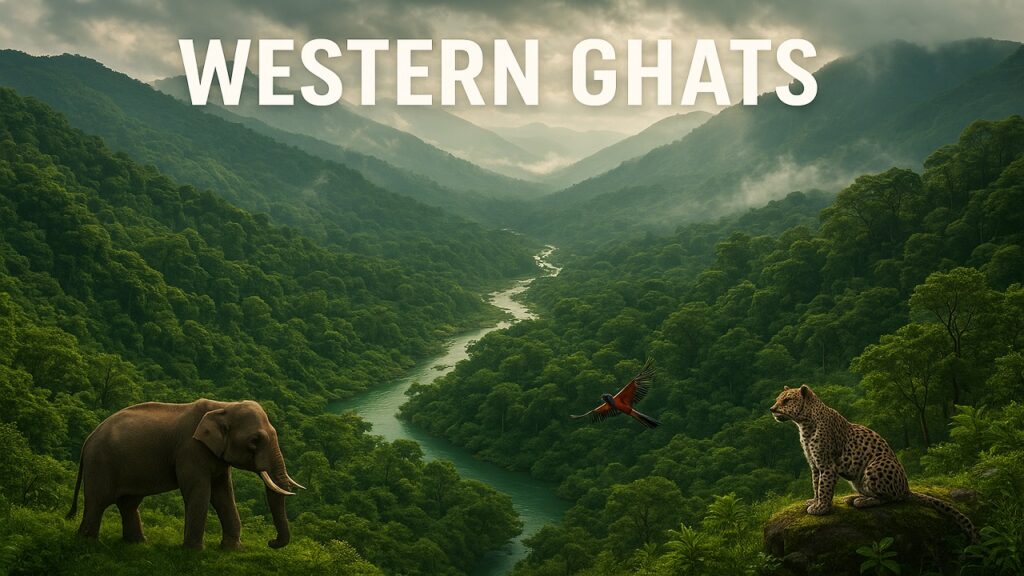
Context:
- The IUCN World Heritage Outlook 4 has placed India’s Western Ghats under the category of “significant concern”.
- Key threats include climate change, unregulated tourism, and invasive species.
- This highlights the urgent need for sustainable management and conservation measures to protect this globally significant ecosystem.
About the Western Ghats:
What it is:
- The Western Ghats, also known as the Sahyadri Hills, form a north–south mountain range along the western edge of the Deccan Plateau.
- Recognised as a UNESCO World Heritage Site, they are one of the eight hottest biodiversity hotspots in the world.
Location:
- Runs parallel to the Malabar Coast of the Arabian Sea, covering about 1,600 km from the Tapti River in Gujarat to Kanyakumari in Tamil Nadu.
- Traverses six states — Gujarat, Maharashtra, Goa, Karnataka, Kerala, and Tamil Nadu.
- Covers an area of approximately 1,64,280 sq km.
- Interrupted by the 30 km wide Palghat Gap near 11°N latitude.
Formation and Geological Significance:
- Older than the Himalayas, formed during the breakup of Gondwanaland (~150 million years ago).
- Composed mainly of basaltic lava flows and residual plateaus.
- Acts as a geomorphic and climatic barrier, influencing India’s monsoon system.
- Considered an “Evolutionary Ecotone”, showing speciation due to India’s geological isolation and later collision with Eurasia.
Key Features:
- Highest Peak: Anamudi (Kerala) — 2,695 m (8,842 ft); other notable peaks include Doda Betta (Nilgiris) and Mahabaleshwar Plateau (Maharashtra).
- Major Rivers: Godavari, Krishna, and Kaveri, forming peninsular India’s main watershed.
- Topography:
- Western slopes rise sharply from the Arabian Sea.
- Eastern slopes gently descend toward the Deccan Plateau.
- Creates a rain-shadow effect → lush tropical evergreen forests in the west and dry deciduous forests in the east.
Flora:
- Hosts over 7,400 plant species, many of which are endemic.
- Contains some of the world’s best non-equatorial tropical evergreen forests.
Fauna:
- Home to 325 globally threatened species.
- Supports about 30% of the world’s Asian elephants and 17% of the global tiger population (Panthera tigris).
Conclusion:
- The Western Ghats are a critical ecological treasure of India, vital for biodiversity, freshwater resources, and climatic regulation.
- However, human-induced pressures and climate threats place it in significant concern, requiring urgent conservation actions to maintain ecological balance and global significance.
Source : The Hindu