
India’s Energy Paradox: Clean Ambitions, Carbon-Heavy Reality
Context
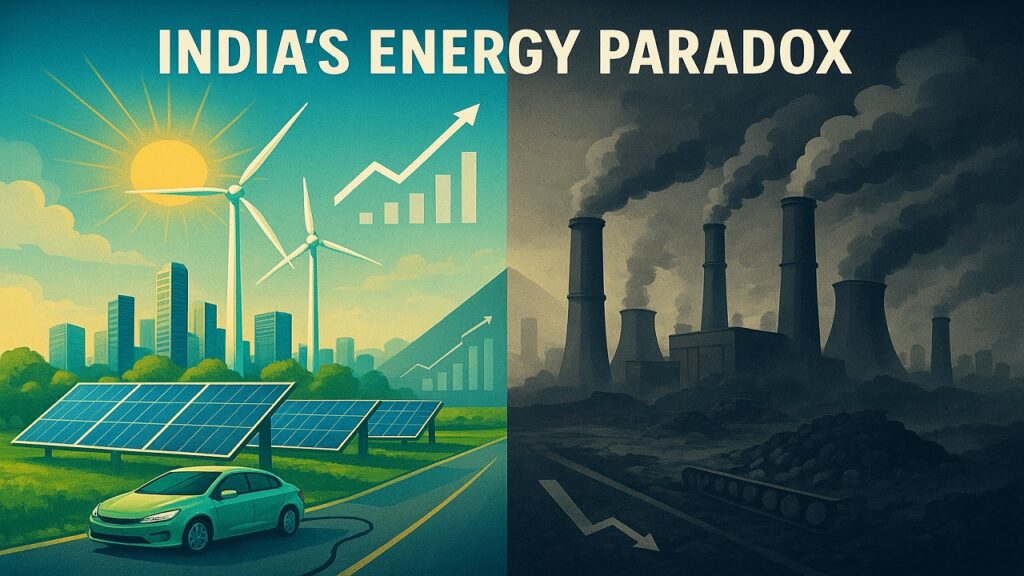
- India has intensified its push for clean energy, yet paradoxically, the electricity consumed today is more carbon-intensive than it was five years ago.
- This paradox highlights the challenges in India’s energy transition, particularly balancing renewable capacity with actual grid emissions and demand patterns.
Status of Energy Efficiency in India
1. What is Energy Efficiency?
- Using less energy to perform the same task, reducing energy waste and lowering costs without compromising performance or comfort.
- Achieved through technological innovations, improved systems, and behavioral changes.
- Example: An LED bulb produces the same light as an incandescent bulb but uses significantly less electricity.
2. India’s Energy Mix and Emissions
- As of June 2025, non-fossil fuel sources contribute ~50% of installed capacity.
- Grid Emission Factor (GEF): Carbon intensity of electricity has increased from 0.703 tCO₂/MWh (2020–21) to 0.727 tCO₂/MWh (2023–24), per Central Electricity Authority (CEA).
3. Capacity–Generation Mismatch
- Renewables now account for large installed capacity, but actual generation is lower than coal or nuclear.
- Solar/wind plants: 15–25% capacity utilisation vs. coal/nuclear: 65–90%.
- In 2023–24, renewables supplied only 22% of total electricity; the remainder came from fossil fuels.
4. Dependence on Coal
- India’s rising demand is still met primarily by coal, the most carbon-intensive source.
- Peak electricity demand often occurs when renewable generation is low.
5. Challenges with Solar Power
- Solar generation peaks in afternoon but declines in evening, coinciding with household peak demand.
- Fossil fuel plants act as shock absorbers, maintaining grid stability but locking in emissions.
Role of Energy Efficiency
1. First Fuel Concept
- Energy efficiency reduces demand before supply is needed, lowering reliance on coal during high-emission periods.
2. Efficient Appliances & Systems
- Scaling up fans, ACs, motors, industrial processes, and buildings can reshape demand curves.
3. Demand Flexibility
- Aligns electricity demand with renewable availability, preventing stranded renewables and lock-in of inefficient technologies.
4. Evidence from India
- Bureau of Energy Efficiency (BEE): Saved ~200 Million Tonnes of Oil Equivalent (Mtoe) from FY2017-18 to FY2022-23.
- Equivalent to ~1.29 GT CO₂ avoided and ₹7.6 lakh crore savings.
5. International Comparison
- France, Norway, Sweden: GEF of 0.1–0.2 tCO₂/MWh due to hydro and nuclear.
- India: GEF 0.727 tCO₂/MWh, coal-heavy base, high demand growth — making efficiency essential.
Key Measures Needed for India
- Battery Integration: Connect home/office batteries to virtual power plants.
- Appliance Efficiency Standards: Promote 4- and 5-star products, raise benchmarks.
- Support SMEs: Adopt efficient motors, pumps, and processes.
- Flexible Pricing: Incentivize demand shift to periods of high renewable availability.
- Scrappage Incentives: Replace old energy-guzzling equipment.
- DISCOM Engagement: Facilitate green electricity services, e.g., high-efficiency air conditioning powered by RTC clean power.
Conclusion
- CEA National Electricity Plan: GEF projected to fall to 0.548 tCO₂/MWh by 2026–27 and 0.430 tCO₂/MWh by 2031–32.
- Achieving this requires more than just solar/wind capacity — a flexible system with efficiency at its core.
- India has reduced emissions intensity by 33% (2005–2019) while growing the economy (UNFCCC 4th Biennial Update Report).
- Balanced approach: Accelerate renewables, storage, transmission, and embed efficiency in households, industries, and cities.
- To decarbonise India’s grid, efficiency must become the first fuel, and flexibility — not fossil fuels — must power the future.
Source : The Hindu