
India’s New Labour Framework: Consolidation, Protection and Modernisation
Context
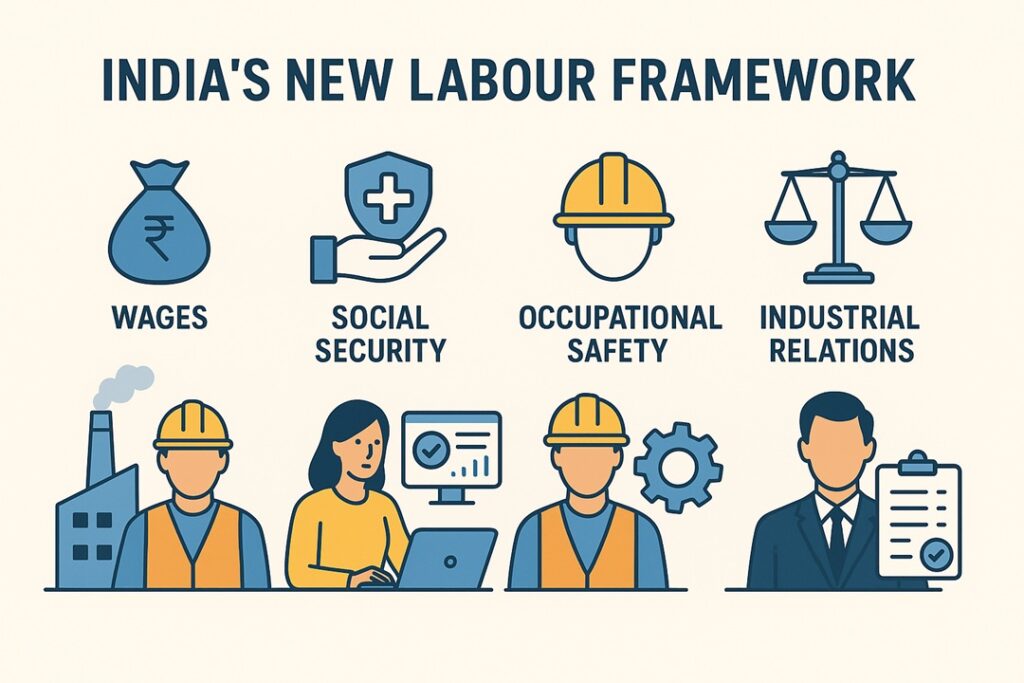
The Union Government, on November 21, 2025, operationalised the complete set of four Labour Codes. This marks a major restructuring of India’s labour governance system by integrating 29 scattered and outdated legislations into a single, modernised framework aimed at simplifying procedures, improving worker protection and creating a predictable regulatory environment for businesses.
Overview of the Four Labour Statutes
- Wage Regulation Code, 2019
- Employment Relations Code, 2020
- Social Protection Code, 2020
- Workplace Safety, Health and Conditions Code, 2020
Why the Overhaul Was Necessary
- Previous labour laws were fragmented, outdated and complicated.
- High compliance burden inhibited formal job creation and business expansion.
- Workers such as gig earners, platform-based workers, MSME labour and migrant employees lacked consistent social security.
- Varying state-level amendments led to regulatory divergence across India.
Key Provisions for Various Worker Segments
1. Digital-Economy Workforce
- Gig and platform earners formally recognised in national labour law.
- Aggregators must contribute 1–2% of turnover (capped at 5% of worker payouts) to a welfare fund.
- Commute-related injuries treated as work-linked.
- Aadhaar-enabled UAN allows portable benefits.
2. Agency-Deployed Workforce
- Principal employer responsible for medical, safety and social-security provisions.
- Mandatory annual medical examinations.
3. Women in the Workforce
- Guaranteed equal pay and non-discrimination.
- Night shifts allowed with strict safety safeguards.
- 26-week maternity leave, crèche access, and medical incentives.
- Wider family definition includes parents-in-law.
4. Migrant Labour Force
- Equal pay and welfare entitlements ensured.
- Portability of ration benefits through PDS.
- Claims for unpaid dues allowed up to three years.
- Double overtime pay mandated.
5. Provisions Across Major Sectors
Applicable to MSMEs, textiles, mines, IT units, audio-visual work, plantations, ports, hazardous industries and beedi/cigar units.
Benefits include:
- Standardised work-hour rules
- Mandatory appointment letters
- Strengthened safety norms and PPE
- Annual health check-ups
- Wider ESI inclusion
Fixed-Term Engagements (FTE)
- Introduced to shift workers from informal contracting to direct payroll employment.
- FTE employees receive benefits equivalent to permanent staff.
- Equal pay guaranteed.
- Gratuity eligibility after one year.
- Regulated working hours, leave and medical benefits.
- Government views FTE as a pathway to formalisation and expanded social security.
Economic and Employment Outcomes Across States
Gujarat
- GSDP: ₹25.63 trillion (2023–24), 13.36% growth.
- Manufacturing contributes 28–30%.
Punjab
- GSDP CAGR: 9.43% (FY16–FY24).
- Investment inflows of ₹1.25 lakh crore generating 4.5 lakh jobs.
Bihar
- GSDP for 2024–25: ₹9.76 lakh crore (13.5% rise).
Maharashtra
- Largest state economy: ₹42 lakh crore (2024–25).
- ₹1.4 lakh crore fresh investments.
- 3 lakh increase in organised manufacturing jobs.
Uttar Pradesh
- Added 7.4 lakh workers in organised manufacturing (2014–15 to 2023–24).
Andhra Pradesh
- GSDP: ₹16.41 lakh crore (2024–25), 12.5% growth.
- ₹13.25 lakh crore investment proposals; 16 lakh potential jobs.
- Electronics clusters generating 5,000–7,000 jobs.
- 5.7 lakh surge in organised manufacturing jobs.
- 7.1 percentage-point rise in factories with 300+ workers.
Haryana
- Tertiary-sector employment rose from 38.8% to 41.9%.
- Unemployment declined from 9.3% to 3.4%.
Rajasthan
- 25–30% faster growth in large factories.
- Industrial output increased 20–25%.
- 1.22 lakh rise in organised manufacturing jobs.
- Women’s night-shift provision increased female employment indicators significantly.
Conclusion
The implementation of the four Labour Codes marks one of India’s most significant regulatory transitions in decades. By replacing outdated and fragmented laws with a unified framework, the Codes aim to reduce compliance complexity, promote formalisation, and extend social protection to a diverse and evolving workforce—from gig workers to migrant labour. Early trends from states indicate that streamlined labour governance contributes to improved industrial performance, investment inflows and employment growth. Moving forward, effective enforcement, cooperative federalism and capacity-building among employers and workers will determine how successfully these reforms translate into inclusive, resilient and future-ready labour markets.
Source : The Hindu