
Appointment of the 53rd Chief Justice of India
Context
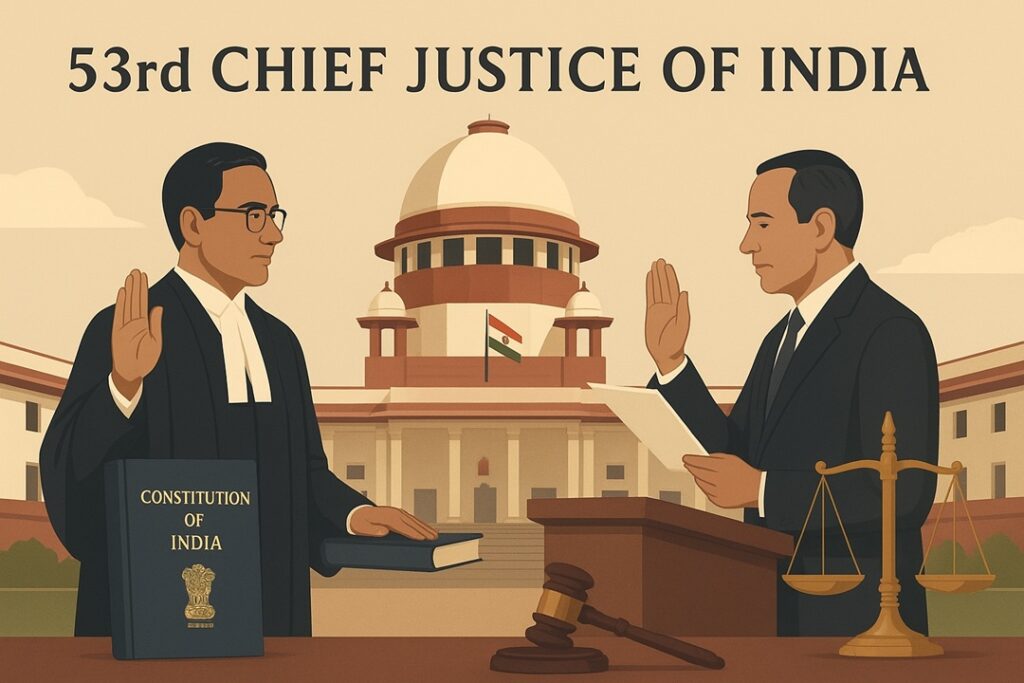
Justice Surya Kant is set to take oath as the 53rd Chief Justice of India on 24 November 2025, following the retirement of CJI B. R. Gavai. His tenure will extend until 9 February 2027, making it one of the longer CJI tenures in recent years.
About the 53rd Chief Justice of India
What is the Office of the CJI
The Chief Justice of India is the head of the Indian judiciary and the presiding judge of the Supreme Court. The position derives from Article 124(1), which establishes a Supreme Court comprising a CJI and other judges.
Constitutional Provisions
• Article 124(1): Establishes the Supreme Court of India.
• Article 124(2): Judges, including the CJI, are appointed by the President by warrant under his hand and seal.
• Article 126: Provides for an Acting CJI when required.
• Article 127: Mentions appointment of ad hoc judges.
• Article 128: Allows retired Supreme Court judges to act as judges of the Court.
Procedure for Appointment of the CJI
• Seniority Principle: The senior-most judge of the Supreme Court is considered for the post, if found fit.
• Recommendation by Outgoing CJI: A month before retirement, the sitting CJI recommends the next CJI to the Union Minister of Law & Justice.
• Executive Processing: The Law Minister forwards the proposal to the Prime Minister, who advises the President.
• Presidential Appointment & Oath: The President issues the appointment warrant under Article 124(2), after which the CJI takes oath before the President.
• Memorandum of Procedure (1999): Codifies that the senior-most eligible judge should be appointed as CJI.
Key Features of the Appointment System
• Seniority-based and convention-driven process strengthens judicial independence.
• Executive formalities exist, but the recommendation originates from the judiciary.
• As the CJI heads the collegium, the appointment influences the entire judicial appointments system.
Significance of the CJI’s Role
• Acts as the master of roster, allocating benches and prioritizing cases.
• Heads the collegium, shaping appointments and transfers in the higher judiciary.
• Functions as a constitutional guardian, presiding over cases on federal issues, fundamental rights, and separation of powers.
Conclusion
The appointment procedure for the Chief Justice of India balances constitutional authority with judicial convention, ensuring continuity, transparency, and independence. Justice Surya Kant’s elevation reflects adherence to the seniority norm and reinforces the stability of India’s judicial system.
Source : The Hindu