
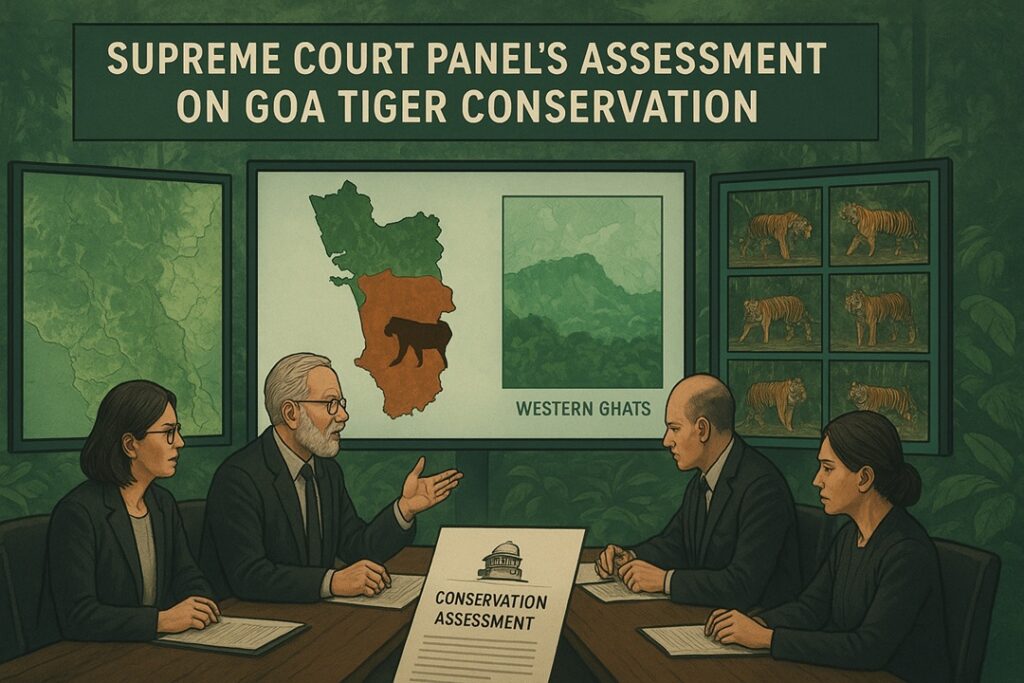
Supreme Court Panel’s Assessment on Goa Tiger Conservation
Context
A Supreme Court-appointed Central Empowered Committee has recommended the creation of a tiger reserve in Goa through a phased approach designed to protect ecologically sensitive areas while reducing the impact on local communities.
Definition of the Proposal
• The CEC proposes declaring a Goa Tiger Reserve in stages, beginning with areas that have very low human presence and strong ecological connectivity.
• The phased method aims to be community-sensitive while ensuring ecological protection.
Background of the Issue
• The Bombay High Court (Goa Bench) directed the State in 2023 to notify a tiger reserve.
• The Goa government opposed the directive, arguing that tigers seen in the State were transient and not resident.
• The Supreme Court referred the matter to the CEC for an independent scientific assessment.
Protected Areas Identified for Phase 1
• Netravali Wildlife Sanctuary as a core area
• Cotigao Wildlife Sanctuary as a core area
• Bhagwan Mahavir National Park as a buffer area
• Northern part of Bhagwan Mahavir Wildlife Sanctuary as a buffer area
Protected Areas Considered for Phase 2
• Mhadei Wildlife Sanctuary may be included later after further evaluation.
Need for a Tiger Reserve in Goa
• Goa forests are ecologically connected to Karnataka’s Kali Tiger Reserve, which has a strong breeding population.
• Connectivity allows natural tiger movement and genetic flow.
• The region lies within the Western Ghats, a global biodiversity hotspot.
• Scientific evidence of tiger presence supports the need for corridor protection.
Significance of the Proposed Tiger Reserve
• Ensures landscape-level conservation by creating a combined 1814 sq km tiger habitat with Kali Tiger Reserve.
• Minimises displacement as Phase 1 areas have very few households.
• Secures wildlife corridors essential for tiger dispersal and long-term population stability.
Conclusion
The proposed Goa Tiger Reserve represents a balanced conservation strategy that prioritises ecological connectivity and long-term tiger recovery while keeping community concerns at the forefront through a phased and sensitive implementation approach.
Source : The Hindu