
Earliest Evidence of Thorny Bamboo Found in Manipur
Context
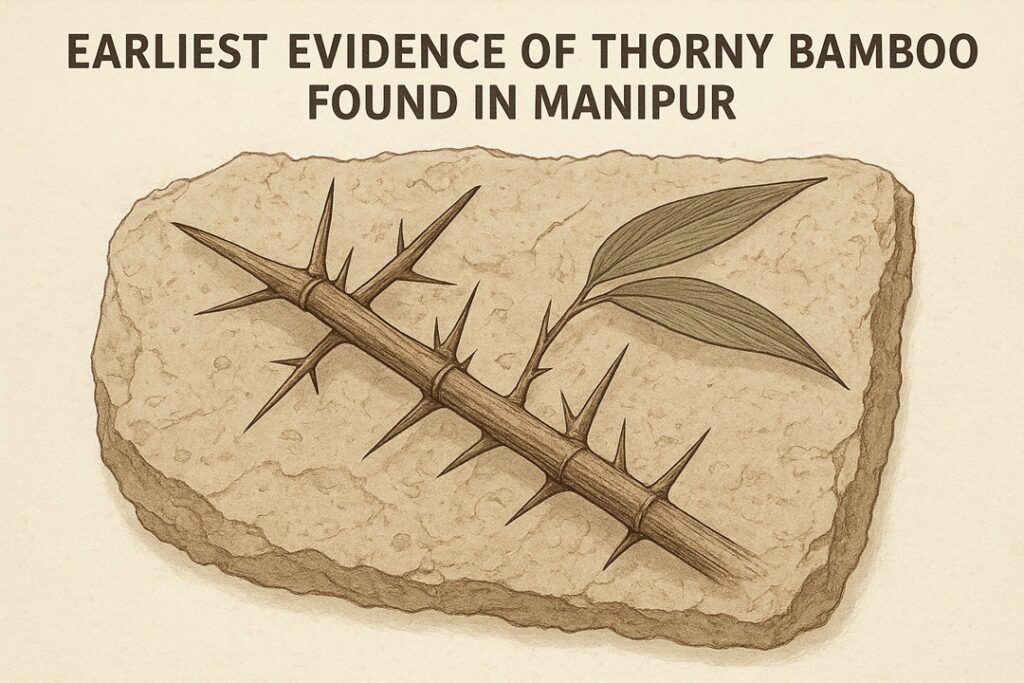
Scientists from the Birbal Sahni Institute of Palaeosciences under the Department of Science and Technology have discovered a 37,000-year-old thorny bamboo fossil in the silt-rich deposits of the Chirang River in Manipur. This represents the earliest known evidence of thorniness in Asian bamboo.
What it is
A well-preserved Ice Age bamboo fossil belonging to the genus Chimonobambusa, retaining thorn scars, nodes and buds that rarely fossilise due to bamboo’s fragile and hollow structure.
Discovery
Microscopic analysis identified the species as Chimonobambusa manipurensis, showing close similarity to modern thorny bamboos such as Bambusa bambos.
Significance
The fossil represents the earliest evolutionary evidence of thorny bamboo in Asia, indicating that defence traits developed before or during the Ice Age.
It highlights Northeast India as a climatic refugium during the Pleistocene, enabling bamboo survival even as harsh conditions wiped out bamboo from regions like Europe.
It provides important insights into palaeoclimate, evolutionary biology and biodiversity resilience in the Indo-Burma hotspot.
The preservation of delicate structures like thorn scars and buds marks a major advancement in palaeobotanical studies and aids reconstruction of ancient ecosystems.
Location of Manipur
Manipur lies on India’s eastern frontier between 23.83°N–25.68°N latitudes and 93.03°E–94.78°E longitudes, covering 22,327 square kilometres. It consists of a central valley surrounded by extensive highlands and shares borders with Myanmar, Nagaland, Assam and Mizoram.
Geographical Features of Manipur
Hills occupy nearly 90 percent of the state’s area, encircling the valley and forming a protective mountain ring with higher elevations in the north and lower altitudes toward the south.
The Manipur Valley accounts for about 10 percent of the area, located around 790 metres above sea level and sloping gently southward to support natural drainage.
Chirang River
The Chirang River in the Imphal Valley contains silt-rich sediment layers that allow preservation of plant remains. These deposits yielded the 37,000-year-old bamboo fossil.
Conclusion
The discovery of the ancient thorny bamboo fossil from Manipur provides crucial evidence of early plant defence evolution and reinforces the ecological significance of Northeast India as a biodiversity refuge during the Ice Age. It enriches palaeobotanical research and helps reconstruct past ecosystems, offering valuable insights for environmental and evolutionary studies relevant to UPSC preparation.
Source : PIB