
Paradip Port: Milestone in India’s Maritime Cargo Growth
Context
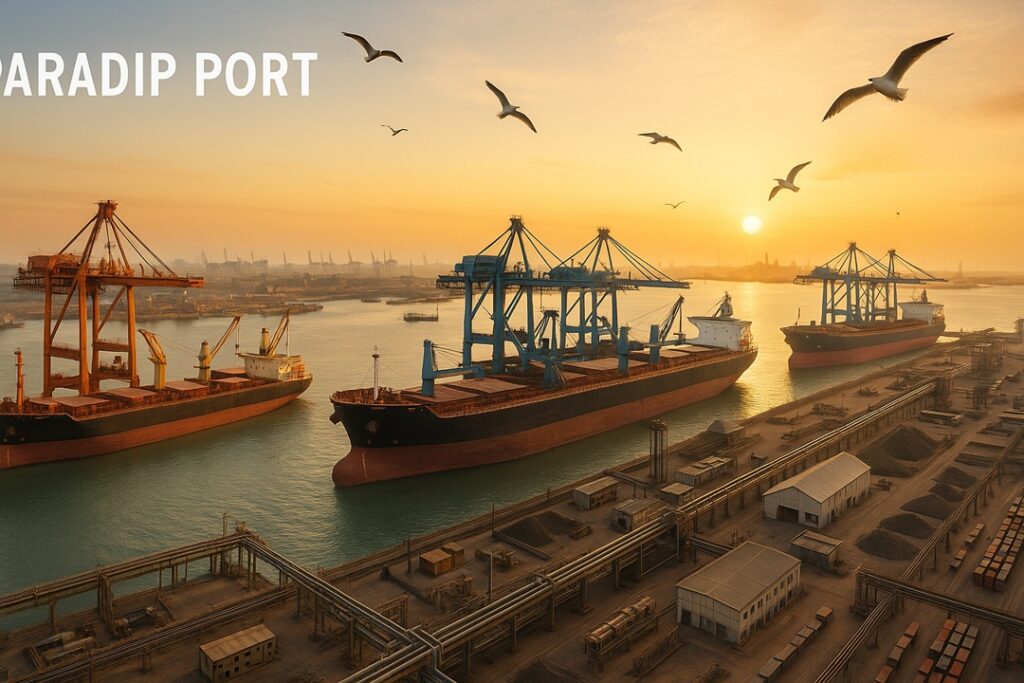
Paradip Port Authority has achieved its fastest-ever handling of 100 MMT cargo in a single fiscal year, marking a significant improvement over previous performance. This is the ninth consecutive year that the port has crossed the 100 MMT mark, and the milestone was reached twelve days earlier than last year, reflecting enhanced operational efficiency and growing cargo movement through the port.
Overview of Paradip Port
• Paradip Port is one of India’s major ports managed by the Paradip Port Authority under the Ministry of Ports, Shipping and Waterways.
• It is a deep-water port handling coal, POL products, iron ore, steel, containerised cargo and coastal shipments.
• Located in Jagatsinghpur district of Odisha near the confluence of the Mahanadi River and the Bay of Bengal.
Historical Background
• Foundation stone laid by Prime Minister Jawaharlal Nehru on 3 January 1962.
• Administrative control transferred to the Government of India on 1 June 1965.
• Declared the eighth major port of India on 18 April 1966, and the first major port on the East Coast after Independence.
• Functions as an autonomous body under the Major Port Trusts Act, 1963, governed by a Board of Trustees.
Key Operational Features
• Handles a diversified cargo profile, with coal accounting for about 45 percent of total cargo.
• Consistently records year-on-year growth, crossing 100 MMT for nine consecutive years.
• Equipped with modern mechanised cargo-handling systems and enhanced evacuation facilities.
• Backed by strong railway connectivity and coastal shipping networks.
Strategic Significance
• One of India’s top-performing major ports in cargo throughput.
• Acts as a crucial gateway for coal-based power plants, steel industries and mineral exports.
• Helps reduce logistics costs through coastal shipping and multimodal connectivity.
• Strengthens industrial and export linkages across eastern India, boosting national maritime trade capacity.
Conclusion
Paradip Port’s record-breaking performance highlights its increasing role in India’s maritime economy. Its operational strength, strategic location and sustained cargo growth underline its importance as a central hub for energy supply chains, mineral exports and coastal logistics, contributing significantly to India’s port-led development strategy.
Source : PIB