
Disaster Management Challenges in India: Lessons from Recent Events
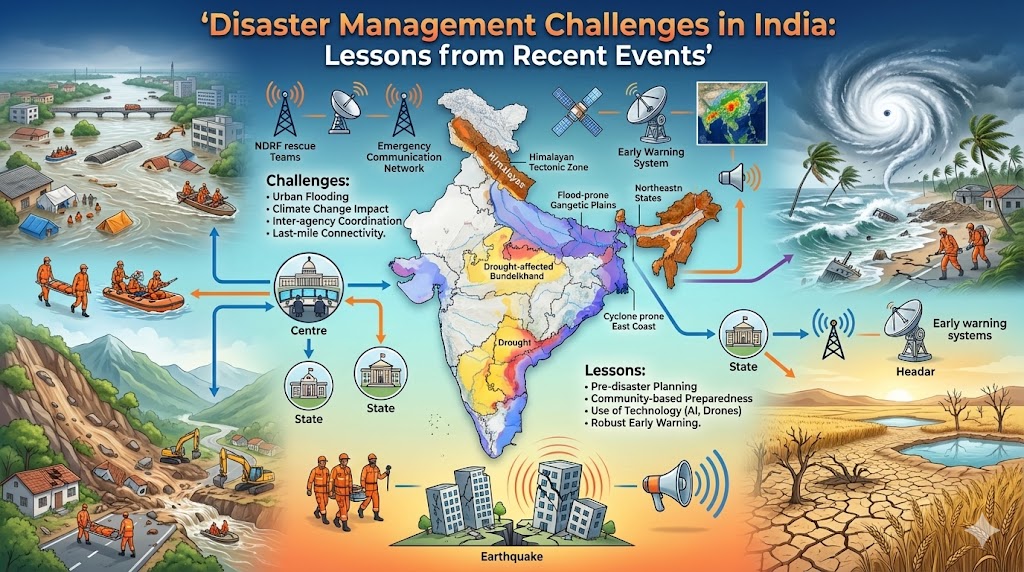
Context
The 2024 Wayanad landslides and the gap between State requirements and Central relief have raised concerns about increasing centralisation, delays and conditionality in disaster financing, affecting cooperative federalism.
Introduction
India’s disaster management framework under the Disaster Management Act, 2005 aims to reduce risk and strengthen preparedness through coordinated action across administrative levels. Despite institutional progress, issues such as centralised control of funds, outdated norms and weak risk-based allocation remain. As climate-related events intensify, India must shift to a more transparent and predictable disaster financing system.
What is India’s Disaster Response
• It is a multi-tier national framework created under the DM Act, 2005 for prevention, preparedness, response, relief and recovery.
Institutional Structure
• NDMA leads at the national level, while SDMAs and DDMAs operationalise disaster management at the State and district levels.
Traditional Relief-Centric Model
• Historically depended on post-disaster compensation, with States relying on Central financial support.
Current Risk Reduction Model
• Based on NPDM 2009 and NDMP 2016/2019, prioritising prevention, mitigation and preparedness.
Multi-Hazard Approach
• Addresses risks from earthquakes, floods, cyclones, droughts, landslides and industrial accidents.
Sendai Framework Alignment
• Integrates principles of the Sendai Framework 2015–2030, such as build-back-better, resilience and inclusive planning.
Successes So Far
Institutional Strengthening
• India has established a comprehensive system through NDMA, NDRF, SDMAs and DDMAs.
Cyclone Mortality Reduction
• Odisha and Andhra Pradesh demonstrate globally recognised cyclone preparedness and evacuation capacities.
Improved Forecasting
• IMD offers more accurate cyclone forecasting supported by satellites, Doppler radars and SMS alerts.
Preparedness Drills
• Exercises such as Suraksha Chakra enhance earthquake and extreme-event readiness.
Community Participation
• Initiatives like Aapda Mitra train volunteers and improve last-mile response.
Challenges
Centralisation and Fiscal Asymmetry
• Central assistance is often lower than State assessments, causing delays and reducing trust in cooperative federalism.
Outdated Relief Norms
• Compensation amounts for death, housing damage and livelihood loss are inadequate compared to present reconstruction costs.
Ambiguity in Severe Disaster Classification
• The criteria for categorising a disaster as severe remain unclear, allowing discretionary decisions.
Procedural Delays
• Multiple assessments and approvals slow down timely fund release.
Weak Risk-Based Allocation
• Finance Commission allocations rely on population and area rather than scientific hazard and vulnerability indicators.
Local Capacity Gaps
• DDMAs, municipalities and panchayats lack sufficient capacity in GIS planning, enforcement and risk preparedness.
Way Ahead
Rules-Based Trigger Financing
• Use measurable indicators such as rainfall thresholds, loss–GSDP ratio and per capita loss to automatically trigger Central support.
Updated Relief and Compensation Norms
• Revise norms periodically to align with current construction costs and livelihood restoration needs.
Empowering States and Local Bodies
• Strengthen SDMAs, DDMAs and local bodies through trained personnel, Emergency Operation Centres and clear protocols.
National Disaster Vulnerability Index
• Develop an index combining hazard intensity, exposure, population density, ecology and socio-economic vulnerability.
Integrating Risk Reduction into Development
• Ensure strict implementation of building codes, zoning rules, CRZ norms and floodplain management.
• Design all major infrastructure to be climate-resilient.
Strengthening Cooperative Federalism
• Institutionalise regular Centre–State consultation on disaster financing and norms for predictable and rules-based support.
Conclusion
India has built a strong institutional foundation for disaster governance, but challenges in financing, centralisation and coordination continue. With climate shocks rising, India must transition to a transparent, rules-based and scientifically informed system. Strengthening decentralised capacity and cooperative federalism is essential for protecting lives and ensuring resilient governance.
Source : The Hindu