
Reclaiming Ethics in an Exam-Driven Education System
Context
• Recent incidents of caste humiliation in elite institutions, professional violence and ethical lapses across services have reopened the debate on the dangers of excellence without ethics in India.
Why Education Cannot Be Ethically Neutral
• Education shapes individuals who hold power; without ethics, this power can deepen injustice and institutional harm.
• Knowledge without conscience becomes a tool for rationalising cruelty or corruption, as seen in the NEET 2023 paper leak network.
• Ethical grounding, not rules, determines decisions in ambiguous or high-pressure situations, evident from failures in corporate and administrative settings.
Symptoms of Excellence Without Ethics in India
• Rising toxic behaviour among educated individuals, including casteist harassment and bullying in premier institutions.
• Increasing dehumanisation within systems where people are treated as numbers, targets or files rather than individuals.
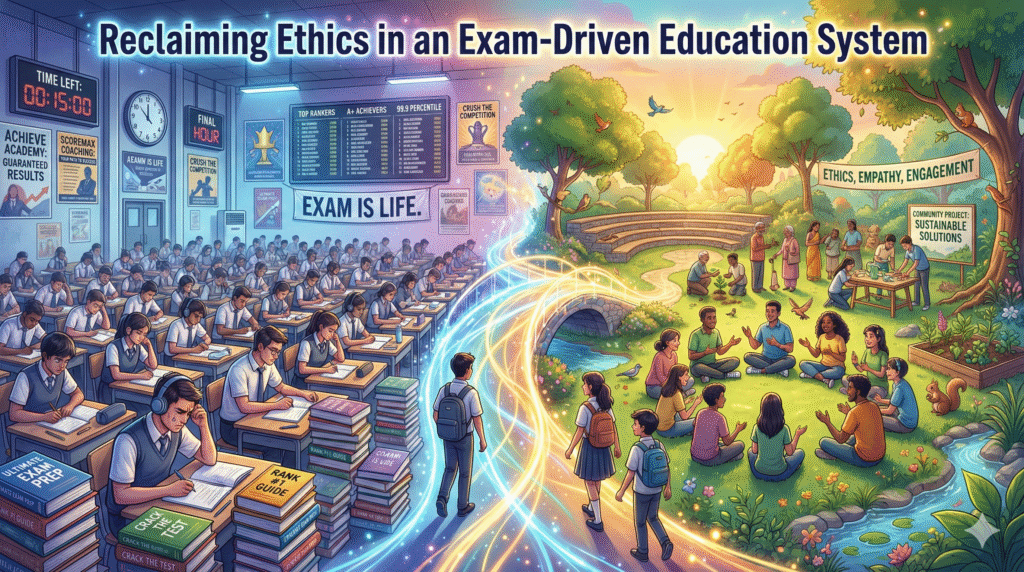
• Obsession with ranks, placements and competitive scores overshadowing empathy, socio-emotional learning and civic values.
• Academic dishonesty becoming widespread due to performance-driven culture, highlighted in NEET-UG 2024 allegations.
• Growing insensitivity to inequality, where privileged groups remain detached from the hardships of marginalised communities.
Why Ethical Education Matters for India
• A highly unequal society requires professionals with empathy across caste, class and gender lines.
• India’s demographic dividend can turn volatile if skill development is not matched with moral development.
• Democracy depends on civic morality; inability to respect dissent or diversity threatens institutional stability.
• Rule of law needs ethical sensitivity, not just procedural compliance, as reflected in controversies involving civil service entrants.
Key Challenges in Building Ethical Education
• Exam-driven schooling sidelines ethics and value-based learning in favour of marks and ranks.
• Lack of trained teachers capable of conducting ethical dialogue, case-based learning or socio-emotional education.
• NEP 2020’s vision remains weakly implemented without a clear curriculum, pedagogy or measurable learning outcomes.
• Campus environments often contradict ethical values due to discrimination, favouritism or harassment.
• Fear of ideological conflict leads institutions to avoid essential discussions on gender, equality and justice.
Way Forward
• A national, secular, Constitution-based ethical education framework with age-appropriate learning outcomes.
• Integration of ethical dilemmas and value questions into all subjects, including science, technology, economics and literature.
• Mandatory teacher training in ethics and socio-emotional learning through B.Ed, M.Ed and faculty development programmes.
• Creation of ethical campus cultures through zero tolerance for harassment, transparent grievance mechanisms and honour codes against cheating.
• Promotion of experiential learning through community projects, field visits and immersion programmes to connect students with real-life social contexts.
Conclusion
• India’s challenge today is not a shortage of talent but a shortage of ethically anchored talent.
• If educational institutions continue prioritising achievement without values, they risk producing capable individuals who may undermine societal trust.
• Rebuilding education around conscience, compassion and constitutional morality is essential for nurturing citizens who can safeguard India’s democratic and social fabric.
Source : Hindustan Times