
Child Marriage in India: Insights from the Madhya Pradesh Upsurge
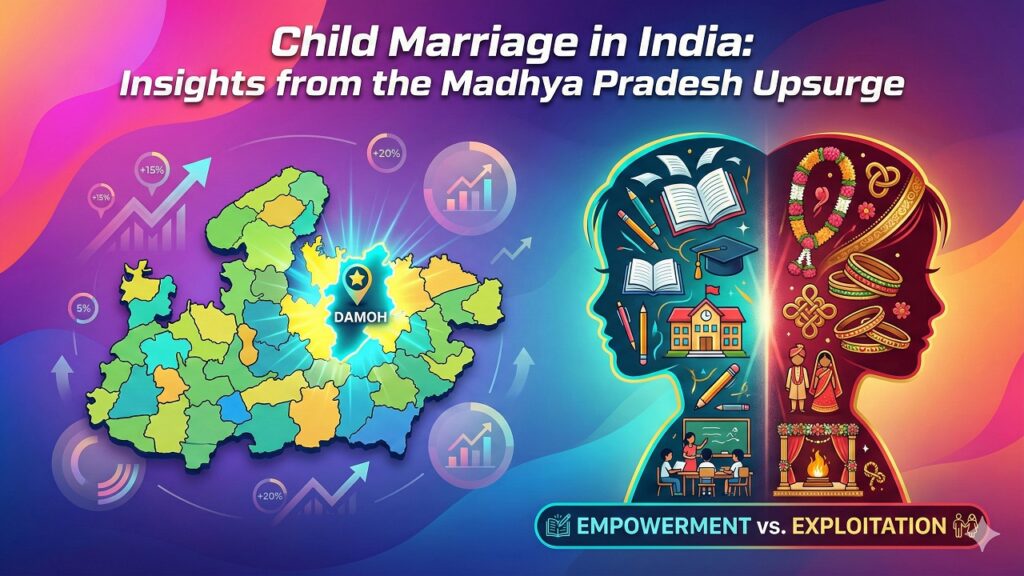
Context: Recent parliamentary data shows that child marriages in Madhya Pradesh have increased by 47 percent since 2020, with 538 cases in 2025, the highest in five years. Damoh district alone contributes 21 percent of these cases, making it the worst hotspot for child marriages in 2025. The trend highlights deep socio-economic vulnerabilities and weaknesses in enforcement mechanisms.
Introduction
Child marriage remains a persistent challenge in India despite legal prohibitions and welfare interventions. The sharp rise in Madhya Pradesh, particularly in its backward and tribal regions, reflects gaps in governance, social protection and gender empowerment. This pattern is significant for UPSC as it links to issues of social justice, women and child welfare, regional disparities and policy effectiveness.
Definition of Child Marriage Hotspot:
A hotspot refers to a cluster of districts consistently reporting disproportionately high child marriages, especially in Bundelkhand, central MP, Gwalior–Chambal and tribal belts. These areas reflect entrenched poverty, low female literacy, gender norms and weak institutional reach.
Statewide Rising Trend:
Madhya Pradesh recorded an increase from 366 cases in 2020 to 538 in 2025, marking a 47 percent rise despite awareness and community-level interventions.
District-Level Surge in Damoh:
Damoh district accounts for 115 cases in 2025, rising sharply from 33 cases in 2024, making it responsible for 21 percent of all reported child marriages in the state.
Regional Concentration:
Most cases emerge from Bundelkhand, tribal-dominated areas and economically backward districts, indicating region-specific vulnerabilities linked to poverty and social customs.
Implications for Social Development:
The rise undermines girls’ education, health, nutrition and future economic opportunities, reinforcing intergenerational poverty and social exclusion.
Health and Safety Risks:
Early marriages heighten risks of maternal mortality, early pregnancies, reproductive health complications, and increased exposure to domestic violence.
Governance and Policy Gaps:
The trend points to weak enforcement of the Prohibition of Child Marriage Act 2006, inadequate community surveillance, and limited penetration of social protection schemes among vulnerable households.
Conclusion
The surge in child marriages in Madhya Pradesh signals a critical need for targeted interventions, stronger enforcement, and region-specific development strategies. Addressing socio-economic vulnerabilities, improving girls’ education and strengthening local governance systems will be essential to reverse this worrying trend and advance India’s commitments to child rights and social justice.
Source : NDTV, TheNewIndianExpress