
India–Russia Relations: Challenges, Convergence and the Road Ahead
Context
Russian President Vladimir Putin is in India for the 23rd India–Russia Annual Summit in New Delhi, receiving a ceremonial welcome at Rashtrapati Bhavan and holding high-level talks with the Prime Minister.
About India–Russia Bilateral Relations
Nature of ties: The partnership was upgraded to a Special and Privileged Strategic Partnership in 2010, marked by high political trust, defence interdependence and shared support for multipolarity.
Institutional structure: Coordination takes place through Annual Summits, IRIGC (TEC and M&MTC), 2+2 dialogue, NSA-level talks and multiple joint working groups.
Strategic convergence: Both nations support a multipolar world order, UNSC reforms including India, and work together in BRICS, SCO, G20 and the UN.
Key Areas of Cooperation
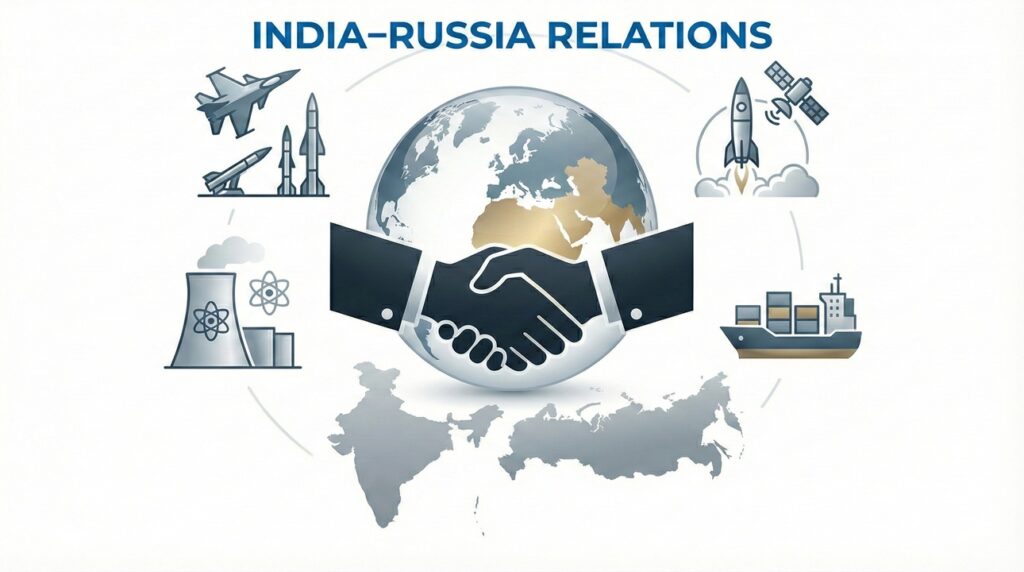
Defence and strategic security: Russia is India’s primary defence partner with platforms such as Su-30MKI, T-90, INS Vikramaditya, submarines and the S-400 system. Key joint programmes include BrahMos, AK-203 rifles, and the 2021–31 military-technical cooperation plan.
Nuclear and space cooperation: Russia remains India’s only operational civil nuclear partner through Kudankulam NPP and plays a major role in Gaganyaan astronaut training and space technology collaboration.
Energy and resources: Russia supplies discounted crude, gas and coking coal, with Indian companies invested in projects such as Sakhalin. Cooperation increasingly spans LNG, hydrogen, critical minerals, Arctic energy and nuclear fuel cycle work.
Trade and connectivity: Bilateral trade reached USD 68.7 billion (FY 2024–25), driven by energy imports. Connectivity initiatives include INSTC, Chennai–Vladivostok Maritime Corridor and potential use of the Northern Sea Route.
Science, technology and space: The STI Roadmap (2021) guides joint work in AI, nanotechnology, materials science, IT and basic sciences, promoting innovation and commercialisation.
Education and culture: Over 20,000 Indian students study in Russia. Cultural ties continue through film festivals, academic exchanges, yoga, literature and long-standing people-to-people links.
Key Challenges in the Relationship
Geopolitical pressures and Ukraine conflict: Western sanctions and global scrutiny complicate India’s balancing between Russia and the West, creating financial and diplomatic risks.
Trade imbalance and payment issues: Trade remains heavily tilted towards Russian exports; unresolved issues include rupee–rouble settlement, frozen funds and banking connectivity.
Defence dependence risks: India’s large inventory of Russian-origin equipment creates vulnerabilities due to delays, sanctions and wartime production pressures.
Technological competition: India’s growing preference for Western and Japanese high-tech systems reduces Russia’s relative role in cutting-edge defence and technology supply.
Connectivity and logistical constraints: INSTC and the Chennai–Vladivostok corridor face infrastructure, regulatory and geopolitical bottlenecks.
Way Ahead
Rebalancing economic ties: India needs to diversify exports in pharma, agri, machinery and IT, streamline payment mechanisms and build dedicated trade facilitation frameworks.
Deepening defence co-production: Future cooperation should prioritise joint design, IP sharing and export-oriented manufacturing, especially in advanced systems and space-defence technologies.
Accelerating connectivity initiatives: Fast-tracking INSTC and the Eastern Maritime Corridor with harmonised customs and digital logistics will enhance trade resilience.
Expanding new-age cooperation: Joint work in SMRs, green hydrogen, critical minerals, AI, quantum technologies and cybersecurity will modernise the partnership.
Strengthening people-to-people ties: Improving student mobility, degree recognition, tourism and cultural exchanges will reinforce long-term trust.
Conclusion
India–Russia relations continue to be one of India’s most durable strategic partnerships, but must adapt to emerging geopolitical and technological realities. The summit provides an opportunity to modernise, rebalance and diversify cooperation while safeguarding India’s strategic autonomy and long-term national interests.
Source : TOI