
PSL: Bridging Credit Gaps in Agriculture, MSMEs and Weaker Sections
Context
The State Level Bankers’ Committee of Jharkhand reported that although banks have met the overall PSL mandate, their agricultural credit disbursement remains below RBI’s targets.
Meaning of PSL
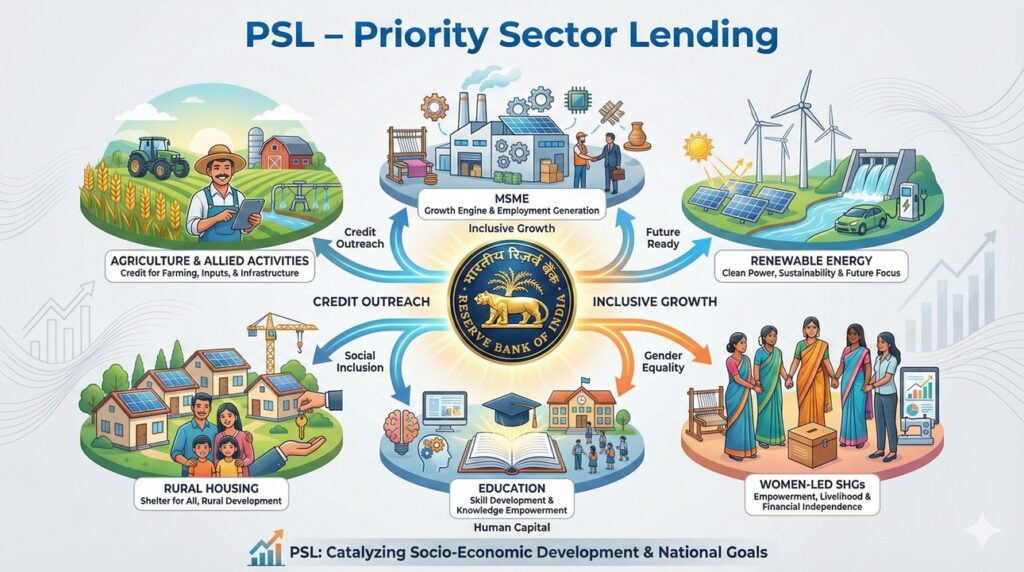
Definition Priority Sector Lending is an RBI mandate requiring banks to allocate a fixed share of credit to identified essential sectors such as agriculture, MSMEs, housing, education, and renewable energy.
Purpose It ensures inclusive growth, promotes affordable credit for vulnerable groups, and supports balanced regional development.
Role of SLBC
Coordination The State Level Bankers’ Committee acts as a state-level forum under the Lead Bank Scheme to supervise and review PSL implementation.
Origin SLBCs were introduced by RBI in 1969, based on recommendations of the Gadgil Committee and Nariman Committee.
Evolution of PSL
Early Recognition In 1966, Finance Minister Morarji Desai emphasized credit expansion to agriculture and small enterprises.
Bank Nationalisation The 1969 nationalisation strengthened institutional capacity for directed lending to underserved sectors.
Formalisation PSL was formally adopted in 1972, guided by the RBI’s Informal Study Group.
Targets Initial targets required banks to reach 33.3 percent by 1979, later revised to 40 percent of ANBC based on the Krishnaswamy Committee 1980.
Reforms The Nair Committee 2012 and later revisions refined PSL norms, with major updates issued in March 2025, effective April 2025.
Key Sectors under PSL
Coverage Major areas include Agriculture, MSMEs, Export Credit, Education, Housing, Social Infrastructure, Renewable Energy, and other eligible categories.
PSL Targets under RBI 2025 Guidelines
Commercial Banks Required to lend 40 percent of ANBC, with 18 percent to agriculture, 10 percent to small and marginal farmers, 7.5 percent to micro enterprises, and 12 percent to weaker sections.
RRBs and SFBs Must allocate 75 percent of ANBC to priority sectors, with similar sub-targets for agriculture and SMFs.
UCBs As per 2025 revision, required to lend 60 percent of ANBC to priority sectors.
ANBC Refers to the adjusted loan portfolio of banks used as the basis for PSL computation.
Priority Sector Lending Certificates (PSLCs)
Meaning PSLCs are tradeable instruments introduced in 2016 to help banks meet PSL obligations.
Mechanism Banks with surplus PSL issue certificates, while those falling short purchase them. Types include Agriculture, Small and Marginal Farmers, Micro Enterprises, and General.
Key Trends and Measures
Growth Trend PSL credit disbursement increased by 85 percent between 2019 and 2024, particularly in agriculture, MSMEs, and social infrastructure.
FinTech Integration Banks increasingly use digital KYC, AI-based verification, alternate data analysis, and API-based solutions to streamline lending.
Legal Strengthening Reforms through IBC, amendments to recovery laws, early warning systems, and improved monitoring have strengthened credit discipline.
Impact of PSL
Financial Inclusion Expands access to affordable credit for rural and underserved communities.
Balanced Development Helps reduce regional inequalities and strengthens the formal credit ecosystem in rural areas.
Employment Supports MSMEs which employ over 25 crore people and contribute 45.73 percent of exports.
Innovation Supports entrepreneurship, particularly by including startups within PSL eligibility.
Agriculture Support Aids crop diversification, allied activities, and rural infrastructure, enhancing food security and rural incomes.
Challenges in PSL
High NPAs Priority sectors face income instability and limited collateral, contributing to elevated NPAs, especially in agriculture.
Compliance Burden Banks must balance profitability with mandated PSL targets, creating operational strain.
Monitoring Gaps Weak tracking and misallocation of loans reduce intended impact and affect asset quality.
Higher Costs PSL lending involves extensive paperwork, outreach, and slower assessment, increasing operational costs.
Market Skew Banks prefer safer PSL categories, leading to inadequate credit flow to agriculture and weaker sections.
Conclusion
Priority Sector Lending remains central to India’s financial inclusion objectives, ensuring that crucial sectors like agriculture and MSMEs receive sustained institutional credit. Despite structural and operational challenges, the 2025 revised guidelines reflect RBI’s continued efforts to strengthen targeting, improve balance, and promote equitable and sustainable economic growth across regions.
Source : PIB