
Untouchability in India: NCRB Data and Policy Imperatives
Context
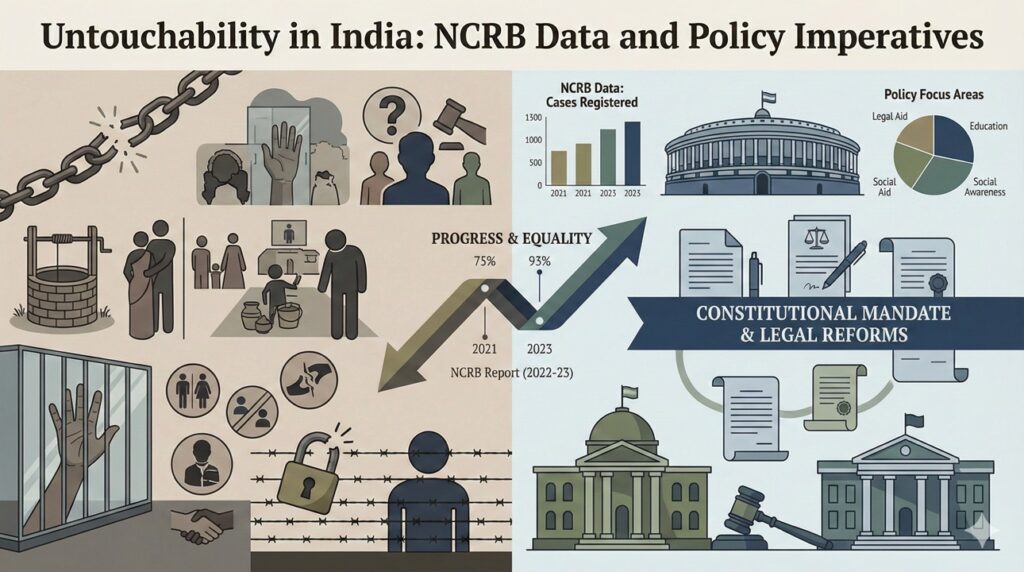
As per the NCRB Crime in India 2023 Report, 24 cases were registered under the Protection of Civil Rights (PCR) Act, 1955 related to untouchability against Scheduled Castes and Scheduled Tribes.
Meaning and Nature of Untouchability
• Historical background: A caste-based practice rooted in the segregation and humiliation of Dalits, denying equality, dignity, and access to public spaces.
• Definition issue: The Constitution does not define untouchability; the term first appeared in 1909 and remains conceptually broad.
• Key aspects: Includes caste-based discrimination, social exclusion, economic exploitation, and humiliation or violence.
Constitutional and Legal Protections
• Article 17: Abolishes untouchability and makes its practice a punishable offence.
• PCR Act 1955: Penalises enforcement of disabilities arising from untouchability.
• SC/ST (PoA) Act 1989: Prevents atrocities against SCs and STs; strengthened by 2016 and 2018 amendments.
• Central mechanism: A committee chaired by the Union Minister of Social Justice reviews implementation of these Acts.
Administrative Measures
• Centre-state coordination: Regular reviews with States and UTs for enforcement of PCR and PoA Acts.
• Advisories to states: Issued periodically for strict implementation; misuse reported and handled legally.
• Direction to states: Ensure prevention of caste-based discrimination and full compliance with the Acts.
Key Impediments
• Social and cultural prejudice: Deep-rooted caste norms limit behavioural change despite legal restrictions.
• Economic dependence: Dalits remain in vulnerable positions and in occupations like manual scavenging.
• Weak enforcement: Low conviction rates and institutional bias reduce law effectiveness.
• Segregated habitation: Dalit hamlets restrict access to common public spaces.
• Lack of awareness: Limited education and rights-awareness perpetuate discrimination.
• Caste-based politics: Electoral mobilization on caste lines reinforces divisions.
Social Solutions
• Inclusive education: Common schooling and equality-oriented curriculum to reduce caste barriers.
• Inter-caste interaction: Community activities and shared spaces to reduce prejudice.
• Vigilance committees: Local monitoring mechanisms to prevent discrimination.
• Media campaigns: Awareness drives to challenge caste stereotypes.
• Occupational rehabilitation: Alternatives to degrading caste-linked jobs.
Cultural Way Forward
• Religious reform: Engage leaders to promote egalitarian interpretations.
• Inter-caste marriages: Institutional support to encourage social integration.
• Cultural assertion: Promote Dalit literature and self-respect movements.
• Equal access: Ensure entry to all public and religious spaces.
• Civic education: Promote constitutional values and teachings of Dr B R Ambedkar.
Conclusion
Untouchability continues due to persistent social prejudices, economic vulnerabilities, and weak institutional enforcement. A combination of strong legal measures, social reform, and constitutional morality is essential to build an inclusive and equal society.
Source : PIB