
India’s Blue Economy Vision in the Indian Ocean Region
CONTEXT
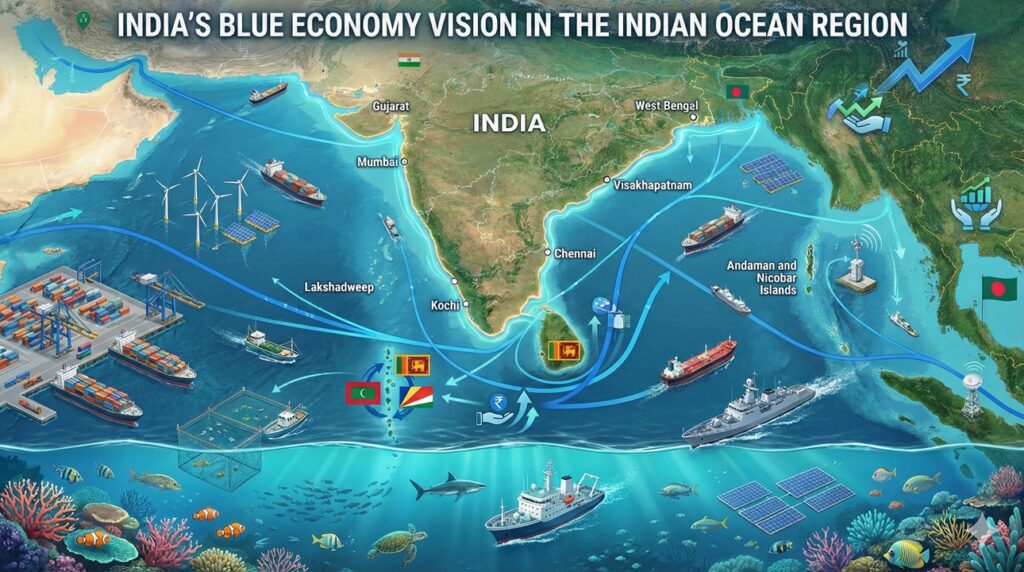
The Indian Ocean is emerging as a critical arena of climate change, economic connectivity, and geopolitical competition, generating the need for a new Blue Economy framework that integrates sustainability, equity, and cooperative ocean governance.
INDIA’S HISTORICAL LEADERSHIP IN OCEAN GOVERNANCE
Common Heritage of Mankind Leadership
India supported Small Island Developing States during UNCLOS, advocating that seabed resources beyond national jurisdiction are a global common, strengthening its moral leadership in ocean governance.
Maritime Vision and Strategic Thought
Jawaharlal Nehru emphasised that India’s security and prosperity are inseparable from ocean freedom, embedding maritime thinking into national strategy from the 1950s.
Environmental Justice and Equity
Indira Gandhi’s Stockholm Conference 1972 intervention highlighted balancing poverty eradication with environmental protection, shaping India’s credibility in equitable environmental governance.
Commitment to Multilateral Ocean Institutions
India’s engagement with IORA, IONS, and the Indian Ocean Commission reflects a preference for cooperative maritime security over power rivalry.
Support for Sustainable Ocean Norms
India’s readiness to ratify the BBNJ Agreement reinforces its image as a responsible steward of marine biodiversity.
EMERGING CHALLENGES IN THE INDIAN OCEAN
Climate Vulnerability Hotspot
The Indian Ocean is warming faster than the global average, leading to sea-level rise and more intense cyclones impacting coastal populations.
Coral Degradation and Ocean Acidification
Rising CO₂ levels threaten coral systems such as Lakshadweep and Chagos, affecting fisheries, biodiversity, and tourism livelihoods.
Illegal Unreported and Unregulated Fishing
IUU fishing depletes fish stocks, harms artisanal livelihoods, and fuels tensions in the Bay of Bengal and East African waters.
Declining Marine Productivity
Overfishing and altered monsoon patterns reduce nutrient upwelling, posing food security risks for littoral nations.
Socio Economic and Security Risks
Marine ecosystem decline drives livelihood loss, migration, and coastal instability, expanding maritime security beyond naval threats.
RATIONALE FOR INDIA’S BLUE OCEAN STRATEGY
Stewardship of the Commons
India can promote rules-based ocean governance, joint marine research, and biodiversity protection across the Indian Ocean.
Climate and Disaster Resilience
Strengthening INCOIS and MoES can improve cyclone forecasting, monsoon modelling, and tsunami preparedness, especially for SIDS and African nations.
Inclusive Blue Growth
Green shipping corridors, offshore renewable energy in India’s EEZ, and sustainable aquaculture can enable low-carbon coastal growth.
GLOBAL MOMENTUM FOR OCEAN FINANCE
Rising Ocean Investments
At the Blue Economy and Finance Forum 2025, a €25 billion existing investment pipeline and €8.7 billion new pledges reflected growing confidence in blue economy returns.
Mainstreaming Oceans in Climate Finance
The One Ocean Partnership launched at COP30 aims to mobilise $20 billion by 2030, integrating oceans into global climate finance.
WAY AHEAD
Indian Ocean Blue Fund
India can initiate a regional financing mechanism to convert global pledges into implementable ocean projects.
Security Through Sustainability
Integrating anti-IUU operations, coral monitoring, and pollution tracking with maritime domain awareness can align ecology with security.
Norm Setting and Science Diplomacy
Leveraging IORA, G20, IOC UNESCO and strengthening collaboration among INCOIS and CSIR NIO can shape global ocean governance standards.
CONCLUSION
The Indian Ocean can emerge as a model of sustainable and inclusive blue growth by aligning ecological stewardship, cooperative governance, and innovative finance. India’s leadership can ensure that ocean governance is driven by cooperation rather than rivalry, strengthening global climate resilience and development outcomes.
Source : The Hindu