
Natyashastra and India’s Intangible Cultural Heritage
Context
During the 20th Session of UNESCO’s Intergovernmental Committee for Safeguarding Intangible Cultural Heritage (ICH) held in New Delhi, the Indira Gandhi National Centre for the Arts (IGNCA) organised an academic programme on the Natyashastra, underlining its relevance to safeguarding living cultural traditions.
Nature of the Text
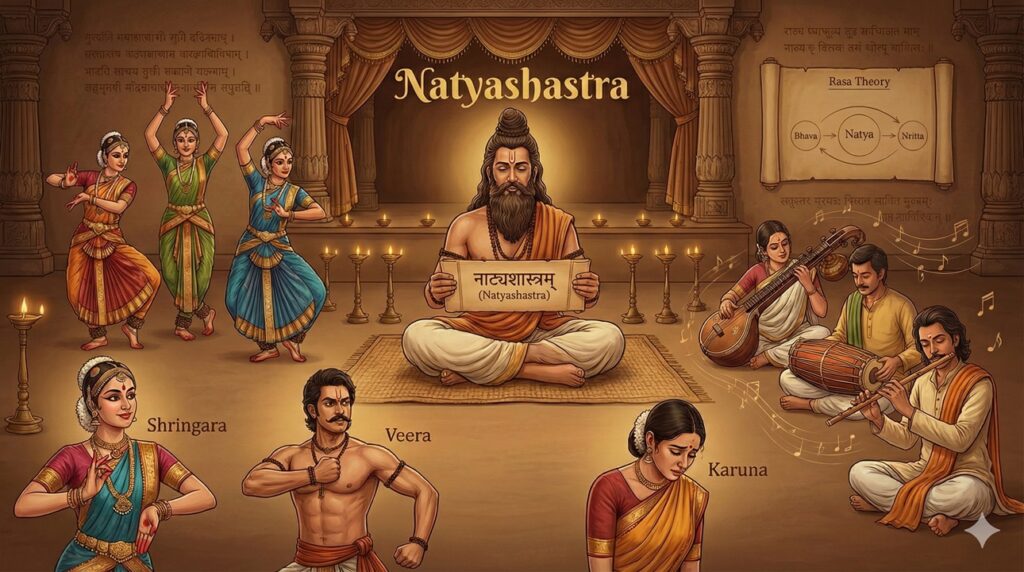
The Natyashastra is the foundational Sanskrit treatise on drama, dance, music, aesthetics, and stagecraft in India. It is regarded as the Natya Veda (Fifth Veda), aimed at communicating ethical, aesthetic, and social values through performance to all sections of society.
Authorship and Language
The text is traditionally attributed to Bharata Muni. It is composed in Classical Sanskrit, primarily in śloka (verse) form, with limited prose additions in later recensions.
Historical Development
Scholars broadly date the work to c. 200 BCE–200 CE. It evolved from an oral performance tradition before being codified. The most influential commentary is Abhinavagupta’s Abhinavabharati from the 10th–11th century CE.
Structural Features
The treatise consists of 36 chapters, with some traditions counting 37, and covers the entire process of theatrical production, from conception to performance.
Rasa Theory
Its core contribution is the Rasa–Bhava framework, explaining aesthetic experience. The eight classical rasas are Shringara, Hasya, Karuna, Raudra, Veera, Bhayanaka, Bibhatsa, and Adbhuta, while Shanta was added in later tradition.
Concept of Abhinaya
Performance is explained through fourfold Abhinaya comprising Angika (body movements), Vachika (speech), Aharya (costume and props), and Sattvika (inner emotional states).
Dramaturgy and Stagecraft
The text provides detailed guidance on plot construction, character types, theatre architecture, performance styles, costumes, make-up, and direction, making it a comprehensive production manual.
Codification of Dance and Gesture
It standardises training through detailed descriptions of mudras, hastas, body postures, facial and eye movements, and movement units like karanas.
Integration of Performing Arts
The Natyashastra treats performance as a synthesis of music, rhythm, movement, and expression, ensuring unity between theory and practice.
Conclusion
The Natyashastra forms the theoretical foundation of India’s classical performing arts, supporting cultural continuity and enabling the reinterpretation of traditions in contemporary contexts, making it central to India’s intangible cultural heritage discourse.
Source : PIB