
India’s Student Migration: Aspirations, Debt and Developmental Dilemmas
Context
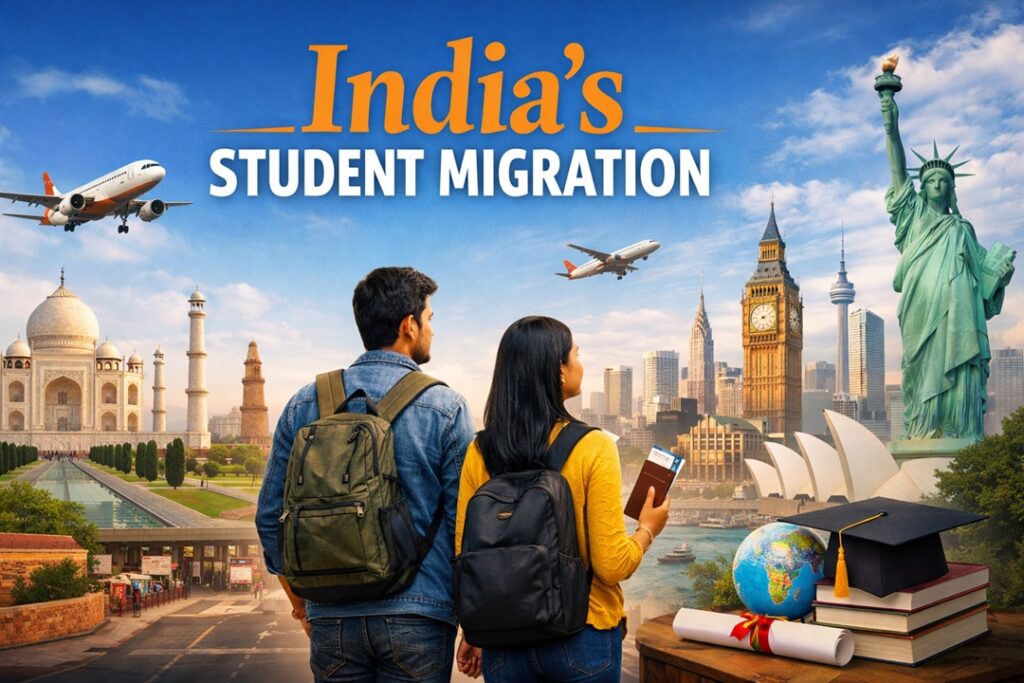
India is witnessing a sharp rise in self-financed student migration, with overseas enrolment projected to reach 13.8 lakh by 2025. While it reflects rising aspirations, concerns over debt, underemployment and brain waste question its developmental value.
Changing Patterns of Student Migration
Nature of migration:
. Shift from elite, scholarship-based mobility to a mass middle-class phenomenon
. Heavy reliance on education loans and household savings
Emerging destinations:
. Nearly 82 lakh Indian students in 153 countries by December 2025
. Germany and France as cost-effective alternatives
. Germany recorded about 49% growth due to stricter rules in traditional hubs
Regional evidence Kerala:
. Student migration rose from 1.29 lakh in 2018 to 2.5 lakh in 2023
. Now accounts for 11.3% of total emigrants
. Gulf labour migration showing stagnation
Financial dimension:
. Outward education remittances of ₹43,378 crore in 2023–24
. Nearly 20% of inward labour remittances
. Indicates rising household financial stress
Drivers of the Shift
Aspirational mobility and PR pathways:
. Education increasingly viewed as a migration ladder
. Preference for destinations offering post-study work and residency
. Australia and Germany attracted higher enrolments in 2024–25
Domestic education–employment mismatch:
. Weak linkage between degrees and labour-market needs
. Only 51% of Indian graduates employable as per India Skills Report 2024
Recruitment ecosystem:
. Unregulated agents prioritising commissions
. Steering students towards low-quality institutions abroad
Normalisation of self-financed migration:
. High debt accepted as legitimate investment
. RBI 2024 reports rise in LRS remittances under education categories
Challenges and Risks
Deskilling and underemployment:
. Restrictive visa regimes limiting skilled employment
. Graduates pushed into low-skill and gig work
Reverse remittances and debt burden:
. Education loans averaging ₹35–40 lakh in 2024
. Mortgaging of family land and assets
Exploitation and informal labour:
. Unsafe housing and undocumented work
. Heightened vulnerability during housing crises abroad
Mental health stress:
. Isolation, debt pressure and visa insecurity
. Rising distress calls to Indian missions
Brain waste over brain gain:
. Return of students with loans instead of skills
. Weak absorption into domestic innovation systems
Way Forward
Regulation of recruitment agents:
. Mandatory registration and strict penalties
. Curb fraud and misinformation
Pre-departure counselling:
. Realistic guidance on costs, risks and outcomes
. MEA initiative Surakshit Jaaye Prashikshit Jaaye 2024
Bilateral education frameworks:
. Predictable and accountable mobility pathways
. India–Australia MATES programme as a model
Domestic higher education reforms:
. Improve quality and global exposure at home
. Foreign university campuses at GIFT City
Return and reintegration mechanisms:
. Absorption of returnees into R and D and startups
. VAIBHAV Fellowship linking diaspora with Indian institutions
Conclusion
India’s expanding student migration mirrors rising aspirations but exposes structural vulnerabilities. Without regulation and domestic reform, overseas education risks becoming a cycle of debt and underemployment. A balanced policy approach is essential to convert student mobility into genuine human capital gains.
Source : The Hindu