
SHANTI Act 2025 Reform of India’s Civil Nuclear Law
Context
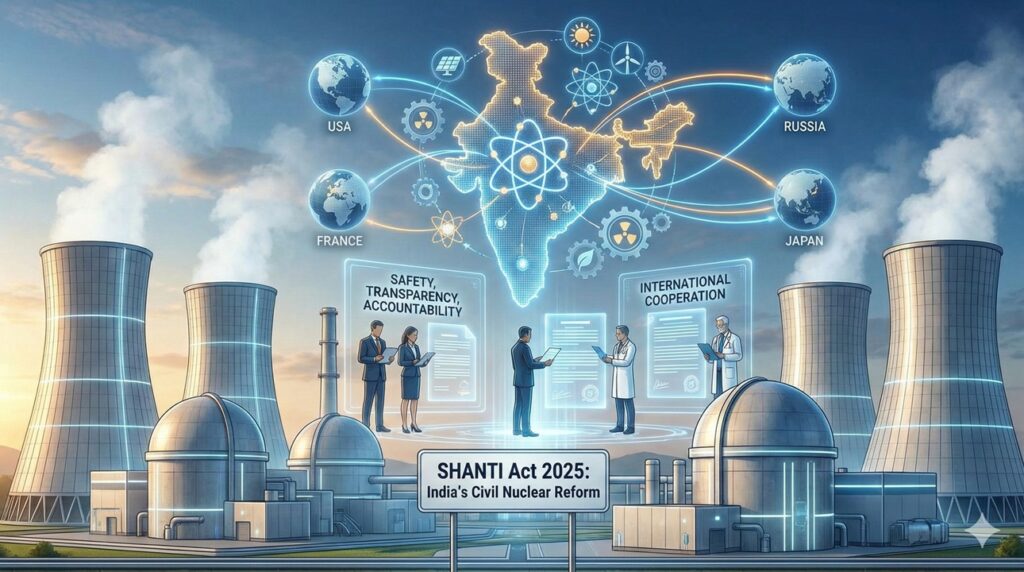
The President of India has granted assent to the Sustainable Harnessing and Advancement of Nuclear Energy for Transforming India SHANTI Act 2025, passed during the Winter Session of Parliament, replacing the Atomic Energy Act 1962 and the Civil Liability for Nuclear Damage Act 2010
Unified Legal Framework
Scope of the Act
. Establishes a single comprehensive framework for regulation licensing safety and liability
. Applies to India’s civil nuclear energy sector
Laws Replaced
. Atomic Energy Act 1962
. Civil Liability for Nuclear Damage Act 2010
Objectives of the Act
Clean Energy Transition
. Accelerate nuclear power capacity as a low carbon energy source
Private Sector Participation
. Enable private and joint venture participation under strict regulatory oversight
Governance Reform
. Modernise safety liability and oversight mechanisms
Opening of the Nuclear Sector
Eligible Entities
. Indian private companies and government private joint ventures
. Foreign incorporated companies excluded
Permitted Activities
. Construction operation and decommissioning of nuclear power plants
. Fabrication transport trade and storage of nuclear fuel
Safety Oversight
. Mandatory safety authorisation by AERB for all radiation related activities
Revised Nuclear Liability Regime
Liability Principles
. Retains no fault liability for operators
. Continues mandatory insurance coverage
Liability Caps
. Introduces tiered operator liability based on reactor capacity
. Range fixed between ₹100 crore and ₹3,000 crore
. Replaces earlier flat cap of ₹1,500 crore
Government Responsibility
. Central Government bears excess liability beyond operator cap
Operator’s Right of Recourse
Change in Provision
. Removes automatic right of recourse against suppliers
Permitted Recourse
. Allowed only if contractually provided
. Applicable in cases of wilful acts causing damage
Global Alignment
. Brings India in line with international nuclear liability norms
Expanded Territorial Jurisdiction
Cross Border Compensation
. Covers nuclear damage in foreign states caused by incidents in India
. Subject to specified conditions
Statutory Status to AERB
Legal Backing
. Grants statutory status to Atomic Energy Regulatory Board
Composition
. Chairperson one whole time member and up to seven part time expert members
Appointments and Tenure
. Selection through search cum selection committee
. Tenure of 3 years extendable up to 6 years
Atomic Energy Redressal Advisory Council
Nature of Body
. New appellate authority for nuclear sector disputes
Jurisdiction
. Hears appeals against Central Government and AERB decisions
Composition
. Chaired by Chairperson Atomic Energy Commission
. Members include heads of BARC AERB and CEA
Further Appeal
. Lies with Appellate Tribunal for Electricity
Conclusion
The SHANTI Act 2025 introduces structural reforms in India’s civil nuclear sector by promoting regulated private participation strengthening safety institutions and aligning liability norms with global standards to support India’s clean energy and net zero goals
Source : News on Air