
Bal Vivah Mukt Bharat Abhiyan India’s Fight Against Child Marriage
Context
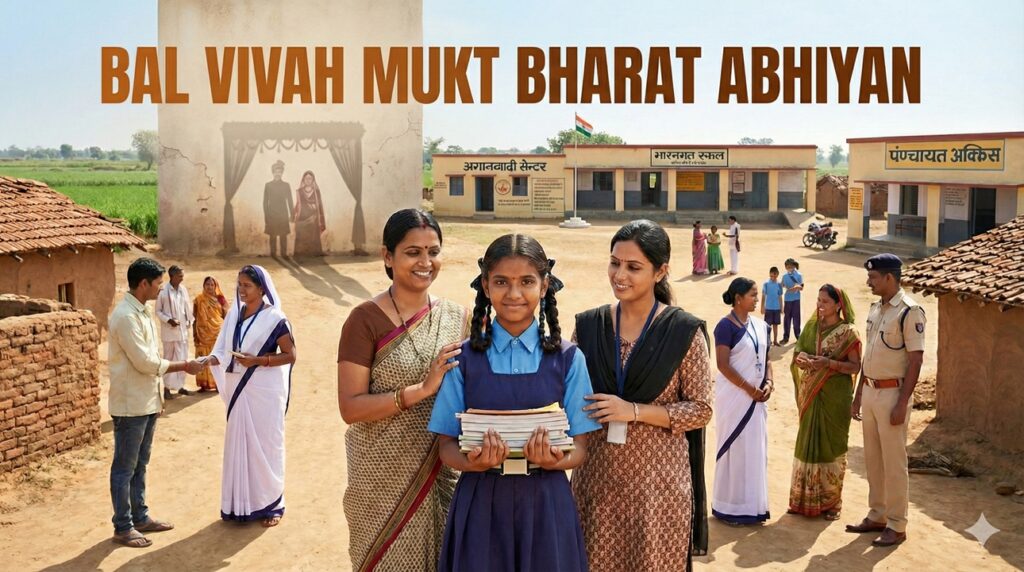
The Union government marked the first anniversary of the Bal Vivah Mukt Bharat Abhiyan with a 100-day nationwide awareness campaign, reaffirming India’s commitment to end child marriage by 2030 in line with UN Sustainable Development Goals.
Global Framework and Situation
SDG Linkage
The issue is addressed under SDG 5 Gender Equality, specifically Target 5.3, which aims to eliminate child early and forced marriages.
Measurement Indicator
Progress is tracked through the percentage of women aged 20 to 24 married before 18 years.
Global Burden
According to UNICEF 2023, around 64 crore girls were married in childhood globally, with India accounting for nearly one third.
Trends and Regional Patterns
Globally 19 percent of women aged 20 to 24 were child brides, down from 23 percent a decade ago.
South Asia hosts 45 percent of all child brides, while Sub Saharan Africa has the highest prevalence, with one in three girls marrying before 18.
At the current pace, elimination in Sub Saharan Africa may take over 200 years.
Risk of Reversal
Progress has stagnated in Latin America, West Asia and North Africa, with pandemics conflicts and climate change threatening gains.
Situation in India
Long Term Decline
As per NFHS, child marriage declined from 47.4 percent in 2005 06 to 26.8 percent in 2015 16, a fall of 21 percentage points.
Recent Slowdown
The decline slowed to 23.3 percent in 2019 21, a reduction of only 3.5 percentage points in five years.
High Prevalence States
Highest rates are reported in West Bengal 42 percent, Bihar 40 percent, Tripura 39 percent, Jharkhand 35 percent, Andhra Pradesh 33 percent and Assam 32 percent.
Low Prevalence Regions
Lowest rates are seen in Lakshadweep 4 percent, Jammu and Kashmir 6 percent, Ladakh 6 percent and Himachal Pradesh Goa and Nagaland 7 percent each.
Socio Economic Disparities
48 percent of girls with no education were married before 18 compared to 4 percent among those with higher education.
40 percent of girls from the poorest households married early, against 8 percent from the richest group.
Government Measures and Initiatives
Legal Framework
The Prevention of Child Marriage Act 2006 and POCSO Act 2012 have contributed to reducing child marriage, though social norms limit their impact.
Minimum Age Reform
The proposal to raise the minimum marriage age for women to 21 years aims to promote education skill development and gender parity.
Bal Vivah Mukt Bharat Abhiyan
As of December, 54,917 Child Marriage Prevention Officers have been appointed nationwide.
The campaign prevented 1,520 child marriages in one year, with Madhya Pradesh and Haryana reporting the highest numbers.
Community and Welfare Schemes
Collaboration with faith leaders youth groups and community networks strengthens grassroots action.
Schemes like Beti Bachao Beti Padhao and Kanyashree in West Bengal focus on education and delayed marriage, though concerns remain about mixed incentives in some states.
Conclusion
Child marriage remains a major social and developmental challenge despite significant progress. Achieving the 2030 target requires not only legal reforms but also education of girls economic empowerment community participation and behavioural change, as failure to end child marriage will undermine progress on multiple SDGs related to poverty health education gender equality and economic growth.
Source : The Hindu