
India–New Zealand Free Trade Agreement and Its Strategic Significance
Context
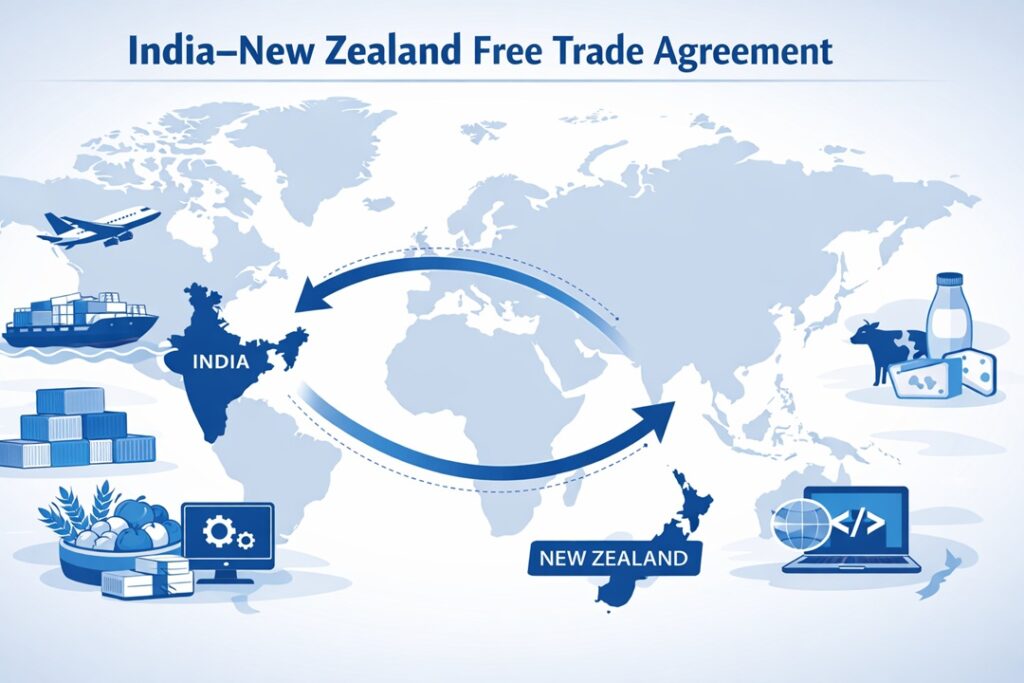
India and New Zealand concluded a forward-looking Free Trade Agreement in December 2025, marking a major milestone in bilateral economic relations. Announced in March 2025 and finalised within the same year, it is among India’s fastest-concluded FTAs. The Agreement aims to expand trade in goods and services, enhance investment flows, improve mobility of students and professionals, and strengthen cooperation in agriculture and emerging sectors, while positioning New Zealand as a strategic gateway for India to the Oceania and Pacific Island region.
Nature of the Agreement
• Aims to reduce or eliminate tariffs and non-tariff barriers
• Facilitates trade in goods, services, investment, and intellectual property
• Creates a predictable and transparent trade framework
Background and Strategic Importance
• Negotiations announced in March 2025
• Positions New Zealand as a gateway to Oceania and Pacific Island markets
• Reinforces India’s Indo-Pacific economic engagement
Bilateral Trade Performance
Merchandise Trade
• Trade rose from USD 873 million in 2023–24 to USD 1.3 billion in 2024–25
• Recorded 49 percent growth
Exports from India
• Increased to USD 711 million in 2024–25
• Achieved 32 percent growth and a positive trade balance
Services Trade
• Services exports reached USD 634 million in 2024
• Grew by 13 percent, led by IT, travel, and business services
Market Access Gains for India
Tariff Liberalisation
• Zero duty on 100 percent tariff lines covering 8,284 products
• Average tariff of 2.2 percent reduced to zero
Sectoral Coverage
• Labour-intensive sectors such as textiles, apparel, leather, footwear
• Engineering sectors including automobiles, pharmaceuticals, electronics, machinery
• Agricultural products like fruits, vegetables, spices, cereals, processed foods
Support to Domestic Industries
Critical Imports
• Access to wooden logs, coking coal, ferrous and non-ferrous metal scrap
• Supports manufacturing competitiveness and infrastructure growth
Agriculture and Farmer Welfare
Agri Technology Cooperation
• Action Plans for apples, kiwifruit, and honey
• Establishment of Centres of Excellence and capacity building for farmers
Market Access with Safeguards
• Imports regulated through Tariff Rate Quotas
• Use of minimum import price and seasonal controls
• Oversight by a Joint Agriculture Productivity Council
Services, Education, and Mobility
Services Liberalisation
• Commitments in 118 services sectors
• MFN treatment in 139 sectors
Health and Traditional Medicine
• Dedicated annex promoting AYUSH systems
• Supports medical value travel and wellness services
Student and Professional Mobility
• Indian students allowed 20 hours of work per week
• Extended post-study work visas
• 5,000 skilled visas for Indian professionals for up to 3 years
• 1,000 Working Holiday Visas annually for Indian youth
Investment and Economic Cooperation
Foreign Direct Investment
• New Zealand commitment of USD 20 billion over 15 years
MSME and Sectoral Cooperation
• Institutional support for MSMEs
• Cooperation in AYUSH, tourism, sports, audiovisual industries
Pharmaceuticals and Intellectual Property
• Faster regulatory approvals for pharmaceuticals and medical devices
• EU-level protection for Indian Geographical Indications within 18 months
Trade Facilitation Measures
• Customs clearance within 48 hours and 24 hours for perishables
• Strong Rules of Origin to prevent trade circumvention
Conclusion
The India–New Zealand FTA represents a significant step in India’s trade diplomacy by securing wider market access, boosting exports, supporting farmers and MSMEs, and creating new opportunities in services, education, and skilled mobility. By balancing liberalisation with protection of sensitive sectors and deepening long-term investment and technological cooperation, the Agreement contributes to inclusive and sustainable growth. It reinforces India’s credibility as a reliable global trading partner and aligns with the broader vision of a globally integrated Viksit Bharat 2047.
Source : PIB