
India’s Urban Transition: Challenges and the Path to Inclusive Cities
Context
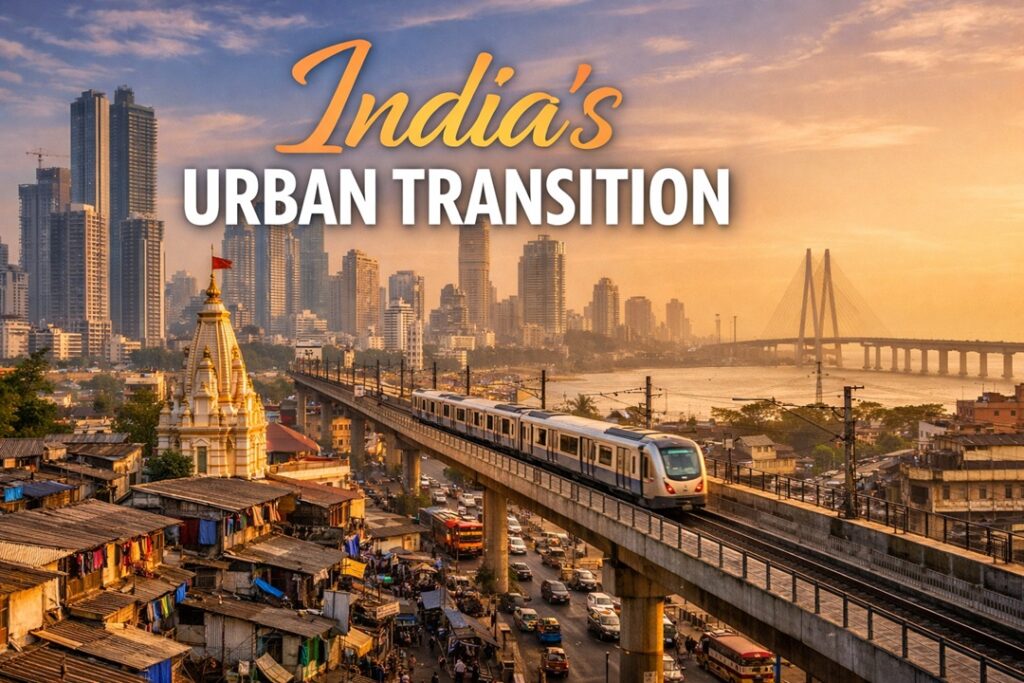
Policy debates increasingly stress the need to reshape India’s urban model to manage rapid urbanisation, migration pressures, mobility stress, and rising inequality, while ensuring cities remain inclusive, sustainable, and resilient.
Urbanisation in India
- Meaning of Urbanisation
- Shift of population from rural to urban areas with expansion of economic activity and spatial footprint
- Driven by industrialisation, migration, and access to services
- Key Trends
- Urban population around 36 percent in 2024, projected to exceed 50 percent by the 2050s–60s
- Cities contribute 65 to 70 percent of GDP despite a smaller population share
- Rising inter-State and rural–urban migration towards Tier-1 and Tier-2 cities
Existing Pattern of Urban Growth
- Metro-Centric Expansion
- Concentration of growth in Tier-1 cities
- Limited development of new urban centres
- Peripheral Sprawl
- Expansion of informal settlements at city edges
- Inadequate access to basic services
- Sectoral Urban Hubs
- Cities specialising in IT, manufacturing, and services
- Uneven regional development
- Smart City Approach
- Focus on physical infrastructure
- Neglect of social inclusion and lived experience
Key Challenges of Urbanisation
- Exclusion and Inequality
- Migrants face language, cultural, and documentation barriers
- Weak access to welfare schemes such as PDS
- Housing Deficit
- High land prices and weak rental markets
- Growth of slums and insecure housing
- Urban Mobility Stress
- Dependence on private vehicles
- Only 37 percent have easy access to public transport
- Need for 2 lakh urban buses against 35,000 operational buses
- Governance Gaps
- Fragmented authority among multiple agencies
- Weak fiscal autonomy of Urban Local Bodies
- Environmental Stress
- Rise of urban heat islands, air pollution, and water scarcity
- Delhi AQI above 400 during winter smog episodes
- Social Fragmentation
- Decline of community bonds
- Growth of gated communities and social silos
Way Forward for Indian Cities
- People-Centric Urban Planning
- Design cities as human-centric ecosystems
- Prioritise safety, walkability, and public spaces
- Inclusive Urban Governance
- Multilingual service delivery
- Representation of migrants in decision-making
- Sustainable Urban Mobility
- Strengthening bus-based public transport
- Integration of last-mile and non-motorised transport
- Fiscal Empowerment of ULBs
- Use of municipal bonds and rational user charges
- Enhanced financial autonomy
- Affordable and Integrated Housing
- Transit-oriented development
- Schemes like PM Awas Yojana Urban and ARHCs
Conclusion
India’s cities will determine its economic dynamism, social cohesion, and environmental resilience. A shift towards inclusive governance and people-centric planning is essential for building a sustainable and equitable urban future.
Source : The Hindu