
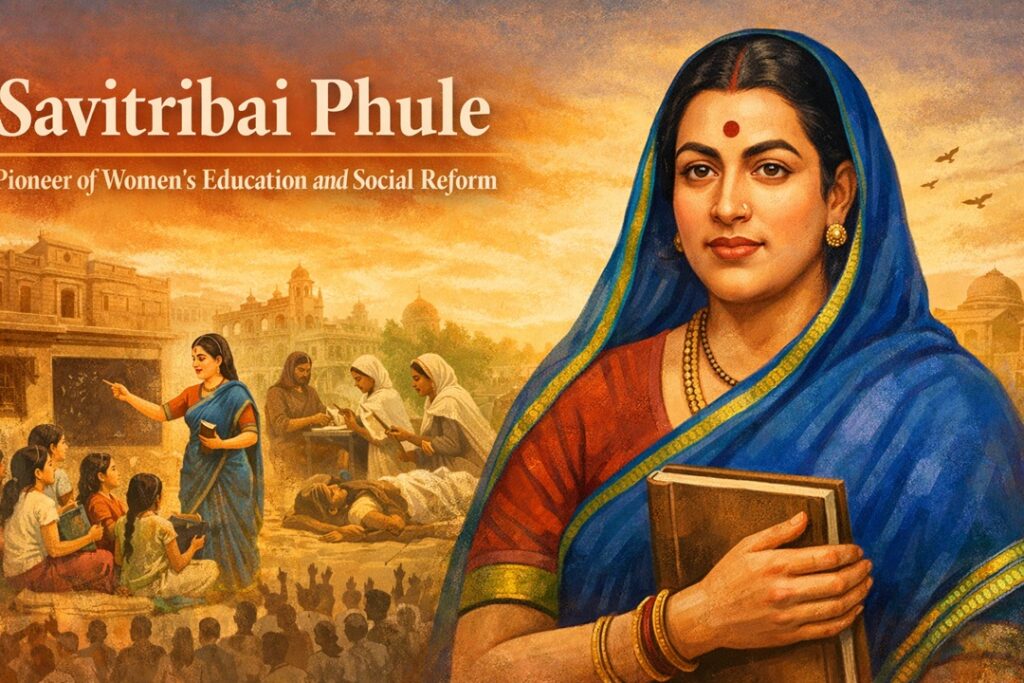
Savitribai Phule: Pioneer of Women’s Education and Social Reform
Context
The Prime Minister paid tributes to Savitribai Phule on her birth anniversary, recalling her lifelong commitment to education, equality, and social transformation.
Who She Was
Savitribai Phule (1831–1897) was a pioneering social reformer, educator, and poet. She is widely regarded as modern India’s first woman teacher and a foundational figure of Indian feminism.
Early Life and Education
Born in Naigaon, Maharashtra, she was married in childhood to Jyotirao Phule and later moved to Pune. With his encouragement, she became literate and received formal teacher training in Ahmednagar and Pune, qualifying as a teacher in 1847.
Contributions to Education and Social Reform
• Co-founded India’s first girls’ school in 1848 at Bhidewada, Pune.
• Helped establish 18 schools for girls and marginalized communities.
• Set up shelters for widows, destitute women, and child brides in 1854, expanded in 1864.
• Actively opposed child marriage, caste discrimination, and untouchability.
• Played a key role in the Satyashodhak Samaj, challenging caste hierarchy.
• Promoted priestless and dowry-free marriages to ensure social equality.
• Continued teaching despite social hostility and abuse.
• Served plague victims during the 1897 epidemic, ultimately sacrificing her life.
Conclusion
Savitribai Phule’s life highlights education as a powerful instrument of social emancipation. Her contributions laid strong foundations for women’s rights, social justice, and inclusive reform in India, making her legacy highly relevant for contemporary policy and governance debates.
Source : DD News