
Digital Surveillance in Indian Policing: Trends, Challenges and the Road Ahead
Context
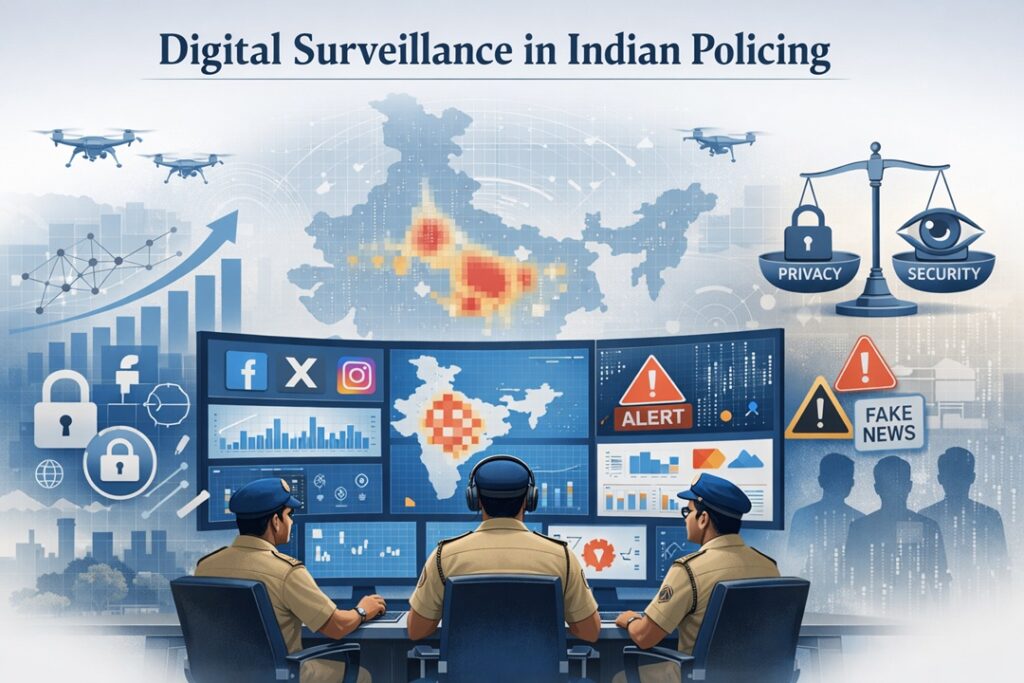
Indian policing has witnessed a rapid expansion of digital surveillance capabilities in response to the growing influence of social media in shaping public order, crime, and information flows.
Status of Social Media Surveillance Cells
Overall Expansion
Dedicated social media surveillance units increased from 262 units across 28 States and 8 UTs in January 2020 to 365 units by January 2024.
State-wise Growth
A significant rise has been recorded in Bihar with 52 units, Maharashtra with 50, Punjab with 48, West Bengal with 38, and Assam with 37 units.
Unrest-driven Expansion
Conflict-affected regions have witnessed sharper growth in surveillance capacity. In Manipur, monitoring units increased from 3 in 2020 to 16 in 2024 following ethnic violence.
Underlying Rationale
Digital platforms such as Facebook, X, Instagram, and WhatsApp are increasingly used for mobilisation, misinformation dissemination, and criminal coordination.
Impact of Digital Monitoring
Preventive Policing
Social media surveillance enables early identification of emerging crime trends, online mobilisation, and potential law-and-order disturbances.
Control of Misinformation
Monitoring mechanisms assist in tracking fake news, hate speech, communal narratives, and politically motivated violence.
Associated Technological Developments
Expansion of Cybercrime Infrastructure
Cybercrime police stations increased from 376 in 2020 to 624 in 2024, strengthening responses to online fraud, data theft, cyber financial crimes, and digital harassment.
Integration of Drones
The use of drones for surveillance and crowd management has expanded. As of January 2024, police forces operated 1,147 drones, up from 1,010 in 2023.
Key Challenges and Concerns
Privacy and Legal Issues
Unclear boundaries between public and private digital spaces raise constitutional and privacy-related concerns.
Data and Technology Constraints
The large volume of online content complicates threat identification, while dependence on basic analytical tools limits accuracy.
Contextual and Bias Risks
Misinterpretation of slang, sarcasm, and cultural nuance can lead to false positives, while algorithmic and institutional biases may disproportionately affect certain communities.
Capacity and Manpower Gaps
Shortages of trained personnel and absence of uniform policies hinder effective monitoring. 5,92,839 police posts remain vacant against a sanctioned strength of 27,55,274, despite representation of 3,30,621 SC, 2,31,928 ST, and 6,37,774 OBC personnel.
Conclusion
The expansion of digital surveillance, cybercrime units, and drone deployment marks a structural shift in Indian policing. Addressing legal safeguards, manpower shortages, skill development, and public trust is essential to ensure effective and constitutionally compliant technology-driven policing.
Source : The Hindu