
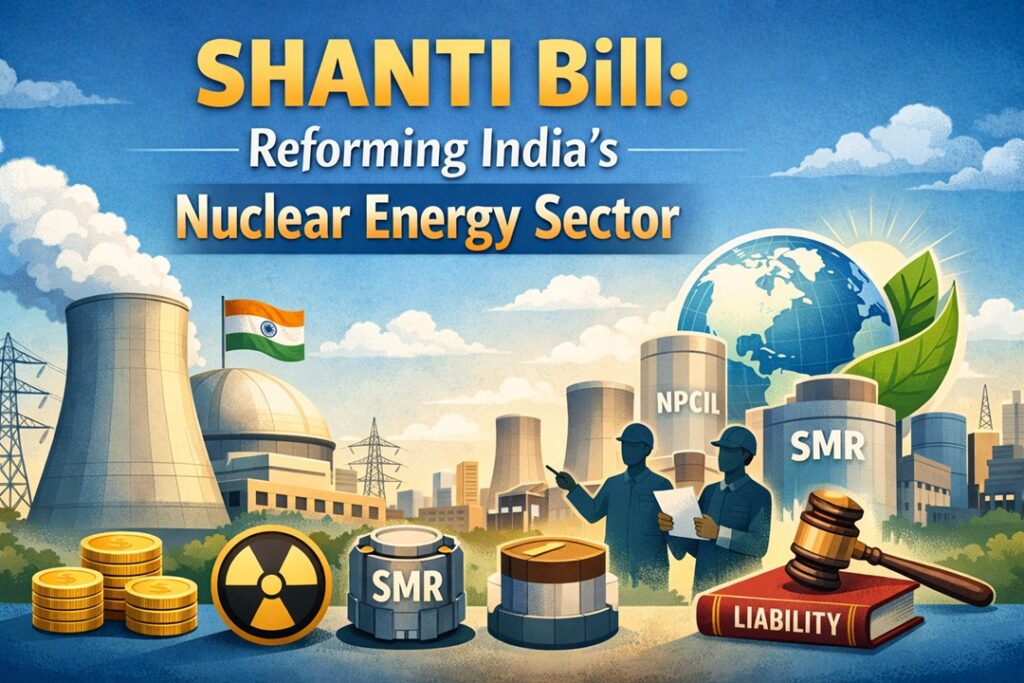
SHANTI Bill: Reforming India’s Nuclear Energy Sector
Context
The Parliament recently passed the Sustainable Harnessing and Advancement of Nuclear Energy in India (SHANTI) Bill, opening India’s nuclear sector to private and foreign participation. The Bill aims to strengthen energy security, promote clean energy, and boost advanced nuclear technologies while regulating private involvement.
Need for the Bill
Energy Security
- Government allocated ₹20,000 crore for Small Modular Reactors (SMRs) and advanced pressurised water reactors.
- Aims to diversify India’s power mix and reduce fossil fuel dependence.
Relaxing State Control
- Nuclear sector has remained state-controlled since 1956.
- Previous legal framework restricted private and foreign participation.
Encouraging Private Investment
- Earlier laws like the Atomic Energy Act, 1962 and Civil Liability for Nuclear Damages Act, 2010 limited private involvement.
- Strict liability rules discouraged foreign companies from entering India.
Key Features of the SHANTI Bill
Private Sector Participation
- Indian companies can build, own, and operate nuclear plants.
- Foreign suppliers are permitted to participate.
- 49% private ownership allowed; government retains 51% control over nuclear fuel, heavy water, waste, safety, licensing, and strategic oversight.
Ending Monopoly
- Ends NPCIL’s monopoly in plant operations.
- Private sector can engage in fuel fabrication, equipment manufacturing, plant operations, and R&D.
- Operates under a public-private partnership model with government oversight.
Advanced Nuclear Technologies
- Supports deployment of Small Modular Reactors (SMRs) and indigenous reactor designs.
- Facilitates India’s clean energy transition and enhances long-term energy security.
Role of AERB
Statutory Status
- Atomic Energy Regulatory Board (AERB) now has statutory powers and reports to Parliament.
Responsibilities
- Ensures nuclear safety, radiation protection, emergency preparedness, and quality assurance.
Authority
- Issues licenses, safety measures, and standards.
- Administers Factories Act, 1948 for units under the Department of Atomic Energy.
Significance
- Strengthens regulatory oversight as private sector involvement increases.
Safeguards under the Bill
Authorisations
- Private companies must obtain AERB approval for plant establishment, operation, radioactive material handling, and facility withdrawal.
Government Control
- Retains authority over spent fuel management, heavy water production, and isotope enrichment.
Nuclear Liability Fund
- Provides a fund to meet compensation needs in case of nuclear accidents.
Liability Provisions
Operator Liability Caps
- Large plants (3,600 MW): ₹3,000 crore
- Medium plants (1,500–3,600 MW): ₹1,500 crore
- SMRs (150 MW): ₹100 crore
Penalties
- Penalties for violations capped at ₹1 crore.
- Government bears liability beyond operator’s cap.
Supplier Liability
- Supplier accountability removed, unlike the earlier regime.
Government Perspective
Energy Security
- Diversifies power mix and reduces fossil fuel dependence.
- Ensures 24×7 baseload power complementing renewables.
Clean Energy
- Supports low-carbon electricity and India’s net-zero target by 2070.
International Cooperation
- May revive stalled civil nuclear deals with the U.S., France, and Japan.
- Enhances India’s global nuclear credibility.
India’s Nuclear Energy Need
Geography and Climate
- Solar, wind, and hydro energy are variable; coal remains dominant.
Baseload Requirement
- Nuclear plants ensure reliable and affordable electricity.
Energy Security
- Strengthening nuclear capacity is critical for India’s growing economy.
India’s Nuclear Energy Mission
Thorium Utilisation
- Focuses on indigenous fuel cycle using thorium reserves.
Reactor Portfolio
- 25 reactors: 21 PHWR and 4 LWR, managed by NPCIL.
Self-sufficiency
- Bhabha Atomic Research Centre reprocesses spent fuel, manages waste, and ensures operational independence.
Advanced Reactors
- Operational Fast Breeder Reactor (FBR) for thorium use.
Opposition Concerns
Accountability
- Liability placed mostly on State and society, allowing private profit-driven participation.
Accident Risk
- Fear of incidents similar to Bhopal, with limited public recourse.
Liability Issues
- Operator liability caps and removal of supplier liability may not cover actual damages.
Transparency
- Section 39 overrides RTI Act 2005, limiting public access to nuclear information.
Labor Safety
- Section 42 exempts nuclear workers from general labor protections.
Public Oversight
- Lacks mandatory public hearings, EIA disclosures, community consent, and parliamentary scrutiny.
Pro-Profit Bias
- Critics argue the Bill favours private capital over public safety, unlike global practices where reactors remain government-controlled.
Conclusion
The SHANTI Bill marks a significant shift in India’s nuclear energy policy by allowing private and foreign participation while maintaining government oversight over sensitive areas. It aims to enhance energy security, clean energy transition, and advanced nuclear technology deployment, supporting India’s long-term development and net-zero goals. However, concerns regarding liability, transparency, and public safety highlight the need for strong regulatory enforcement and continuous monitoring to balance economic growth with societal protection.
Source : The Hindu