
POCSO and Consensual Adolescent Relationships: Need for Legal Reform
Context
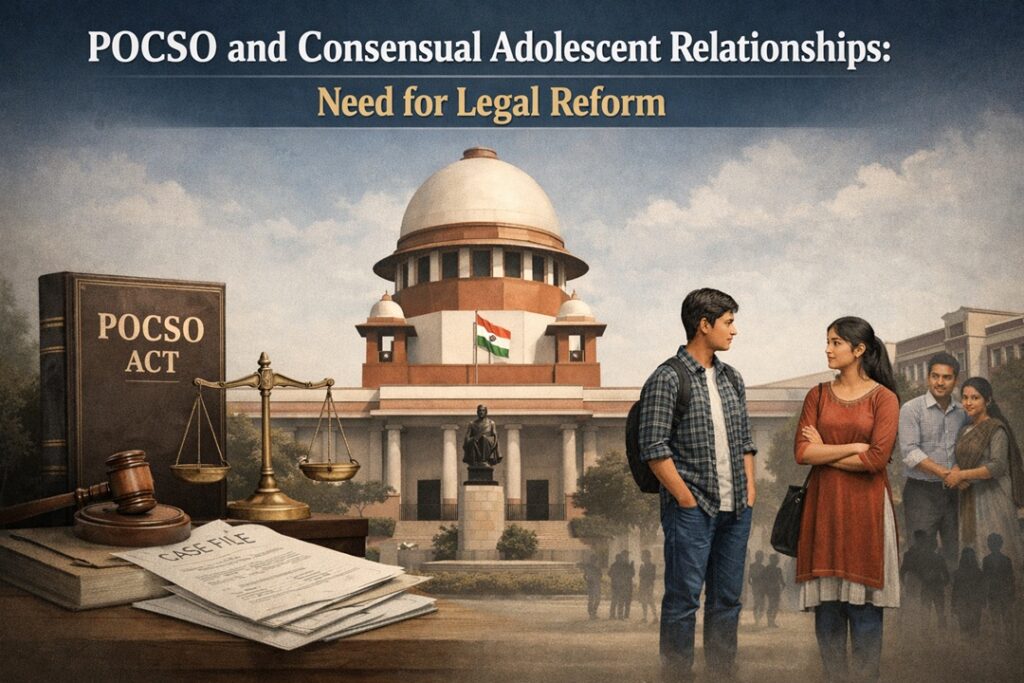
The Supreme Court in January 2026, in State of UP vs Anurudh & Anr., highlighted the misuse of the POCSO Act in consensual adolescent relationships and urged the Union government to consider legal reforms.
Concept
Age of consent refers to the legally defined age at which an individual can validly consent to sexual activity. In India, it is 18 years under POCSO Act, IPC and Bharatiya Nyaya Sanhita, 2023.
Key Data and Trends
NFHS-4: 39% of Indian girls reported first sexual experience before 18.
Enfold & Project 39A (2016–20): Around 25% of POCSO cases involved consensual adolescent relationships.
Emerging trend: Rising POCSO cases often reflect parental opposition to teenage relationships rather than sexual exploitation.
Current Legal Position
Statutory rule: Under POCSO Act 2012, IPC Section 375 and BNS Section 63, any sexual activity with a person below 18 amounts to rape, irrespective of consent.
Supreme Court Position:
Judgment (Jan 10, 2026): The Court acknowledged misuse of POCSO in romantic adolescent cases and recommended exploring exemptions for genuine teenage relationships.
Judicial approach: While High Courts have favoured adolescent autonomy, the Supreme Court maintains that consent below 18 is legally invalid, occasionally using Article 142 to reduce hardship.
Arguments for Relaxation of Age of Consent
Criminalisation of adolescent love: Enfold (2020) found that in 24% of cases, the girl declined to testify, indicating consensual relationships.
Parental misuse: Justice Nagarathna observed that POCSO is often used to penalise elopement or socially disapproved relationships.
Social reality mismatch: Large numbers of adolescents engage in relationships before 18, yet the law treats them as criminal.
International comparison: Countries like UK and Canada permit consent at 16 years with safeguards.
Judicial burden: Teenage romance cases increase POCSO pendency, diverting focus from serious abuse.
Arguments Against Lowering the Age
Risk of coercion: MWCD Study, 2007 showed over 50% of abusers are known to the child, making consent unreliable.
Child protection concerns: Law Commission Report 283 (2023) warned of risks to laws against child marriage and trafficking.
Bright-line protection: The 18-year rule provides a clear, objective safeguard.
Legislative intent: Parliamentary Committees 2011 and 2012 rejected recognising minor consent.
Potential misuse: Predators may mask exploitation as consent, especially where power imbalance exists.
Way Forward
Close-in-age exemption: Allow consensual relationships among 16–18-year-olds with a narrow age gap while criminalising adult exploitation.
Judicial assessment: Scrutiny of grooming, coercion and power imbalance to protect victims.
Preventive approach: Strengthen sex education and counselling to promote informed choices.
Systemic clarity: Issue uniform Supreme Court guidelines for consistent handling of adolescent POCSO cases.
Conclusion
A blanket reduction in the age of consent risks weakening child protection, while the existing rigid framework unjustly criminalises adolescent relationships. A balanced, evidence-based reform through close-in-age exemptions best reconciles child safety with adolescent autonomy.
Source : The Hindu