
PESA in Jharkhand: Delayed Decentralisation and Tribal Self-Rule
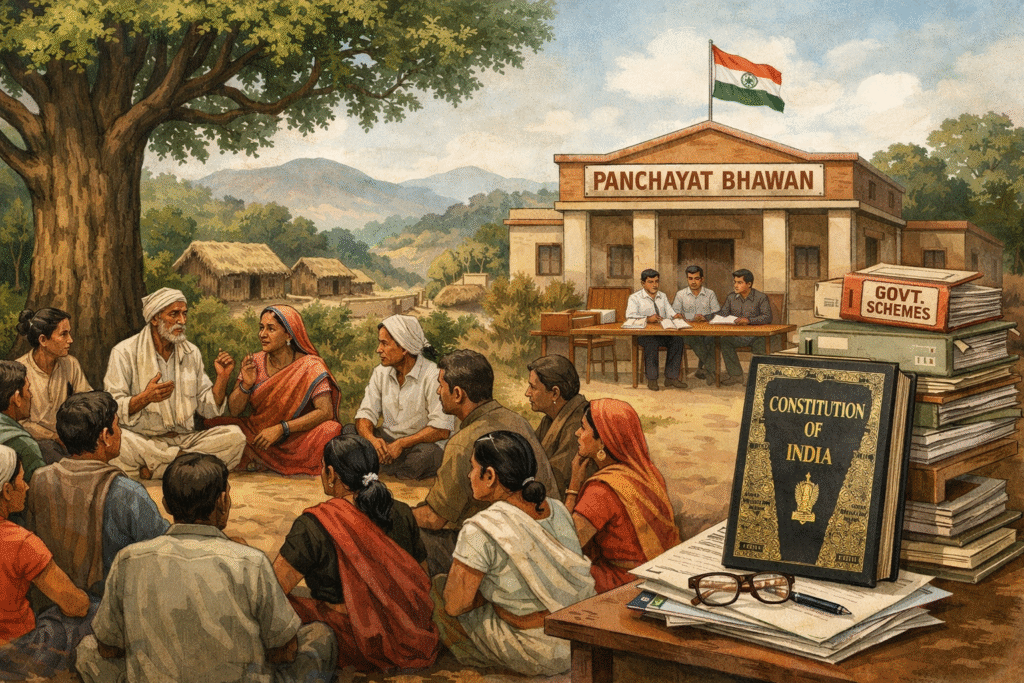
Context: Jharkhand notified the PESA Rules in January 2026, nearly 25 years after attaining statehood, extending tribal self-governance to its Fifth Schedule areas and formally operationalising the Panchayat (Extension to Scheduled Areas) Act, 1996.
What is PESA?
PESA extends Part IX of the Constitution (Panchayati Raj) to Scheduled Areas, recognising the Gram Sabha as the primary authority over local governance, land, forests and community resources. It was enacted on 24 December 1996 to ensure tribal self-rule across nine States, including Jharkhand.
Why was PESA needed? (Background)
- Colonial dispossession: British land and forest laws alienated tribals from their customary lands.
- Constitutional gap: The Fifth Schedule (Article 244) lacked effective grassroots self-governance.
- 73rd Amendment (1992): Panchayati Raj excluded Scheduled Areas.
- Bhuria Committee (1994–95): Recommended Gram Sabha supremacy over resources and development.
Key Features of PESA
- Gram Sabha supremacy: Highest decision-making body in Scheduled Areas.
- Customary law protection: Respect for tribal culture, traditions and social systems.
- Resource rights: Control over Minor Forest Produce (MFPs), water bodies and community land.
- Land safeguards: Mandatory consultation and power to restore illegally transferred land.
- Local regulation: Control over markets, money-lending, liquor and welfare beneficiaries.
Major Gains under PESA
- Legalised traditional self-rule: Gram Sabhas placed above Panchayats.
- Economic empowerment: MFP ownership increased tribal incomes
(e.g. Gadchiroli Gram Sabhas and tendu/bamboo trade). - Participatory democracy: Mandatory household and women’s participation.
- Shield against land alienation: Prior informed consent for land acquisition.
Key Challenges
- Dilution by States: Gram Sabhas reduced to advisory bodies.
- Bureaucratic dominance: Village resolutions often ignored.
- Industrial circumvention: Mining projects bypass consultations.
- Weak oversight: Limited role of Governors and TACs.
- Low awareness: Legal illiteracy in remote tribal areas.
Way Forward
- Empower Gram Sabhas: Direct funds, staff and planning authority.
- Legal convergence: Align PESA with FRA, 2006 and Samata Judgment.
- Binding consent: Make Gram Sabha approval non-negotiable.
- Independent redressal: Fast-track forums for PESA violations.
- Social audits: Civil society-led monitoring of resource use.
Conclusion
PESA is not merely a law but a constitutional promise of tribal self-rule. Jharkhand’s delayed implementation will be meaningful only if Gram Sabhas exercise real authority. Without genuine decentralisation, development in tribal areas risks remaining extractive and unjust rather than inclusive and democratic.
Source : DTE