
Global Risks Report 2026 and Geo-economic Confrontation
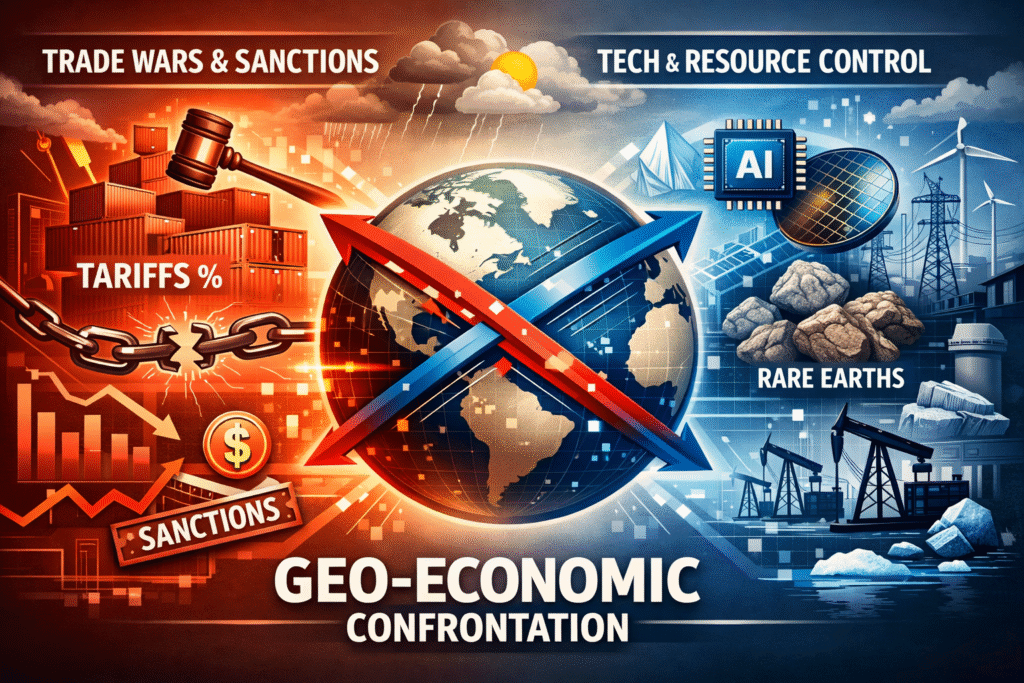
Context: The World Economic Forum’s Global Risks Report 2026 ranks geo-economic confrontation as the top short-term global risk, overtaking armed conflict, driven by rising trade wars, sanctions and weaponisation of economic tools.
Report Overview: The 21st annual Global Risks Report by the WEF is based on the Global Risks Perception Survey of leaders from government, business, academia and civil society. It assesses 33 global risks across 2-year and 10-year horizons.
Key Risk Ranking: Geo-economic confrontation ranks 1st in the 2-year horizon, involving tariffs, sanctions, investment restrictions and resource controls. Extreme weather events fall from 2nd to 4th, while pollution declines from 6th to 9th in short-term rankings.
Long-term Risk Trends: Biodiversity loss and critical Earth-system changes decline in short-term salience but remain among top long-term risks. Adverse outcomes of AI rise from 30th in the 2-year horizon to 5th in the 10-year horizon, reflecting governance and security concerns.
Implications for India – Trade and Supply Chains: Trade fragmentation can disrupt exports and industrial inputs. US–China tech restrictions have pushed India towards semiconductor and electronics localisation under PLI schemes.
Implications for India – Critical Minerals: Concentration of rare earths poses risks to India’s clean-energy transition, accelerating overseas mineral acquisition and the Critical Minerals Mission.
Implications for India – AI and Jobs: Weak AI governance risks job displacement and misinformation, impacting IT and BPO sectors, leading to the IndiaAI Mission and skilling reforms.
Implications for India – Climate Stress: Extreme weather events during 2023–25 disrupted railways, power grids and urban services, stressing infrastructure and public finances.
WEF Recommendations: Reviving multilateral cooperation, de-weaponising economic policies, strengthening global AI governance, investing in resilient infrastructure, and addressing inequality to prevent cascading global risks.
Conclusion: The report underscores a global shift from military conflict to economic and technological rivalry as the dominant short-term risk, highlighting the need for cooperative governance to manage trade, technology and climate-linked challenges.
Source : NDTV