
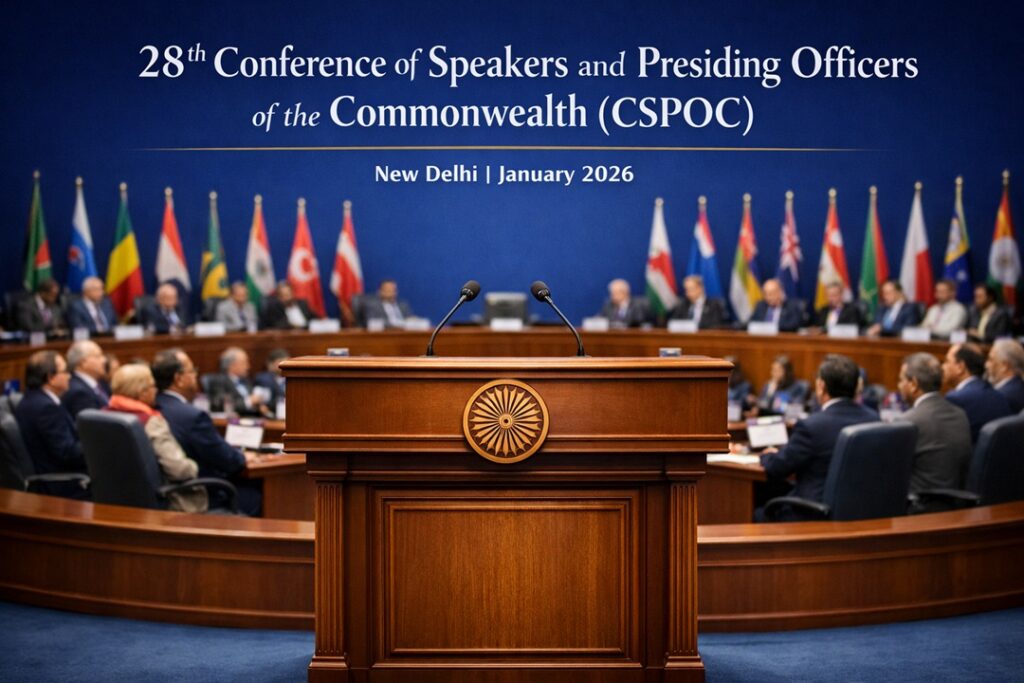
28th Conference of Speakers and Presiding Officers of the Commonwealth (CSPOC)
Context
India organised the 28th Conference of Commonwealth Speakers and Presiding Authorities (CSPOC) in New Delhi from 14–16 January 2026, reinforcing its stature in legislative diplomacy and democratic institutional leadership.
Understanding CSPOC
Concept – The Conference of Speakers and Presiding Officers of the Commonwealth (CSPOC) functions as an autonomous parliamentary platform within the Commonwealth framework.
Participants – It assembles Presiding Officers from 53 independent national legislatures and 14 self-governing regional legislatures, reflecting varied constitutional traditions.
Organisational Position – CSPOC operates independently of the Commonwealth Parliamentary Association (CPA) and the Commonwealth Secretariat, though institutional overlap exists.
Operational Character – Its autonomy allows it to remain a non-partisan forum dedicated to parliamentary ethics and leadership norms.
Meeting Cycle – CSPOC convenes once every two years, supported by an interim Standing Committee session.
Evolution and Normative Basis
Genesis – CSPOC was initiated in 1969 by Lucien Lamoureux, Speaker of the Canadian House of Commons.
Contextual Need – The forum emerged to address the absence of a Speaker-centric, neutral platform within the Commonwealth’s political architecture.
Democratic Purpose – It seeks to reinforce the role of Presiding Officers as custodians of legislative impartiality, procedural discipline, and minority protection.
Regulatory Framework – CSPOC is governed by codified Standing Rules, periodically revised to respond to institutional needs.
Salient Procedural Norms
• Eligibility limited to Presiding Officers of legislatures of sovereign Commonwealth members
• Representation continues through the last Presiding Officer during legislative dissolution
• Deputy Presiding Officers may act as substitutes, excluding Standing Committee eligibility
• Established norms for agenda formulation, quorum, voting mechanisms, and tenure
Mandate and Core Responsibilities
Primary Objectives –
• Ensuring neutrality and fairness in parliamentary chairing
• Advancing comparative understanding of legislative democracies
• Institutional strengthening through peer learning and experience-sharing
Influence Mechanism – Though outcomes are advisory in nature, they shape parliamentary conventions and ethical standards across member legislatures.
Current Focus Areas – CSPOC now engages with digital legislatures, AI governance, public trust, member safety, and institutional legitimacy.
Administrative Framework
Inter-Sessional Authority – The Standing Committee manages affairs between Conferences.
Key Functions –
• Finalising future host locations
• Designing thematic priorities
• Reviewing procedural rules
• Supervising logistical coordination
Constitution –
• Chaired by the Presiding Officer of the forthcoming host legislature
• Regionally representative membership
• 15-member body with a minimum quorum of five
Institutional Support – Canada continues to provide secretariat assistance, ensuring continuity.
India’s Engagement with CSPOC
Parliamentary Footprint – India’s involvement reflects its deep-rooted democratic and legislative traditions.
Host Record – India has hosted CSPOC on four occasions: 1970–71, 1986, 2010, and 2026.
Future Schedule – The 29th Conference is slated for London in 2028.
Strategic Importance of the 28th CSPOC in India
Leadership Role – The New Delhi Conference was conducted under the stewardship of the Speaker of the Lok Sabha.
Thematic Emphasis –
• Integration of emerging technologies in legislative functioning
• Influence of digital media on parliamentary credibility
• Strengthening citizen–Parliament connect
• Ensuring safety, health, and welfare of legislators and staff
Agenda Shaping Role – India chaired the Standing Committee meeting in Guernsey (January 2025), influencing the Conference’s direction.
India’s Policy Narrative at CSPOC
Digital Governance Lens – India acknowledged the benefits of AI and digital tools while cautioning against disinformation, cyber vulnerabilities, and societal fragmentation.
Collective Responsibility – Emphasis on ethical technology use, transparent digital ecosystems, and responsible online platforms.
Domestic Legislative Best Practices
• Rationalisation of colonial-era statutes
• Centrality of Parliamentary Standing Committees in scrutiny
• Alignment with national goals such as Viksit Bharat and Atmanirbhar Bharat
Gender Representation Perspective
• Presence of a woman President and woman Chief Minister of Delhi
• Nearly 1.5 million women representatives in local governance, approaching parity in representation
India, CSPOC, and South-South Leadership
Democratic Credibility – India positioned itself as a capable democracy delivering at scale.
Global Public Goods Contribution –
• Leading vaccine and pharmaceutical supplier
• Among top global producers of steel and rice
• Home to one of the world’s largest aviation, railway, and metro networks
Future Outlook
Institutional Relevance – CSPOC continues to serve as a critical apolitical forum for reinforcing parliamentary norms and leadership integrity.
India’s Democratic Signal – Hosting the 28th CSPOC highlights India’s commitment to adaptive, resilient, and technology-aware democratic governance, vital for contemporary legislatures.
Source : PIB