
Kumbhalgarh Wildlife Sanctuary: A New Eco-Sensitive Zone in the Aravallis
Context
The Ministry of Environment, Forest and Climate Change has declared the Kumbhalgarh Wildlife Sanctuary and its surrounding areas as an Eco-Sensitive Zone (ESZ) to reinforce environmental protection and ecological stability in the Aravalli mountain system.
Overview of Kumbhalgarh Wildlife Sanctuary
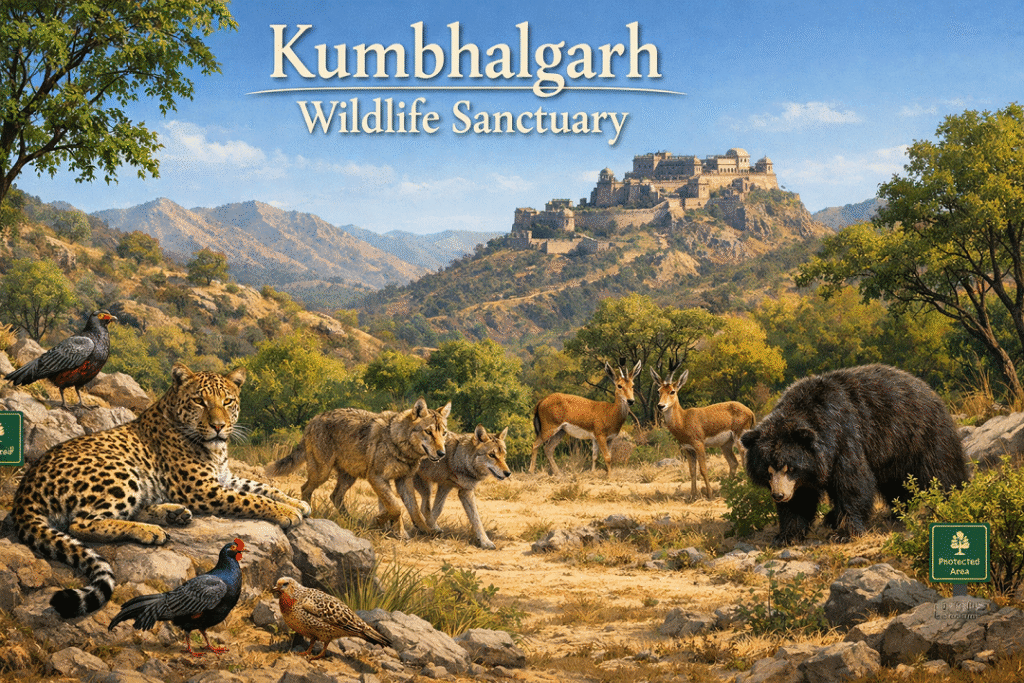
Kumbhalgarh Wildlife Sanctuary is a designated conservation area recognised for its dry deciduous vegetation, diverse wildlife, and its close association with the historic Kumbhalgarh Fort, a site of immense cultural and ecological value.
Geographical Setting and Coverage
Situated in Rajasthan, the sanctuary extends across Rajsamand, Udaipur, and Pali districts. It forms a vital component of the Aravalli range in western India and spans an area of nearly 610.5 square kilometres, encompassing both core protected areas and peripheral buffer regions.
Physical Landscape and Ecology
The sanctuary’s elevation ranges between 500 and 1,300 metres, covering four prominent Aravalli sub-ranges—Kumbhalgarh, Sadri, Desuri, and Bokhada. The region is underlain by ancient Archean metamorphic formations with shallow sandy-loam soils. Ecologically, it is part of the Khathiar–Gir dry deciduous forest zone, characterised by scrub vegetation, open grasslands, and mixed woodland ecosystems.
Flora and Faunal Diversity
The area supports a wide array of wildlife, with the leopard occupying the position of the top carnivore. Other key mammalian species include the Indian wolf, sloth bear, striped hyena, jungle cat, golden jackal, sambhar, nilgai, four-horned antelope (chausingha), chinkara, Indian hare, and Indian pangolin.
Birdlife is represented by species such as the grey junglefowl, painted francolin, and Indian eagle-owl.
Reptiles and aquatic species include the Indian cobra, rat snake, checkered keelback, along with fish like mahseer, rohu, and catla.
Conservation Value and ESZ Implications
The sanctuary serves as a key ecological corridor within the Aravalli landscape, supporting biodiversity conservation and wildlife movement. The designation of an Eco-Sensitive Zone of 0–1 km around the sanctuary is intended to control unregulated development, limit ecologically damaging activities, and reduce pressure on natural habitats, thereby strengthening long-term conservation outcomes.
Source : News on Air