
Green Transition of MSMEs: A Strategic Roadmap for Sustainable Growth
Context
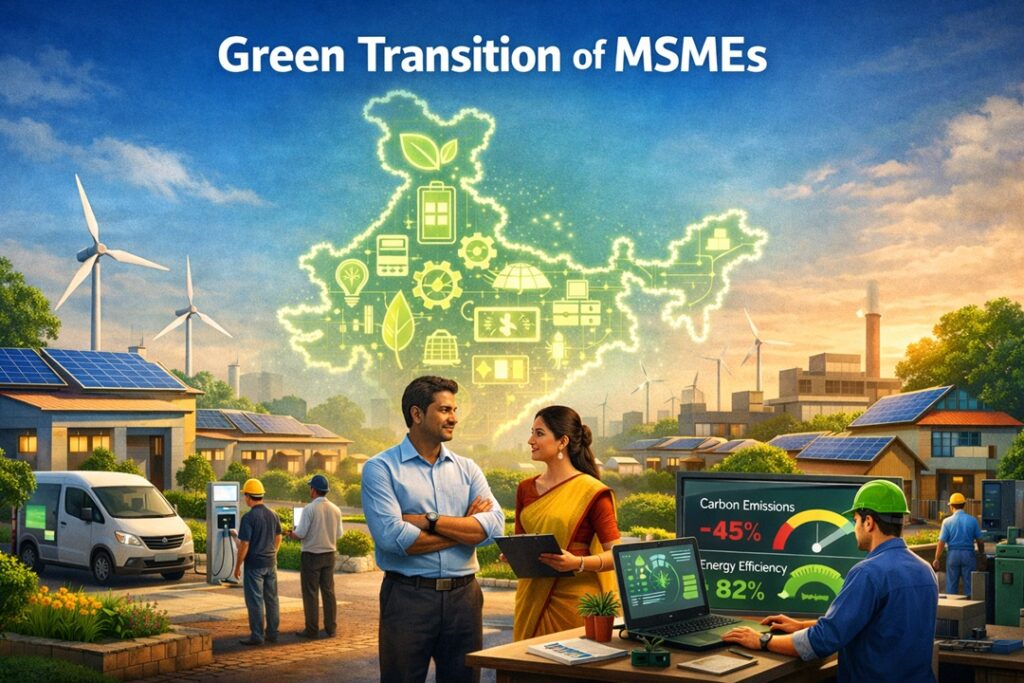
- NITI Aayog unveiled a comprehensive report titled “Roadmap for Green Transition of MSMEs”, along with decarbonisation pathways for emission-intensive sectors such as cement and aluminium.
- Strategic Alignment: The initiative complements Viksit Bharat 2047 and reinforces India’s pledge to attain net-zero emissions by 2070.
Framework Overview: Green Transition Roadmap
- Scope: A decade-long strategic blueprint aimed at enabling nearly 69 million MSMEs to shift towards environmentally sustainable and low-emission operations.
- Core Transition Pillars:
- Enhanced Energy Efficiency
- Adoption of Clean Power
- Use of Low-Carbon and Alternative Fuels
- Implementation Architecture: Recommends a centralized National Project Management Agency (NPMA) to coordinate cluster-level execution, aggregate demand, and channel financial incentives.
Structural Profile of the MSME Sector
- Macroeconomic Role: Accounts for around 30% of national GDP and nearly 45.7% of merchandise exports.
- Employment Contribution: Supports livelihoods of over 250 million individuals, making it the second-largest employer after agriculture.
- Carbon Impact: Generated approximately 135 million tonnes of CO₂e in 2022, driven largely by fossil-fuel-intensive processes.
- Energy Consumption: Responsible for more than one-fourth of total industrial energy usage.
- Cluster-Based Operations: Spread across 140+ industrial clusters, with certain clusters contributing up to 80% of national production in specific commodities.
Rationale for Decarbonising MSMEs
- Export Competitiveness: Compliance with global environmental norms is critical for sustaining access to foreign markets.
- Example: The EU’s Carbon Border Adjustment Mechanism (CBAM) from 2026 will penalize carbon-intensive exports.
- Adaptation to Climate Risks: MSMEs face disproportionate exposure to extreme weather events.
- Example: Cyclone Michaung (2023) disrupted around 4,800 MSME units in Tamil Nadu, causing losses worth ~$360 million.
- Cost Efficiency Over Time: Cleaner technologies reduce long-term operating expenses.
- Example: Most green investments recover costs within 1–5 years.
- Evolving Regulatory Landscape: Sustainability disclosures are increasingly mandatory.
- Example: BRSR norms now require leading firms to account for value-chain (Scope-3) emissions.
- National Energy Transition Goals: MSME participation is vital to achieve 500 GW renewable capacity by 2030.
- Example: MSME energy demand is expected to grow by 50% by 2030, necessitating cleaner growth pathways.
Policy Measures Supporting Green Adoption
- ADEETIE Programme: Encourages energy-efficient upgrades via interest subsidies and technical assistance.
- GIFT Initiative: Provides low-cost institutional finance for green infrastructure and clean mobility.
- SPICE Programme: Promotes circular economy adoption in plastics, electronics, and allied sectors.
- ZED Certification Scheme: Advocates quality-driven production with minimal ecological footprint.
- PM Surya Ghar Muft Bijli Yojana: The roadmap suggests extending rooftop solar incentives to micro and small enterprises.
Bottlenecks in the Transition Process
- Credit Constraints: Limited collateral and perceived risk restrict access to affordable green finance.
- Example: MSMEs often face higher interest rates due to weak credit histories.
- Knowledge Deficit: Low awareness of clean technologies and carbon accounting tools.
- Example: Only 4% of small enterprises track their emissions.
- Dispersed Production Systems: Informality and fragmentation hinder standardized solutions.
- Example: Brick kilns and foundries struggle with assured clean fuel supply.
- Capital-Intensive Investments: Initial costs exceed the financial capacity of micro-units.
- Example: Rooftop solar systems demand high upfront investment.
- Institutional Trust Issues: Hesitation in engaging with ESCOs and innovative financing models.
- Example: Pay-as-you-save mechanisms remain underutilized due to low awareness.
Strategic Recommendations
- Activate NPMA: Ensure professional cluster management and efficient subsidy deployment.
- Collective Procurement Models: Aggregate MSME demand to lower technology acquisition costs.
- Climate Sister Impact Fund (CSIF): Establish blended finance instruments for early-stage green technologies.
- Uniform MRV Systems: Introduce simplified tools for emissions tracking and certification.
- Regulatory Impact Scrutiny: Institutionalize RIA mechanisms to safeguard MSMEs from excessive compliance costs.
Closing Assessment
- The green transformation of MSMEs has become a strategic imperative rather than a voluntary choice.
- With focused financial instruments, institutional coordination, and technology diffusion—anchored by the NPMA framework—India can enable MSMEs to spearhead a just and inclusive green industrial transition.
- Effective implementation will ensure that MSMEs continue to serve as the foundation of a competitive, climate-resilient, and Viksit Bharat by 2047.
Source : PIB