
Managing India’s Groundwater: From Extraction to Sustainability
Context
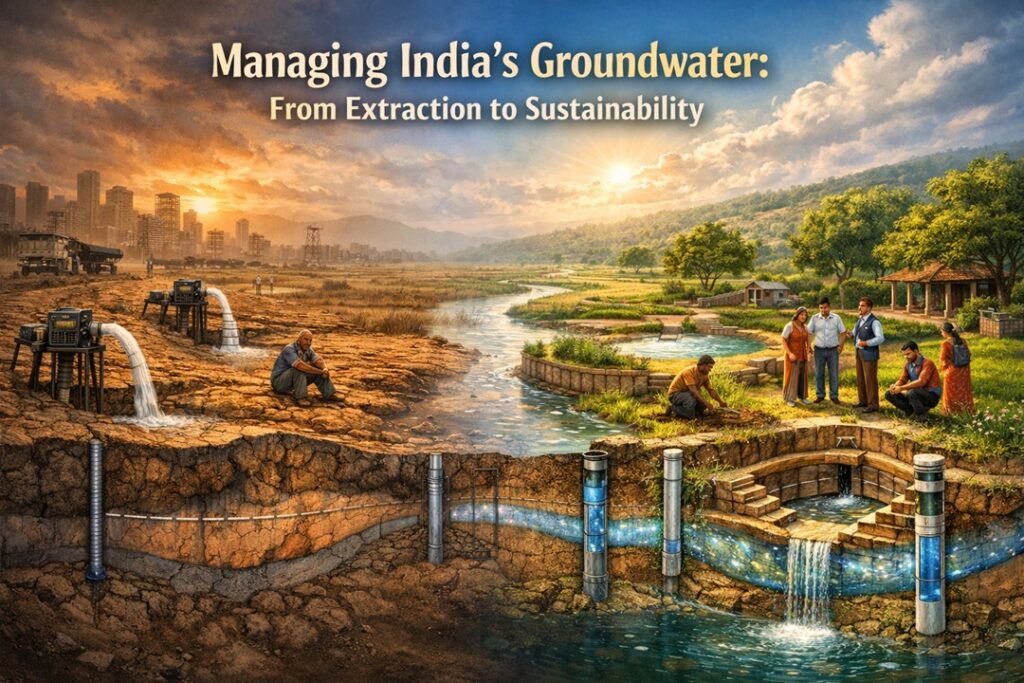
India is advancing a comprehensive groundwater governance framework that integrates regulatory reforms, scientific mapping, monitoring infrastructure, and community participation. Flagship initiatives such as Atal Bhujal Yojana, Jal Shakti Abhiyan, and NAQUIM reflect the country’s commitment to long-term water security, climate resilience, and alignment with the Sustainable Development Goals (SDGs).
Understanding the Importance of Groundwater
Concept: Groundwater refers to freshwater stored beneath the Earth’s surface within soil and rock formations, accessed through wells and springs.
Ecological Significance: It sustains river flows during lean seasons, supports wetlands, and maintains ecosystem stability.
Aquifer Systems: Aquifers are permeable geological layers capable of storing and transmitting groundwater in usable quantities.
Global Perspective: Nearly 99% of the planet’s liquid freshwater exists as groundwater, making it a critical buffer against climate variability.
Indian Scenario:
- Supports over 60% of irrigation
- Supplies around 85% of rural drinking water
- Meets nearly half of urban water demand
Stress Factors Affecting Groundwater Resources
Demographic Pressure: Rising population and rapid urbanisation increase freshwater demand.
Agricultural Dependence: Water-intensive crops and subsidised electricity encourage over-extraction.
Industrial Growth: Expansion of industrial clusters adds pressure on aquifers.
Unregulated Withdrawal: Easy access to drilling and pumping technologies enables indiscriminate extraction.
Framework of Groundwater Governance
Core Dimensions
Utilisation Patterns: Domestic, agricultural, and industrial abstraction.
Emerging Challenges: Falling water tables and deterioration in water quality.
Corrective Strategies:
- Demand Management: Efficient irrigation, crop diversification
- Supply Augmentation: Artificial recharge and water conservation
Strategic Objectives
Recharge Protection: Safeguarding natural replenishment processes.
Environmental Safeguards: Protecting aquifer-dependent ecosystems.
Risk Preparedness: Maintaining groundwater reserves for drought resilience.
Quality Assurance: Aligning groundwater use with its chemical suitability.
Key Public Interventions and Policy Measures
Groundwater Regulation Framework:
A model legal framework promotes regulated and sustainable groundwater extraction and has been adopted by several States and UTs.
Nationwide Water Conservation Campaign:
Jal Shakti Abhiyan – Catch the Rain emphasises rainwater harvesting, afforestation, and community awareness.
Participatory Recharge Initiative:
Jal Sanchay Jan Bhagidari focuses on people’s participation in aquifer and borewell recharge measures.
Scientific Mapping Programme:
National Aquifer Mapping and Management Programme (NAQUIM 2.0) provides high-resolution, location-specific groundwater data to support decentralised planning.
Recharge Infrastructure Planning:
The Master Plan for Artificial Recharge to Groundwater (2020) promotes terrain-specific recharge methods aligned with aquifer capacity.
Community-Centric Scheme:
Atal Bhujal Yojana encourages behavioural change and demand-side management in water-stressed regions.
Water Body Revival Mission:
Mission Amrit Sarovar focuses on rejuvenating ponds and traditional water bodies to enhance groundwater recharge.
Monitoring and Knowledge Support:
- Nationwide network of groundwater monitoring stations
- Jal Shakti Kendras as district-level technical and awareness hubs
Why India Needs Robust Groundwater Management
Regional Variability: Availability and quality of groundwater vary widely across regions.
Declining Water Tables: Excessive withdrawal has resulted in alarming depletion in several states.
Quality Concerns: Pollution from agriculture, industry, and geogenic contaminants threatens public health.
Technological Drivers: Affordable pumps and borewells have enabled unchecked private extraction.
Climate Commitments: Sustainable groundwater use is central to India’s climate adaptation goals.
Development Linkages: Effective management supports SDG 6, SDG 11, and SDG 12.
Future Outlook
Integrated Governance Model: India is moving towards a holistic approach combining policy reform, science-based planning, infrastructure development, and community participation.
Institutional Strengthening: Enhanced monitoring networks, data systems, and decentralised knowledge platforms improve decision-making.
Way Forward: These reforms mark a transition towards science-driven, participatory, and outcome-oriented groundwater governance, ensuring long-term sustainability and water security.
Source : PIB