
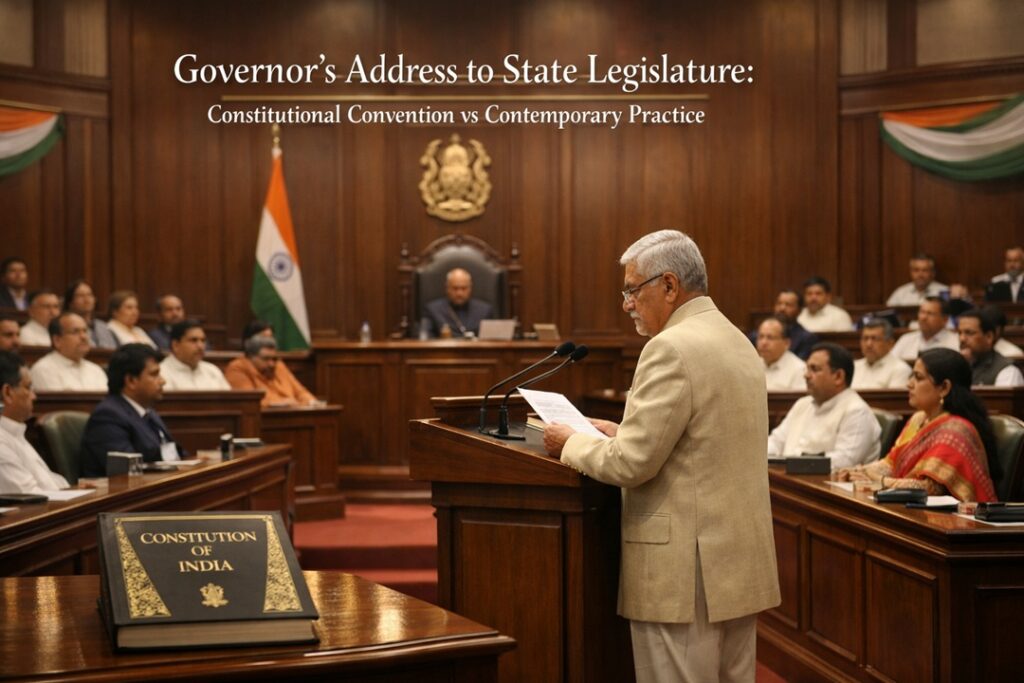
Governor’s Address to State Legislature: Constitutional Convention vs Contemporary Practice
Context
Multiple Opposition-governed States have recently reported confrontations between Governors and elected governments over the delivery of the annual address to the State Legislature at the start of the legislative year.
Understanding the Office of the Governor
Constitutional Position – The Governor serves as the formal head of the State, exercising executive authority in a manner comparable to the President at the Union level.
Mode of Appointment – Appointed by the President for a five-year tenure; normally functions on the advice of the State Council of Ministers, though certain discretionary powers exist.
Role in Legislative Openings – The Governor traditionally inaugurates specific sessions of the Legislature by delivering a formal address.
Nature and Purpose of the Annual Address
Meaning – A ceremonial yet constitutionally significant speech presented at the beginning of select legislative sessions.
Authorship – Drafted by the elected government and approved by the Cabinet.
Character – Represents the vision, policies, and priorities of the government, not the individual opinions of the Governor.
Constitutional Convention – The Governor is expected to read the address in full without modification.
Evolution of the Practice
Colonial Origins – Under the Government of India Act, 1935, Governors were empowered to address provincial legislatures.
Post-1937 Development – With provincial autonomy, addresses began reflecting ministerial advice.
Constitutional Continuity – Constituent Assembly debates affirmed that the address should mirror the policy stance of the Council of Ministers.
Relevant Constitutional Articles
Article 175 – Permits the Governor to address the Legislature at any time.
Article 176 – Mandates an address:
- At the first session after Assembly elections, and
- At the first session of every year.
Substance – Review of past performance and outline of forthcoming policy agenda.
Legislative Follow-Up Mechanism
Discussion Mandate – Rules of procedure require time allocation for deliberation on the address.
Motion of Thanks – House debates and votes on the government’s policy statement.
Judicial Interpretation
Shamsher Singh Case (1974) – Governor is bound by ministerial advice.
Nabam Rebia Case (2016) – Articles 175 and 176 functions must be exercised on aid and advice of the Council of Ministers.
Recent Flashpoints
Tamil Nadu – Governor omitted sections and later declined to deliver the annual address.
Kerala – Portions of Cabinet-approved speech were skipped.
Karnataka – Governor refused to read the prepared text and exited after a brief statement.
Constitutional and Legal Concerns
Oath under Article 159 – Obligation to uphold the Constitution.
Implication – Selective reading or refusal to deliver the address breaches constitutional morality.
Implications for Federal Balance
Centre–State Trust Deficit – Tensions deepen when Governors appear aligned with Union political interests.
Threat to Cooperative Federalism – Actions perceived as encroaching upon State executive authority.
Office Under Scrutiny – Renewed debate on reforming the institution of Governor.
Possible Way Forward
Consultative Appointments – Prior consultation with Chief Ministers as suggested by Sarkaria and Punchhi Commissions.
Norm Reinforcement – Clear reiteration of constitutional conventions through parliamentary or judicial guidance.
Outcome – Reduced institutional confrontation and smoother legislative functioning.
Source : The Hindu