
New Additions to India’s Ramsar Sites List
Context
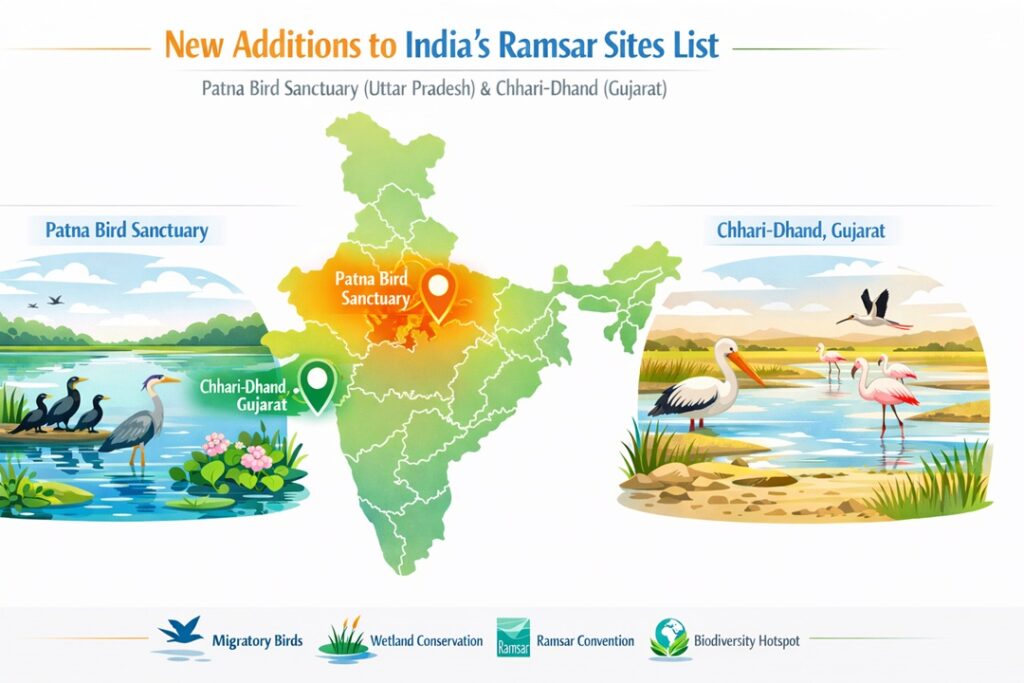
The Prime Minister recently acknowledged the inclusion of Patna Bird Sanctuary (Uttar Pradesh) and Chhari-Dhand (Gujarat) as new Wetlands of International Importance under the Ramsar framework.
Geographical Setting
• Patna Bird Sanctuary – Etah district, Uttar Pradesh
• Chhari-Dhand – Kutch district, Gujarat
Major Takeaways
• Ecological Importance: Both wetlands provide critical refuge and breeding grounds for migratory as well as resident fauna.
• Scale of Expansion: India’s Ramsar sites increased from 26 in 2014 to 98 in 2026 (over 276% growth).
• Regional Leadership: India ranks first in Asia in terms of number of Ramsar-designated wetlands.
Patna Bird Sanctuary (Uttar Pradesh)
Ecosystem Type – Freshwater wetland with a lacustrine (lake) ecosystem.
Floral Features – Seasonal proliferation of aquatic macrophytes such as water hyacinth and Potamogeton.
Faunal Diversity – Supports pied mynas, herons, cormorants, ducks and geese; key waterfowl include Lesser Whistling Duck, Graylag Goose, Comb Duck, Ruddy Shelduck, Gadwall, Eurasian Wigeon, Indian Spot-billed Duck, Northern Shoveler and Northern Pintail.
Special Attribute – Smallest notified bird sanctuary in Uttar Pradesh.
Chhari-Dhand (Gujarat)
Landscape Character – Seasonal desert wetland located between Banni grasslands and the saline flats of the Rann of Kutch.
Water Regime – Transforms into a marshy expanse during monsoon; nourished by north-flowing streams and surrounding hill catchments.
Wildlife Richness – Habitat for threatened birds such as Dalmatian Pelican, Oriental Darter, Black-necked Stork and Indian Skimmer; also home to chinkara, wolf, caracal, desert cat and desert fox.
Ecological Value – Transitional zone between grassland and salt desert ecosystems; prominent birding hotspot.
Ramsar Framework
Concept – Ramsar site denotes a wetland recognized for international significance under the Ramsar Convention.
Origin – Adopted in 1971 at Ramsar (Iran); operational since 1975.
Distinctiveness – Only global treaty focused exclusively on wetlands.
Wetland Scope – Includes marshes, fens, peatlands and waters (natural/artificial; permanent/temporary; fresh/brackish/saline), along with shallow marine waters up to 6 m depth at low tide.
India’s Status – Party to the Convention since 1981.
National Interpretation – Wetlands Rules, 2017 exclude river channels, paddy fields and areas under commercial use.
Institutional Position – Independent of the UN system of Multilateral Environmental Agreements.
Commemoration – 2 February observed annually as World Wetlands Day.
Source : PIB