
Strengthening India’s Seed Quality Assurance Framework
Context
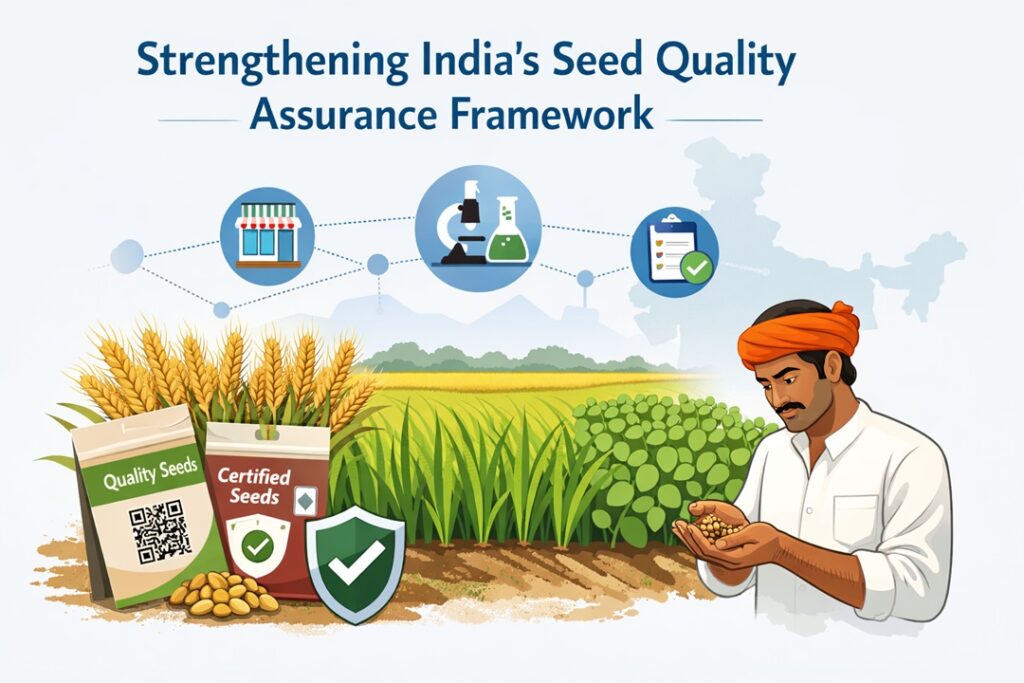
The Union Government has informed the Rajya Sabha about a comprehensive regulatory and institutional framework aimed at improving seed quality, eliminating spurious and sub-standard seeds, and safeguarding farmers’ rights across the country.
Purpose
To ensure quality assurance in seeds, curb the circulation of counterfeit products, and protect farmers’ entitlements, including the conservation of indigenous and traditional seed varieties.
Strategic Focus Areas
- Regulatory Vigilance: Enhancing monitoring and enforcement to detect and deter fake seed networks.
- Supply Chain Transparency: Leveraging digital platforms for traceability of seeds.
- Farmer Protection: Securing customary rights related to farm-saved seeds.
- Economic Access: Promoting availability of certified seeds at affordable prices.
Major Policy Interventions
Regulatory Oversight & Compliance:
- Inspection Powers: State Governments are authorised to appoint Seed Inspection Officers for outlet inspections and sample testing.
- Punitive Measures: Provisions for licence suspension or cancellation, seizure of stocks, stop-sale orders, and prosecution of violators.
Technology-enabled Monitoring:
- SATHI Digital Platform: The Seed Authentication, Traceability and Holistic Inventory system provides end-to-end digital monitoring of the seed supply chain to prevent adulteration and duplication.
Farmer-Centric Safeguards:
- Farm-saved Seed Rights: Farmers may save, reuse, exchange, share, or sell their own farm-saved seeds without restriction.
Conservation of Indigenous Varieties:
- Legal Backing: Protection ensured under the Protection of Plant Varieties and Farmers’ Rights Act, 2001 and the Biological Diversity Act, 2002.
Institutional and Financial Support
Assistance under Food and Nutrition Security Programmes:
- Seed Cost Support: Distribution of seeds at a 50% subsidised rate.
- Production-linked Incentives:
- ₹1,000 per quintal for cereals and millets
- ₹2,000 per quintal for pulses and oilseeds
- Community Seed Banks: One-time financial assistance of ₹50 lakh for establishment and strengthening.
Intellectual Property & Recognition:
- Variety Registration: Farmers’ seed varieties eligible for intellectual property protection.
- Awards and Incentives: Plant Genome Saviour Awards and farmer recognition programmes.
- Financial Assistance: Up to ₹15 lakh from the National Gene Fund for conservation of traditional varieties.
Market Regulation Framework
Seed Trade Governance:
- Dealer Licensing: Mandatory licensing of seed dealers under the Seeds (Control) Order, 1983.
- Nursery Oversight: Regulation of horticulture nurseries under respective State Nursery Acts.
Cotton Seed Price Regulation:
- Price Control Mechanism: Annual fixation of maximum sale prices of Bt cotton seeds under the Cotton Seeds Price (Control) Order, 2015 through the Essential Commodities Act, 1955.
Research, Innovation and Outreach
Capacity Building:
- Financial Support: Assistance to ICAR institutes, State Agricultural Universities, and public sector entities for seed research and infrastructure development.
Varietal Development:
- New Seed Releases: From 2014 to 2025–26, over 3,000 seed varieties have been released, including nearly 3,000 climate-resilient varieties.
Ensuring Seed Availability:
- Government Schemes: Support for breeder seeds, quality seed distribution, and free seed minikits under:
- National Food Security and Nutrition Mission
- National Mission on Edible Oils – Oilseeds
- Rashtriya Krishi Vikas Yojana
Source : PIB