
Global Climate Governance after COP30: Between Collective Intent and Policy Deficit
Context
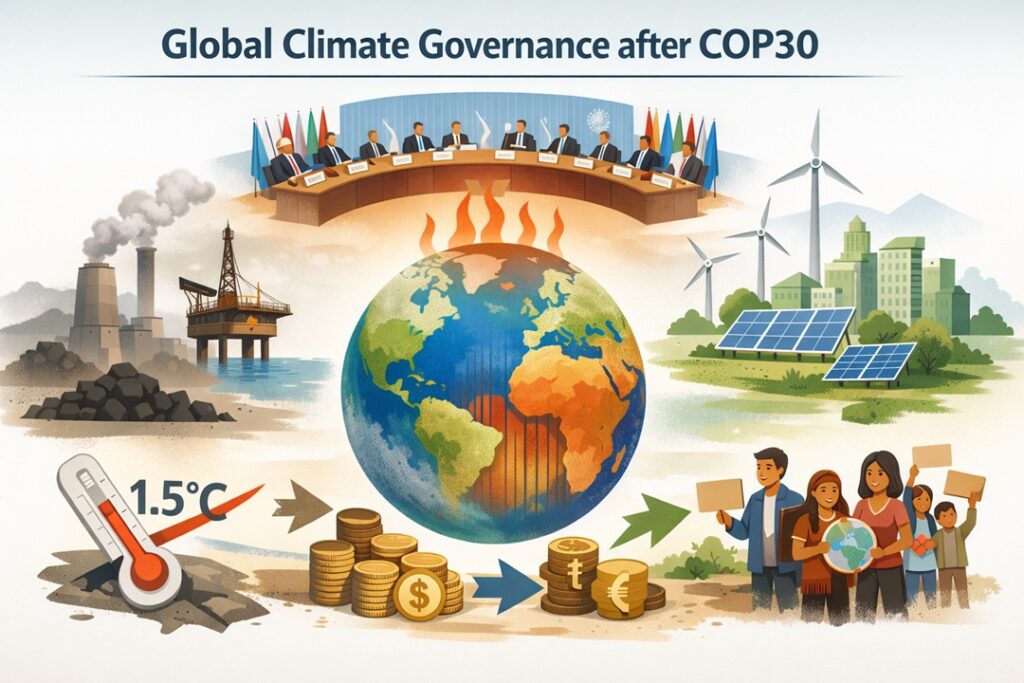
The narrative of international climate cooperation underwent recalibration following COP30 held in Belém, Brazil, promoted under the banner of Global Mutirão—a collective, society-wide response to climate change. Despite the inclusive framing, the summit faced criticism for normalising a temporary breach of the 1.5°C limit and avoiding firm commitments on fossil-fuel exit and assured climate finance.
Understanding Climate Action Governance
Conceptual Basis:
Climate action governance encompasses the global and national mechanisms—treaties, policy instruments, financial arrangements, and institutions—that guide mitigation of emissions and adaptation to climate risks under platforms such as the UN climate regime.
How the Global Climate System Functions Today
Parallel Legal Tracks:
The current regime operates through two overlapping arrangements—the Kyoto legacy framework and the Paris Agreement—ensuring continuity in negotiations but lacking enforceable closure on emission reductions.
Decision-Making Bottlenecks:
Unanimity-based approvals allow even a single dissenting country to stall outcomes, leading to compromise-heavy texts that dilute scientific urgency.
Collective Action Orientation:
The Global Mutirão approach prioritises voluntary participation by communities, civil society, indigenous groups, and youth, shifting emphasis away from binding state-led mandates.
Accountability Mechanisms:
The expanded transparency architecture seeks to improve monitoring through enhanced reporting standards and peer review of national climate pledges.
Key Numbers and Trends
Emission Surge:
Global emissions touched 57.4 GtCO₂e in 2024, with emerging economies accounting for a significant share of incremental growth.
Funding Mismatch:
While adaptation finance promises stand at $120 billion annually by 2035, actual needs in the Global South exceed $2 trillion per year.
Warming Outlook:
If current commitments persist, global temperatures are projected to rise by nearly 2.8°C this century.
Adaptation Underspend:
Only $32 billion was channelled toward adaptation in 2022, leaving climate-vulnerable regions exposed.
Structural and Policy Constraints
Execution Gaps:
Targets often outpace on-ground capacity and financing clarity.
Illustration: Delays in renewable energy deployment due to grid and contractual limitations.
Development Pressures:
Economic and strategic priorities frequently clash with ecological safeguards.
Illustration: Infrastructure approvals in ecologically sensitive regions.
Energy Transition Rigidity:
Dependence on coal for baseload electricity constrains rapid energy shifts.
Urban Fragility:
Poorly planned urban growth intensifies heat stress and flood exposure.
Policy Myopia:
Climate impacts are frequently treated as episodic disasters rather than governance failures.
Recent Policy and Institutional Responses
Forest Conservation Incentives:
Proposal of a large-scale global fund to reward countries for conserving natural forests.
Decentralised Clean Energy Push:
National programmes promoting rooftop solar to reduce emissions and expand energy access.
Climate Damage Support:
Operationalisation of a global fund to assist nations facing irreversible climate losses.
Implementation Support Platforms:
Voluntary mechanisms providing technical assistance to align domestic policies with climate goals.
Strategic Priorities Ahead
From Voluntary to Mandatory:
Shift toward enforceable, time-bound transition pathways for high-emission sectors.
Financial System Reorientation:
Restructure multilateral finance to deliver affordable, long-term climate funding.
Localising Climate Action:
Strengthen the role of states and urban local bodies in adaptation planning.
Ecosystem-Based Adaptation:
Mainstream nature-based solutions in infrastructure and urban development.
Risk Protection Instruments:
Expand climate insurance coverage for vulnerable populations.
Closing Assessment
Global climate governance continues to display a widening gap between ambition and outcomes. While collective platforms such as Global Mutirão underline the importance of shared responsibility, voluntary cooperation alone remains inadequate. As climate thresholds draw nearer, the emphasis must shift decisively toward enforceable commitments, scaled-up finance, and robust protection of critical ecosystems.
Source : The Hindu