
India’s Chairmanship of the Kimberley Process (2026): Reforming Global Diamond Governance
Context
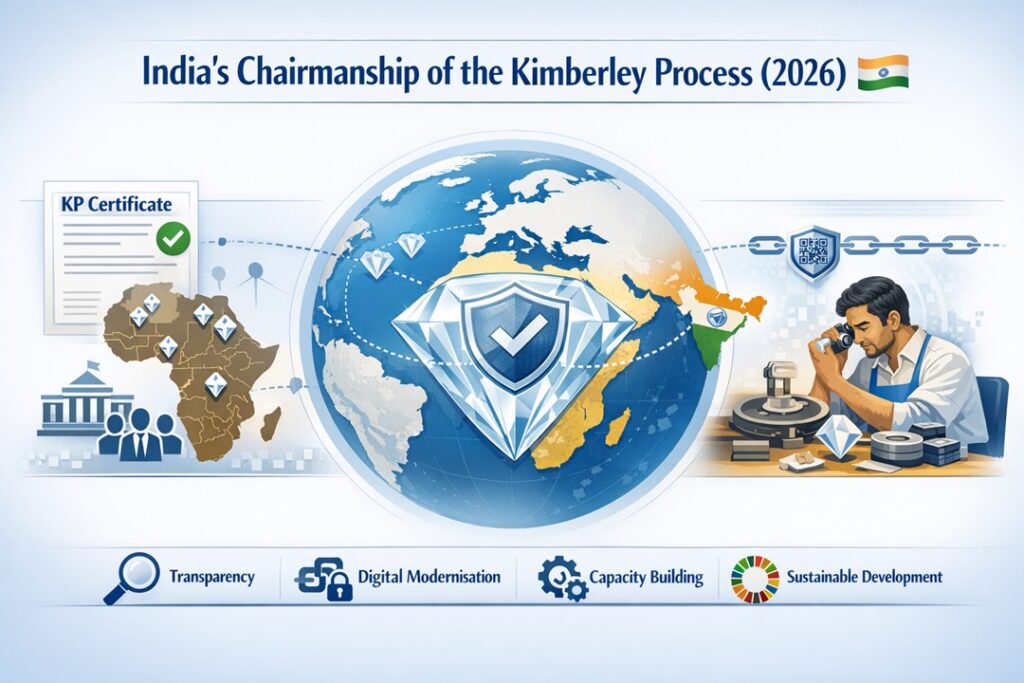
India has assumed the presidency of the Kimberley Process (KP) for 2026, marking its third term in this role. The development comes at a time when global debates on responsible sourcing, human rights compliance, and transparency in the diamond trade are intensifying.
Evolution of the Kimberley Process Mechanism
Background: The Kimberley Process was launched in 2000 to curb the trade in conflict diamonds that financed armed insurgencies.
Certification Architecture: The Kimberley Process Certification Scheme (KPCS), operational since 2003, mandates that every shipment of rough diamonds must carry a validated KP certificate.
Membership Structure: It comprises 60 participants representing 80 countries, with the European Union counted as a single participant.
Regulatory Coverage: The mechanism governs nearly 99.8% of global rough diamond production.
Nodal Implementation (India): The Gem & Jewellery Export Promotion Council (GJEPC) serves as India’s implementing authority under KP.
Operational Framework of the Certification System
Closed Trade Network: Trade in rough diamonds is permitted only between certified KP participants.
National Responsibility: Each member country enforces compliance domestically and verifies the legitimacy of diamond consignments.
Statistical Transparency: Participants are obligated to share periodic data on production and trade flows to maintain accountability.
Supply Chain Integrity: The certification system aims to prevent the entry of illicit diamonds into the formal global market.
India’s Strategic Significance in the Diamond Economy
Production Concentration: Major producers such as Angola, Botswana, Canada, Congo, Namibia, and Russia account for over 85% of global rough diamond output.
Import Dominance: India accounts for nearly 40% of global rough diamond imports in both quantity and value terms.
Processing Hub: India is the world’s largest centre for diamond cutting and polishing, primarily concentrated in Surat and Mumbai.
Export Network: Polished diamonds are re-exported to key destinations including China, Hong Kong, Israel, UAE, and the United States.
Diplomatic Leverage: India’s pivotal role in the diamond value chain strengthens its ability to influence governance reforms within KP.
Structural Gaps in the Existing KP Regime
Narrow Conflict Definition: The current definition limits “conflict diamonds” to those financing rebel movements, excluding state-linked abuses and broader human rights violations.
Consensus-Based Constraints: The unanimity-based decision-making model allows individual participants to block critical actions.
Civil Society Critique: Concerns persist regarding inadequate attention to environmental damage, labour exploitation, and community-level violence.
Central African Republic Experience: Reform Lessons
Case Reference: The Central African Republic was suspended from diamond exports in 2013 and re-admitted in 2024.
Policy Implication: Prolonged trade bans without developmental assistance may fuel smuggling and worsen insecurity.
Balanced Approach: Reform efforts must integrate enforcement with capacity-building and community safeguards.
Reform Priorities under India’s 2026 Leadership
Broadening the Mandate: India may initiate technical discussions on expanding KP’s scope to include human rights and community protection concerns.
Digital Transformation: Introduction of secure, tamper-proof digital certificates and blockchain-enabled traceability systems to enhance transparency.
Capacity Enhancement: Establish technical support hubs in African producing regions for certification training, IT systems, and forensic verification.
Governance Improvements: Promote independent audits and greater public disclosure of granular statistical data.
Tripartite Engagement: Reinforce collaboration among governments, industry stakeholders, and civil society actors.
Strengthening India–Africa Partnership within KP
Livelihood Emphasis: Recognise diamond mining as a critical source of employment and income in African economies.
SDG Alignment: Align KP objectives with Sustainable Development Goals such as poverty alleviation, decent work, and responsible production.
Development Financing: Advocate channeling diamond revenues toward healthcare, education, and infrastructure in mining regions.
Narrative Shift: Transition KP’s focus from restrictive trade control to enabling a transparent, responsible, and inclusive diamond economy.
Way Forward
India’s chairmanship presents a strategic opportunity to modernise the Kimberley Process through inclusive reforms, technological innovation, and enhanced transparency. A calibrated approach balancing regulation with development can strengthen KP’s credibility and effectiveness in global diamond governance.
Source : The Hindu