
India Hosts UN Fellowship Programme on SALW Control in Asia-Pacific
Context
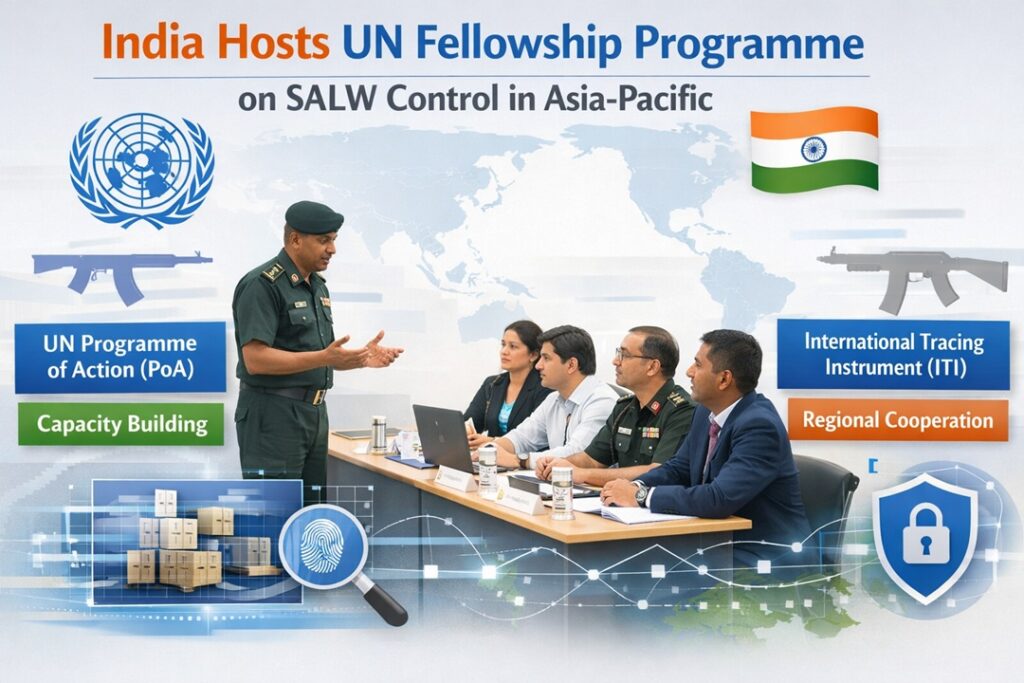
India has taken a significant step in global arms governance by hosting the United Nations Fellowship Training Programme on Small Arms and Light Weapons (SALW) Control for the Asia-Pacific region, becoming the first Asian country to host this programme.
Programme Overview
This is a three-week international training initiative aimed at enhancing the technical and policy capacity of government officials to prevent the illegal circulation, misuse, and diversion of small arms and light weapons.
International Mandate
The programme supports the implementation of global disarmament commitments, particularly under the UN Programme of Action (PoA) and the International Tracing Instrument (ITI).
National Role
The programme is hosted by the Indian Army at the Military College of Materials Management, Jabalpur, Madhya Pradesh.
Institutional Partners
- United Nations Office for Disarmament Affairs (UNODA)
- UN Regional Centre for Peace and Disarmament in Asia and the Pacific (UNRCPD)
Core Objectives
- Capacity Enhancement: Strengthen national institutions to fulfil obligations under UN arms control frameworks.
- Regional Synergy: Encourage cooperation and information-sharing among Asia-Pacific states.
- Technical Modernisation: Improve systems for weapons tracing, inventory control, and secure stockpile management.
- Illicit Trade Prevention: Minimise diversion of arms to terrorist groups and organised crime networks.
Programme Highlights
- Framework-Based Approach: Anchored in internationally accepted UN disarmament norms.
- Regional Participation: Delegates from 13 Asia-Pacific countries, promoting collective security.
- Skill-Oriented Training: Focus on tracing protocols, record maintenance, and safe storage practices.
- Trust in India: Reflects global confidence in India’s arms management and regulatory systems.
- Responsible Disposal: Exposure to India’s established mechanisms for safe and accountable arms disposal.
- Security Relevance: Addresses threats from terrorism, insurgency, and transnational crime linked to SALW proliferation.
Broader Importance
- Strategic Positioning: Enhances India’s role as a regional hub for defence and security training.
- Normative Alignment: Reinforces India’s commitment to responsible arms control and a rules-based international order.
Source : DD News