
India’s Humanitarian Assistance and Disaster Relief Framework
Context
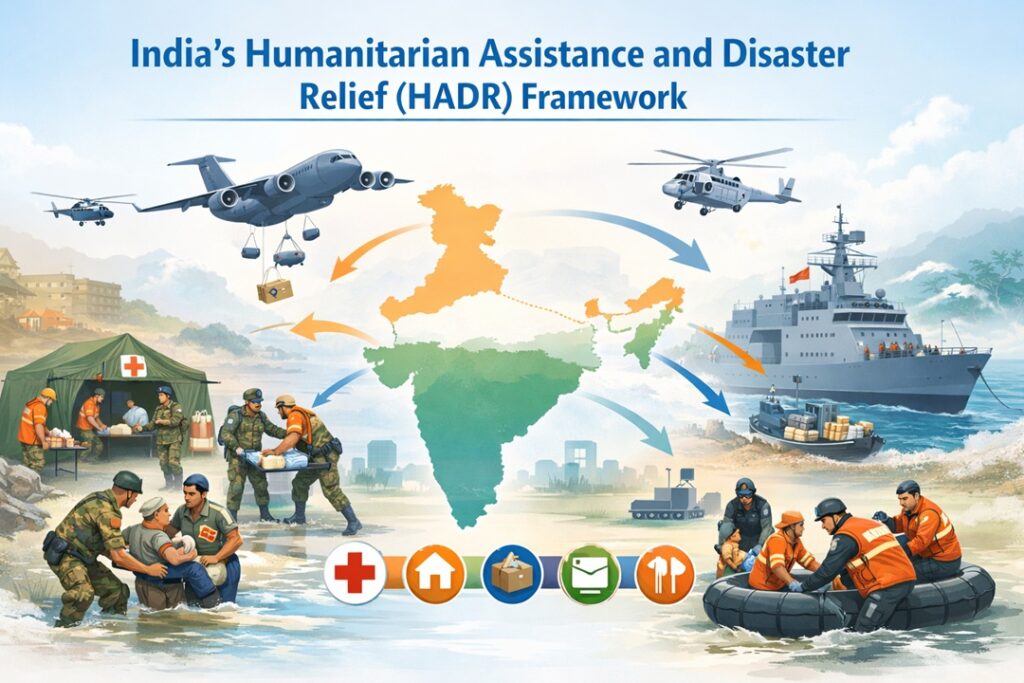
India’s growing engagement in Humanitarian Assistance and Disaster Relief (HADR) highlights its emergence as a dependable crisis responder at the regional and global levels. When civilian capacities are stretched, the Indian Armed Forces are deployed to reinforce disaster response efforts, both within the country and abroad.
Understanding HADR
Concept – Humanitarian Assistance and Disaster Relief refers to prompt and coordinated action by states, armed forces, and humanitarian agencies to mitigate loss of life and suffering arising from natural or human-induced disasters.
Operational Nature – It blends emergency response, diplomatic outreach, and military capabilities to deliver medical aid, evacuation, logistics, and restoration of essential services.
Indian Approach – India applies its institutional experience and operational readiness to ensure swift, organised, and effective disaster response domestically and internationally.
Human-Centric Orientation – Relief efforts prioritise protection of life, alleviation of distress, and preservation of human dignity in affected regions.
Contribution of India’s Armed Forces
Strategic Role – Due to rapid deployability, logistical strength, and capacity to function in adverse conditions, the Armed Forces serve as critical responders during emergencies.
Army’s Role – Conducts search and rescue, establishes temporary medical facilities, repairs infrastructure, and distributes relief supplies.
Naval Support – Facilitates overseas evacuation, transports humanitarian material, and deploys ships and aircraft for coastal and maritime relief.
Air Power – Ensures rapid movement of relief supplies, medical teams, and disaster responders through strategic and tactical airlift, along with evacuation missions.
Coast Guard Assistance – Responds to coastal disasters such as cyclones, tsunamis, flooding, and offshore emergencies, ensuring maritime safety.
Policy Foundations and Institutional Architecture
Systemic Framework – India’s disaster response architecture is anchored in robust policies and institutions enabling timely and coordinated action.
Operational Distinction – While international relief missions are referred to as HADR, domestic disaster response functions under a statutory mechanism.
Integrated Governance – Reflects a whole-of-government model involving defence, diplomacy, disaster management, and public health agencies.
Guiding Norms for Overseas Missions –
- Prime Minister’s 10-Point Disaster Risk Reduction Agenda
- NDMA’s International HADR Guidelines (2024)
Core Principles –
- Respect for sovereignty of affected states
- Compliance with humanitarian law and human rights
- Transparency and accountability
- Inclusive response (aligned with UNDRR Gender Action Plan, 2024)
- Armed Forces as operational enablers
- Use of emerging technologies (drones, AI forecasting)
Domestic Disaster Management Framework
Legal Backbone – Disaster Management Act, 2005.
Institutional Layers – National, State, and District levels through NDMA, SDMAs, and DDMAs.
Responsibility Matrix – States lead disaster response; the Union provides financial, logistical, and technical assistance.
Command Structure – National Crisis Management Committee under the Cabinet Secretary.
Nodal Authority – Ministry of Home Affairs.
Field Execution – District authorities through Incident Command Teams.
Civil–Military Interface – Statutory provision for Armed Forces’ deployment under Aid to Civil Authorities.
Preparedness and Capacity Building Priorities
Inter-Agency Coordination – Emphasis on cooperation among civil administration, Armed Forces, NDMA, NDRF, and sectoral ministries.
Operational Synergy – Enhances communication, interoperability, and joint planning.
Learning Ecosystem – Promotes exchange of best practices, joint exercises, and coordinated mobilisation.
Key HADR Interventions by India
Within India
2004 Indian Ocean Tsunami – Triggered comprehensive reforms; tri-service response and large-scale air operations.
Uttarakhand Disaster (2013) – Large-scale evacuation and relief missions.
Floods and Cyclones – J&K (2014), Kerala (2018), Cyclones Fani and Amphan.
Recent Responses (2023–25) – Tunnel rescue operations, glacial lake outburst response in Sikkim, flood relief, and mining accident rescues.
Beyond Borders
2004 Tsunami Relief – Maldives and Sri Lanka.
Nepal Earthquake (2015) – Emergency rescue and reconstruction assistance.
Afghanistan Evacuation (2021) – Protection of civilians and cultural assets.
Recent Missions – Ukraine, Türkiye–Syria, Sudan, Myanmar, Sri Lanka.
Joint Exercises – Regular tri-service and international exercises to enhance disaster response readiness.
Strategic Significance for India
Humanitarian Diplomacy – Strengthens India’s global image as a responsible and compassionate power.
Regional Leadership – Reinforces India’s position as a first responder in the Indian Ocean Region.
Geopolitical Balancing – Counters competing narratives of disaster diplomacy.
Neighbourhood Engagement – Builds trust and long-term partnerships with neighbouring countries.
Maritime Dimension – Integrates disaster response with regional maritime security objectives.
Future Trajectory
Enduring Commitment – India’s HADR strategy is aligned with its vision of cooperative regional security and global solidarity.
Institutional Strength – Armed Forces remain central to rapid and reliable crisis response.
Value-Based Outreach – Reinforces the principles of Neighbourhood First and Vasudhaiva Kutumbakam.
Regional Assurance – India continues to position itself as a dependable partner and first responder during humanitarian crises.
Source : PIB