
Strait of Hormuz: Renewed Military Signalling and Global Energy Concerns
Context
Iran’s elite military force has initiated a fresh phase of naval and missile exercises in the Strait of Hormuz, closely timed with renewed diplomatic engagement involving the United States.
The drills are projected as preparedness against evolving maritime security and military challenges in the region.
Geographical Setting of the Strait
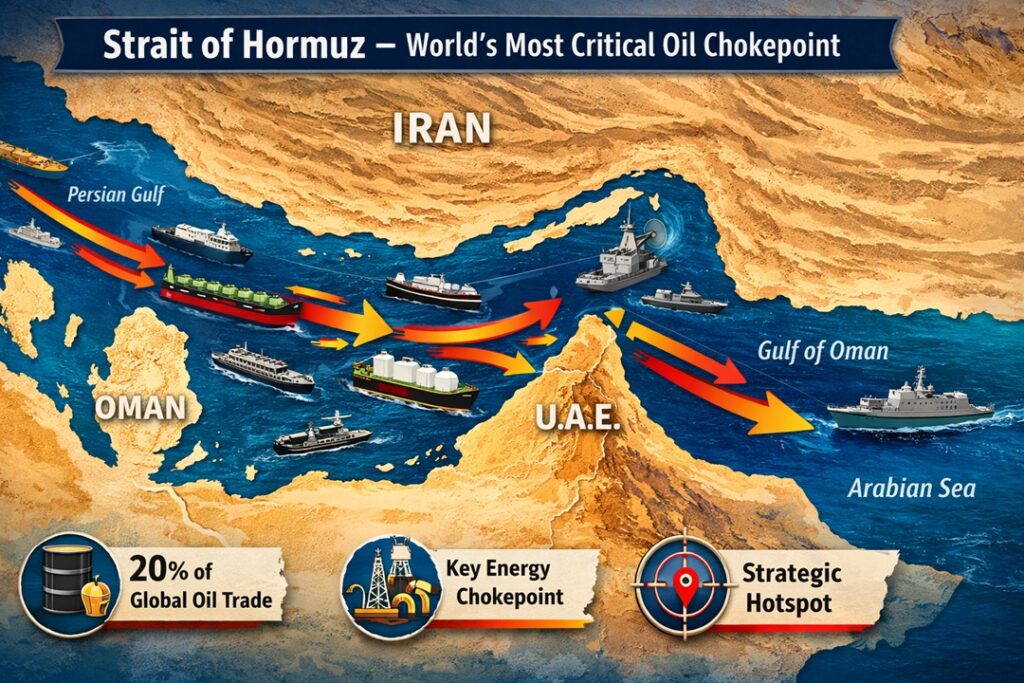
Physical Placement – The strait lies between Iran to the north and Oman–United Arab Emirates to the south.
Maritime Status – Portions of the strait fall within Iranian and Omani territorial waters.
Spatial Constraints – Narrowest width is around 33 km, with navigable shipping lanes of about 3 km in each direction.
Oceanic Linkages – It is the only maritime outlet connecting the Persian Gulf to the Gulf of Oman and the Arabian Sea.
Energy Artery of the World Economy
Hydrocarbon Transit – Large volumes of crude oil, petroleum products, and LNG pass through the strait every day.
Global Dependence – Nearly one-fifth of the world’s petroleum consumption relies on uninterrupted transit through this passage.
Export Corridor – Major Gulf producers, including key OPEC members, ship most of their exports via this route.
Gas Exports – LNG shipments from Qatar are overwhelmingly routed through Hormuz.
Chokepoint Risk – Even temporary disruptions can trigger sharp global energy price volatility.
Iran’s Strategic Calculus
Geopolitical Advantage – Iran’s northern coastline dominates the strait, placing international shipping close to its waters.
Pressure Lever – Narrow sea lanes allow Iran to exercise asymmetric influence during regional tensions.
Conflict History – The 1980s “Tanker War” illustrated the vulnerability of commercial shipping.
Deterrence Signalling – Threats of closure function primarily as strategic messaging rather than executed policy.
Self-Limiting Reality – A full blockade would damage Iran’s own exports and invite international military retaliation.
Consequences for the Global Economy
Systemic Importance – Stability in the strait is essential for global trade and energy security.
Cost Escalation – Military risks raise insurance premiums, freight rates, and shipping delays.
Inflationary Spillovers – Higher energy costs transmit inflation across economies.
Market Sensitivity – Oil prices often rise on perceived threats alone.
Asia at the Receiving End
Destination Concentration – Over 80% of crude and condensate transiting Hormuz is destined for Asia.
Key Dependents – China, India, Japan, and South Korea dominate these imports.
Economic Exposure – Sustained instability would directly affect growth and price stability in Asia.
India’s Strategic Vulnerability
Import Dependence – India sources a large share of its crude oil from Gulf suppliers using this route.
Domestic Impact – Any disruption raises fuel prices and inflationary pressures.
Macroeconomic Risks – Elevated energy costs strain fiscal balances and the current account.
Can the Strait Be Bypassed?
Alternate Routes – Saudi Arabia’s East-West pipeline and the UAE’s Fujairah pipeline offer partial bypass options.
Capacity Gap – These alternatives cannot substitute the full volume transiting Hormuz.
Structural Dependence – The strait remains irreplaceable for Gulf energy exports.
Current Strategic Signals
Military Messaging – Iran’s exercises coincide with heightened regional tensions and increased U.S. naval presence.
Diplomatic Undertone – Drills often serve as coercive signals during negotiations.
Economic Sensitivity – Even without escalation, global oil markets react sharply.
Global Fragility – In an already strained global system, Hormuz remains a critical vulnerability.
Way Forward
Enduring Significance – The Strait of Hormuz will continue to shape global energy security and geopolitics.
Indian Perspective – Developments here directly influence India’s energy costs, inflation trajectory, and economic stability, making it a persistent strategic concern.
Source : The Hindu