
Carbon Capture and Utilisation (CCU): Emerging Climate–Industry Interface
Context
Countries across the world are increasingly investing in technologies that capture carbon dioxide and convert it into value-added products.
These efforts have highlighted Carbon Capture and Utilisation (CCU) as a critical instrument for climate mitigation, industrial transition, and circular economy goals.
Understanding Carbon Capture and Utilisation
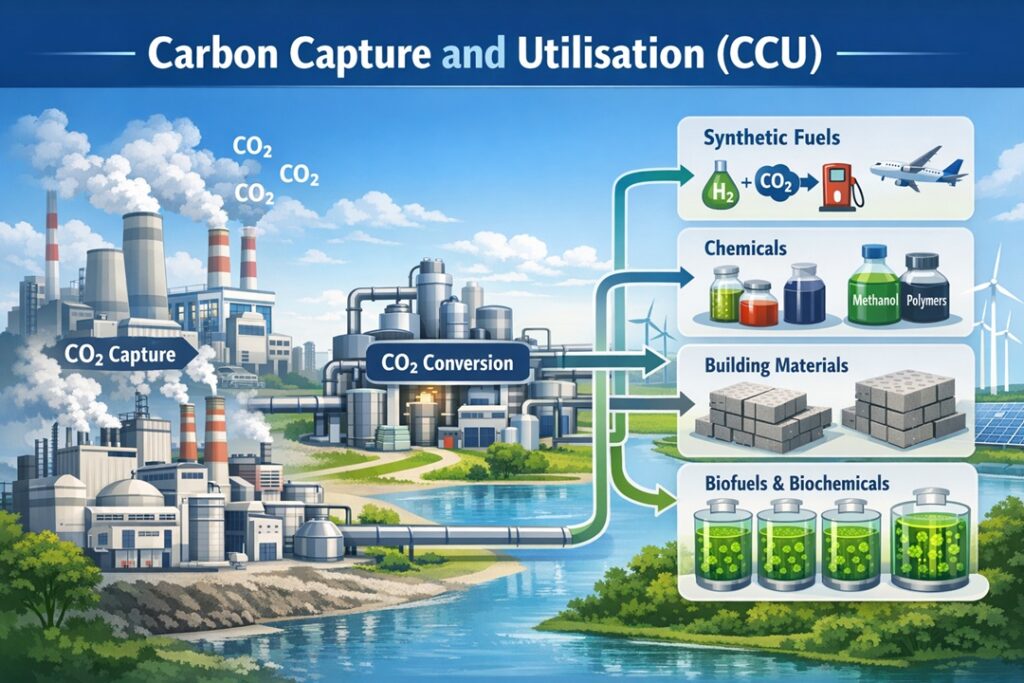
Concept – CCU refers to a suite of technologies that capture carbon dioxide from industrial emission sources or directly from ambient air and transform it into usable products.
Operational logic – Captured CO₂ is redirected into economic activities as an input for fuels, chemicals, construction materials, and polymers.
Key distinction – Unlike carbon capture and storage, which focuses on permanent underground sequestration, CCU prioritises reuse and value generation.
Major Routes of Carbon Utilisation
Chemical conversion – CO₂ is processed into industrial chemicals such as methanol, urea, and polymer intermediates.
Synthetic energy carriers – In combination with green hydrogen, captured CO₂ is used to produce e-fuels and sustainable aviation fuels.
Construction applications – Carbon mineralisation enables the incorporation of CO₂ into cement, concrete curing, and building materials.
Bio-based pathways – Biological systems, including microalgae, utilise CO₂ for the production of biofuels and bio-based chemicals.
India’s Case for Adopting CCU
Emission intensity – India remains among the world’s largest CO₂ emitters, with emissions concentrated in power, cement, steel, and chemical sectors.
Structural constraints – Several industrial processes are inherently carbon-intensive and cannot be fully decarbonised through renewables alone.
Strategic relevance – CCU offers a pathway to reduce emissions from hard-to-abate sectors while generating new clean industrial value chains.
Policy alignment – CCU supports India’s net-zero target for 2070 and strengthens the transition to a circular, low-carbon economy.
Domestic Progress and Initiatives
Research ecosystem – Public research institutions are supporting CCU innovation through targeted funding and technology roadmaps.
Policy direction – A draft national roadmap for Carbon Capture, Utilisation, and Storage (CCUS) outlines potential deployment pathways up to 2030.
Industry participation – Cement manufacturers and clean-tech firms are piloting projects that convert captured CO₂ into fuels, construction materials, and specialty chemicals.
Sectoral expansion – Bio-CCU initiatives are emerging in biogas, waste-to-energy, and agro-industrial systems.
Global Practices and Experiences
European approach – The European Union integrates CCU within its bioeconomy and circular economy frameworks to promote sustainable industrial feedstocks.
Industrial experimentation – Steel and heavy manufacturing companies are piloting CO₂-to-chemical conversion technologies at commercial facilities.
United States model – Fiscal incentives and tax credits are used to encourage large-scale CCU adoption.
West Asian initiatives – Gulf countries are leveraging CCU in combination with green hydrogen to establish low-carbon industrial hubs.
Challenges in Scaling CCU
Economic feasibility – High energy and capital costs reduce the competitiveness of CCU-derived products compared to conventional alternatives.
Infrastructure gaps – Successful CCU deployment requires integrated industrial clusters, CO₂ transport networks, and downstream manufacturing linkages.
Regulatory uncertainty – The absence of clear standards, certification systems, and long-term market signals constrains private investment.
Source : The Hindu