
West Asia Conflict and Its Impact on India’s Industrial Supply Chains
Introduction
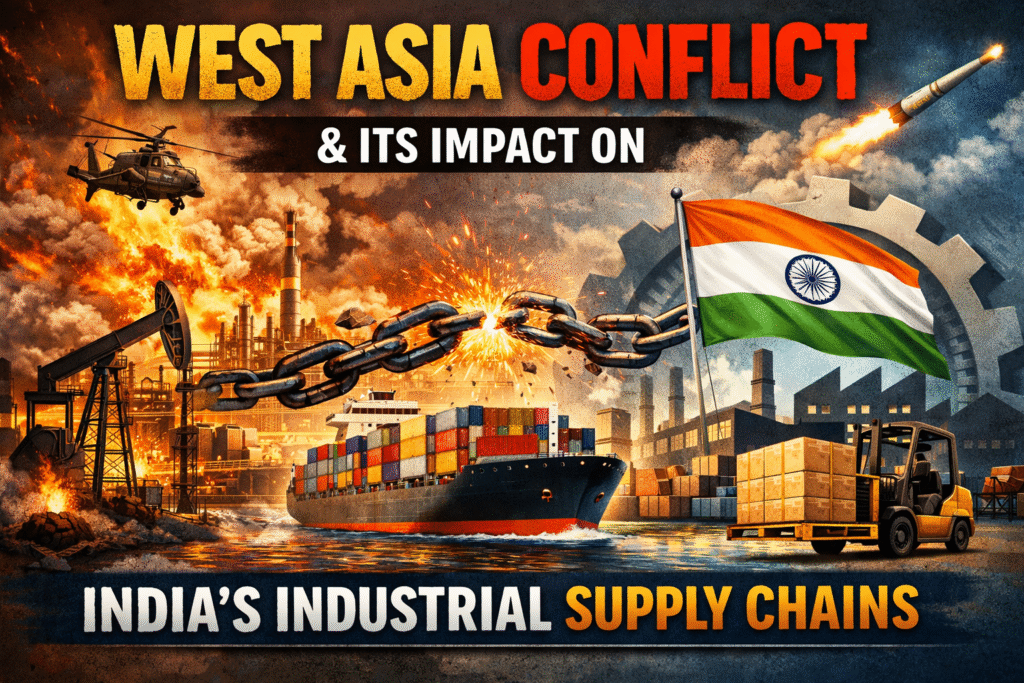
The ongoing conflict in West Asia has raised concerns about potential disruptions in global supply chains and energy markets. The region is a major supplier of oil, gas, and several critical industrial raw materials. India, which maintains strong trade ties with West Asian countries, imports a significant share of these inputs from the region. In 2025, India imported goods worth about $98.7 billion from West Asia. Escalating attacks on energy and logistics infrastructure, along with the possibility of disruptions in the Strait of Hormuz, could affect multiple Indian industries beyond the energy sector.
Dependence on West Asia for Industrial Raw Materials
Several Indian industries depend heavily on raw materials sourced from West Asia. Important imports include limestone, sulphur, gypsum, direct reduced iron (DRI), and copper wires. In many cases, more than half of India’s imports of these commodities originate from West Asia, making the country vulnerable to supply disruptions.
Strategic Importance of the Strait of Hormuz
The Strait of Hormuz is one of the most critical maritime trade routes in the world, through which a large share of global energy and commodity trade passes. Any disruption or closure of this route due to escalating conflict could interrupt the supply of both energy resources and industrial inputs, affecting India’s manufacturing and infrastructure sectors.
Impact on Energy Supply and Industrial Costs
West Asia is one of the world’s largest producers of oil and natural gas, making global energy markets highly sensitive to regional instability. With India’s crude oil stocks expected to last only about one month, refiners have begun increasing imports of discounted Russian crude oil to maintain supply stability. If LNG shipments from Qatar are disrupted, gas companies may consider limiting industrial gas supply, which would increase production costs for several sectors.
Risks to the Fertiliser Sector
The fertiliser industry relies on several raw materials imported from West Asia.
Sulphur is a critical input used to produce sulphuric acid, which is essential for fertiliser manufacturing. India imported $420 million worth of sulphur from West Asia, accounting for about 65.8 percent of total imports.
While the fertiliser sector may not face immediate shortages because it is currently the off-season for fertiliser demand, prolonged disruptions could affect domestic urea production and availability for the next agricultural cycle.
Vulnerability of the Construction and Infrastructure Sector
India depends heavily on West Asia for minerals used in construction and cement production.
Limestone imports from the region amounted to $483 million, accounting for about 68.5 percent of India’s total imports. Limestone is a crucial raw material in cement manufacturing.
Gypsum imports stood at $129 million, making up about 62.1 percent of total imports, and it is widely used in cement and building materials.
Supply disruptions could lead to higher cement prices and delays in infrastructure and construction projects.
Impact on the Steel Industry
The steel industry depends on several imported inputs from West Asia.
India imported $190 million worth of Direct Reduced Iron (DRI) from the region, accounting for 59.1 percent of total imports. DRI is an important raw material used in steel production.
In addition, India’s steel sector is increasingly shifting towards natural gas based production processes as part of its decarbonisation strategy, making it more vulnerable to fluctuations in global gas markets.
Challenges for Export-Oriented Industries
Export industries could also face indirect impacts due to supply disruptions. The diamond processing industry, one of India’s major export sectors, relies significantly on imports of rough diamonds from West Asia.
More than 40 percent of rough diamonds used in India’s cutting and polishing centres originate from the region, making the sector sensitive to supply interruptions.
Availability of Alternative Supply Sources
Certain raw materials can be sourced from alternative regions if supplies from West Asia are disrupted.
For example, limestone can be imported from countries such as Thailand and Vietnam, while DRI may be sourced from Libya and Malaysia. However, alternative sourcing may increase transportation costs and may not fully offset the effects of volatile global energy prices.
Conclusion
The ongoing conflict in West Asia highlights India’s structural dependence on the region for energy and critical industrial inputs. Disruptions in supply chains, especially through the Strait of Hormuz, could have wide-ranging impacts on sectors such as steel, fertilisers, construction, and export industries. Strengthening supply diversification, strategic reserves, and alternative sourcing strategies will be essential for enhancing India’s economic resilience and ensuring stability in industrial production.
Source : Indian Express