
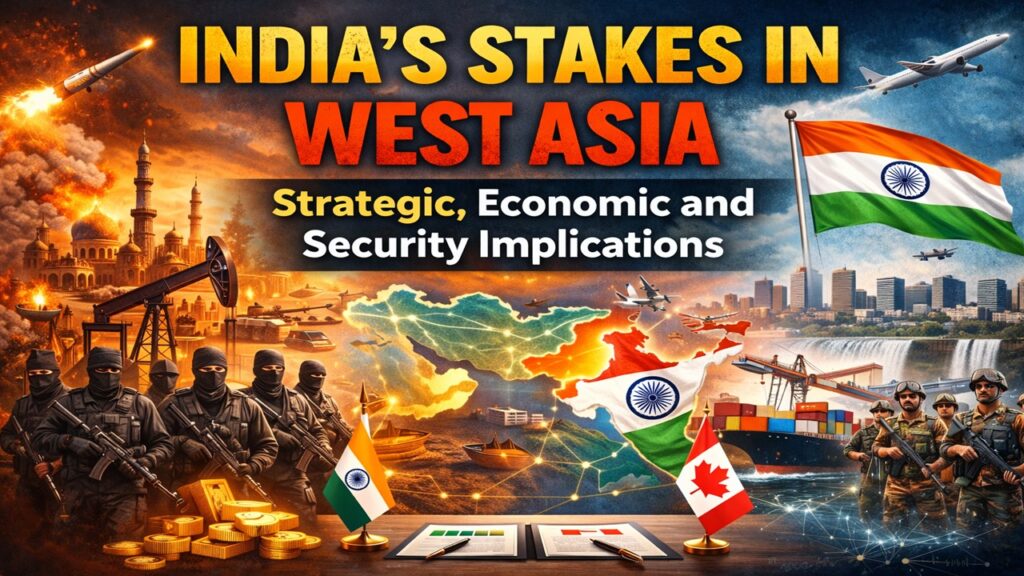
India’s Stakes in West Asia : Strategic, Economic and Security Implications
Context:
As the war in West Asia entered its seventh day following the February 2026 strikes on Tehran, concerns have intensified about its wider geopolitical consequences. Leaders and strategic experts, including Shashi Tharoor, have warned that the escalating conflict threatens the regional order and has direct implications for India’s energy security, trade flows, and the safety of millions of Indian expatriates in the Gulf region.
Introduction
West Asia is a region of immense strategic importance for India due to deep energy, economic, diaspora, and maritime linkages. Instability in the region directly affects India’s domestic economy, as disruptions in energy supply, trade routes, and remittance flows can trigger inflation and economic uncertainty. Therefore, safeguarding India’s interests in West Asia remains a key priority of Indian foreign policy.
India’s Major Stakes in West Asia
Energy Security Dependence:
India depends heavily on West Asia for hydrocarbons. Around 49 to 55 percent of India’s crude oil imports and nearly 70 percent of its natural gas imports originate from the region. Nearly 40 to 50 percent of India’s crude shipments pass through the Strait of Hormuz, making India vulnerable to disruptions in this strategic chokepoint. The 2026 conflict has pushed Brent crude prices toward 83 to 100 dollars per barrel, raising concerns over inflation and widening of the Current Account Deficit.
Remittance and Diaspora Linkages:
West Asia hosts one of the largest Indian diasporas, with more than 9 million to 1 crore Indians living and working in the Gulf countries. Remittances from this region play a crucial role in sustaining household incomes and foreign exchange reserves. The Gulf region contributes nearly 38 percent of India’s global remittance inflows, including about 19 percent from the United Arab Emirates alone. Any escalation in conflict could endanger the livelihood of Indian workers and disrupt remittance flows.
Agricultural Export Market:
West Asia serves as a major destination for India’s agricultural exports, especially Basmati rice, spices, and other high-value commodities. Disruptions in shipping routes and trade channels directly affect Indian farmers and exporters. In March 2026, more than 400,000 tonnes of Basmati rice were reported stranded at Indian ports due to disruptions in trade routes to countries such as Saudi Arabia and Iran.
Fertilizer Imports and Food Security:
India imports a large share of its fertilizers from West Asia, particularly Urea and NPK fertilizers, which are essential for sustaining agricultural productivity. Nearly 40 percent of India’s fertilizer imports originate from the Gulf region. Disruptions in supply chains may increase the government’s fertilizer subsidy burden and contribute to rising food prices in India.
Importance of India for West Asia
Economic Reconstruction Partner:
India is viewed as an important partner in infrastructure development and post-conflict reconstruction due to its technical expertise and cost-effective workforce. Indian public sector enterprises such as IRCON and ONGC have proposed projects like the Zahedan railway line and the Farzad-B gas field in Iran, highlighting India’s role in regional economic development.
Balanced Diplomatic Actor:
India maintains strong relations with diverse actors in West Asia, including Israel, Iran, and Gulf countries, allowing it to play a constructive diplomatic role. In March 2026, External Affairs Minister S. Jaishankar held emergency discussions with Israeli authorities and the interim leadership in Tehran to encourage de-escalation.
Human Resource Backbone:
Indian professionals and labourers form a significant part of the workforce in Gulf economies, contributing to sectors such as construction, healthcare, information technology, and services. Even during periods of instability, Gulf governments have engaged with India to ensure continuity of the Indian workforce that supports their economic systems.
Maritime Security Provider:
India plays an important role in safeguarding sea lanes of communication in the Indian Ocean and the North Arabian Sea. The Indian Navy has been involved in protecting commercial shipping from regional security threats. Operation Sankalp, launched to safeguard merchant vessels, was institutionalized in 2026 as a permanent escort framework.
Challenges for India in the Current Conflict
Diplomatic Balancing Challenge:
India must carefully balance relations with the United States and Israel while maintaining strategic engagement with Iran, which remains vital for energy and connectivity projects. This diplomatic balancing act has become more complex during the ongoing conflict.
Vulnerability of Strategic Chokepoints:
The Strait of Hormuz remains a critical maritime passage for India’s energy supplies. Any blockade or disruption can severely affect India’s oil and gas imports. Reports in March 2026 indicated that Qatar declared force majeure on LNG shipments, forcing Indian industries to seek more expensive alternatives.
Connectivity and Trade Disruptions:
Regional instability has affected strategic connectivity projects linking India with Europe through West Asia. The India Middle East Europe Corridor has experienced delays due to shifting regional priorities toward conflict management.
Evacuation and Humanitarian Concerns:
The large Indian diaspora in the region makes emergency evacuation extremely challenging. Government officials have warned that a full-scale war could require an evacuation effort larger than past operations such as Operation Rahat.
Way Forward
Energy Diversification Strategy:
India should diversify its energy imports by increasing sourcing from Africa, the Americas, and Eurasia, while expanding Strategic Petroleum Reserves to mitigate supply disruptions.
Strengthening Maritime Security:
Institutionalizing a permanent maritime escort framework can safeguard Indian merchant vessels and protect vital trade routes in the region.
Active Diplomatic Engagement:
India can leverage its credibility among different regional actors to encourage dialogue and promote de-escalation through international platforms such as G20 and BRICS.
Promoting Alternative Financial Mechanisms:
Developing rupee-based trade settlement mechanisms and currency swap arrangements can help India continue trade even during sanctions or financial disruptions.
Ensuring Diaspora Protection:
Strengthening evacuation planning, digital registration systems, and diplomatic coordination with Gulf governments can help protect the welfare of Indian citizens abroad.
Conclusion
West Asia remains central to India’s energy security, economic stability, and diaspora welfare. The 2026 conflict highlights the vulnerability of India’s strategic interests to regional instability. By pursuing energy diversification, proactive diplomacy, and stronger maritime security, India can safeguard its interests while contributing to long-term stability in a region that is vital for the prosperity of the Global South.