
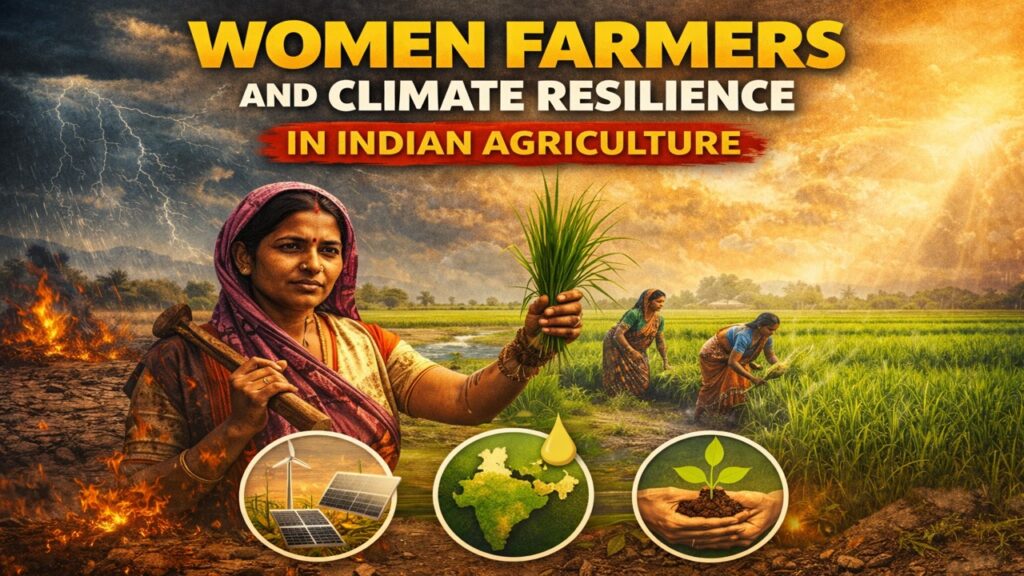
Women Farmers and Climate Resilience in Indian Agriculture
Introduction:
Women constitute the backbone of India’s agricultural sector and play a crucial role in ensuring food security and rural livelihoods. However, their contributions remain largely unrecognized while climate change is increasing vulnerabilities in agriculture. Addressing the intersection of gender, agriculture, and climate change is therefore essential for achieving sustainable and inclusive agricultural development.
Context: The issue has gained renewed attention as the world marks International Women’s Day, and the United Nations has declared 2026 as the “International Year of the Woman Farmer.” This highlights the need to recognize women’s contributions in agriculture and strengthen their role in building climate-resilient farming systems.
Meaning of Gender-Responsive Agriculture: Gender-responsive agriculture acknowledges that climate change affects men and women differently due to disparities in access to land, credit, technology, and decision-making power. In rural India, women face a triple burden of farm labour, unpaid domestic care work, and climate-induced shocks such as droughts and floods.
Women’s Workforce Contribution: Around 80% of rural women in India are engaged in agriculture, performing nearly 70% of total farm-related activities, making them indispensable to the functioning of the rural economy.
Sector-wise Participation: Women contribute significantly across agricultural activities, accounting for 75% of crop production, 79% of horticulture activities, and nearly 95% of livestock, fisheries, and allied sectors, highlighting their importance in ensuring food and nutritional security.
Land Ownership Gap: Despite their major role in farming, only 13.9% of agricultural landholdings in India are owned by women, which limits their access to institutional credit, crop insurance, and government support schemes.
Feminization of Agriculture: Increasing male migration to urban areas for non-farm employment has resulted in the feminization of agriculture, where women are increasingly managing farms independently but often without formal recognition as farmers.
Climate Vulnerability of Women Farmers: Female-led households are more vulnerable to climate shocks due to limited access to technology and financial resources. Globally, women farmers in low-income countries lose an estimated $37 billion annually due to heat stress and climate impacts.
Role of Women as Primary Cultivators: Women perform labour-intensive tasks such as sowing, transplanting, weeding, and harvesting. For instance, in the paddy fields of Chhattisgarh and Odisha, women dominate manual transplantation and post-harvest processing.
Role in Livestock and Allied Activities: Women are the primary managers of dairy, poultry, and small livestock, which provide stable income during crop failures. For example, Pashu Sakhis under the DAY-NRLM initiative provide veterinary services and livestock care in several states.
Role as Seed Conservers and Biodiversity Protectors: Women preserve indigenous seed varieties that are often more climate-resilient. For instance, women associated with the Deccan Development Society in Telangana maintain community seed banks for drought-resistant millets.
Role in Natural Resource Management: Women actively participate in water conservation, forest resource management, and sustainable farming practices. In Bihar, Jeevika Self Help Groups have adopted rainwater harvesting and drip irrigation techniques to tackle water scarcity.
Role in Agricultural Extension and Knowledge Sharing: Women also act as community resource persons and trainers. The government has mobilized over 2 lakh Krishi Sakhis to promote Natural Farming practices across rural India.
Government Initiative – Deendayal Antyodaya Yojana (DAY-NRLM): The programme has mobilized around 10 crore women into nearly 91 lakh Self Help Groups, enabling financial inclusion, skill development, and livelihood generation.
Government Initiative – Namo Drone Didi Scheme: This scheme aims to provide 15,000 women Self Help Groups with drones for precision agriculture, enabling efficient spraying of fertilizers and pesticides while reducing physical drudgery.
Government Initiative – Mahila Kisan Sashaktikaran Pariyojana (MKSP): This initiative focuses on empowering women farmers through sustainable and climate-resilient agricultural practices, while improving their access to training and institutional support.
Government Initiative – Lakhpati Didi Programme: The initiative aims to increase the income of up to 6 crore women SHG members, promoting entrepreneurship, skill development, and market linkages such as SHE-Mart.
Challenge – Lack of Legal Recognition: Many women farmers are not officially recognized as farmers due to the absence of land titles. A Landesa study (2021) found that only about 13% of women in Uttar Pradesh and Odisha possess legal land ownership documents.
Challenge – Digital and Technological Divide: Limited digital access restricts women’s ability to benefit from agricultural innovations. Only about 22% of rural women in India independently access the internet, limiting their use of weather forecasts, digital markets, and platforms such as e-NAM.
Challenge – Gendered Drudgery in Farming: Agricultural machinery is often designed for male users, increasing the physical burden on women. For example, manual weeding in paddy cultivation remains one of the most exhausting tasks for women farmers.
Challenge – Limited Decision-Making Power: Although women perform most farm activities, financial decisions and crop choices are often controlled by male family members, reducing women’s agency in agricultural planning.
Challenge – Climate-Induced Migration: Climate stress leads to male migration, increasing women’s workload. In Bundelkhand, recurring droughts have forced large-scale migration, leaving women to manage farms, households, and water collection simultaneously.
Way Forward – Recognition Based on Cultivation Activity: The definition of a farmer should shift from land ownership to actual cultivation, enabling women farmers to access credit, crop insurance, and welfare schemes such as PM-KISAN.
Way Forward – Promotion of Gender-Friendly Technologies: Introducing lightweight farm tools such as cono-weeders, solar dryers, and small-scale mechanization through Custom Hiring Centres can significantly reduce drudgery.
Way Forward – Local Value Addition and Market Access: Establishing village-level processing units for grains, spices, and dairy products can enhance incomes while accommodating women’s mobility constraints.
Way Forward – Strengthening Land Rights: Policies promoting joint land titles and reduced stamp duties for women can improve women’s ownership and access to institutional credit.
Way Forward – Innovative Financial Instruments: Introducing weather-based parametric insurance and dedicated credit lines for women-led Farmer Producer Organisations can strengthen financial resilience.
Conclusion:
Empowering women farmers is essential for achieving sustainable agriculture, climate resilience, and inclusive economic growth. Recognizing women as farmers, innovators, and decision-makers will strengthen India’s agricultural system and contribute significantly to the country’s broader development goals.
Source : The Hindu