
Andhra Pradesh Population Management Policy : Responding to Declining Fertility and Ageing Population
Context
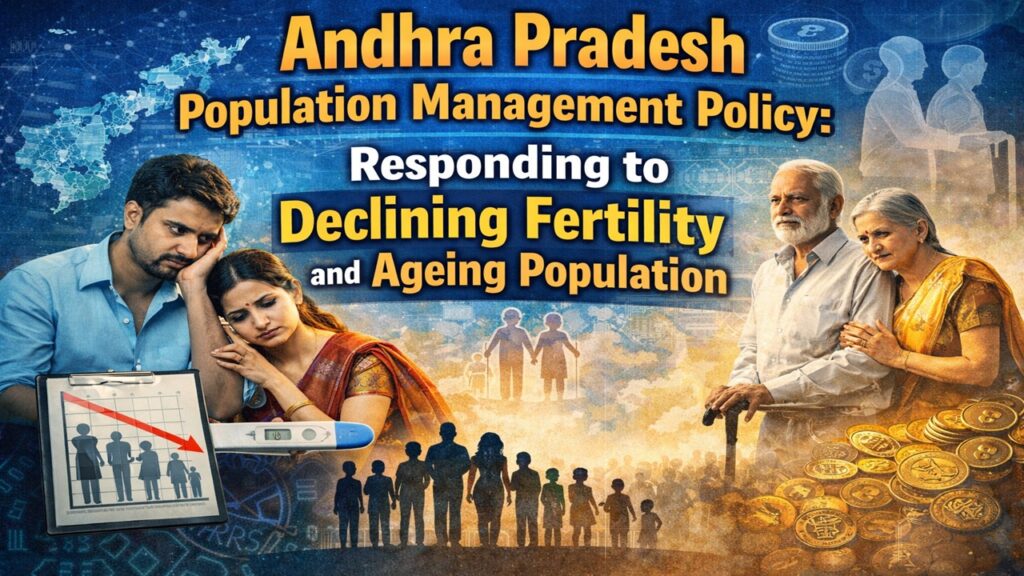
The Government of Andhra Pradesh has proposed a draft Population Management Policy aimed at encouraging families to have two or three children. The initiative comes in response to the sharp decline in fertility rates in the state, which has raised concerns about population ageing, shrinking workforce, and long-term economic sustainability.
Introduction
Population trends play a crucial role in shaping a country’s economic growth, workforce availability, and social welfare systems. Andhra Pradesh has witnessed a significant decline in fertility rates, with the Total Fertility Rate (TFR) falling to 1.5, which is below the replacement level of 2.1. To address this demographic transition, the state government has proposed a comprehensive policy focusing on healthcare, workforce participation, and incentives for childbirth.
Demographic Trends in Andhra Pradesh and India
Declining Fertility Rate in Andhra Pradesh
The Total Fertility Rate (TFR) in Andhra Pradesh has declined from 2.2 in 2003 to 1.5 in 2023. Telangana has also recorded a similar TFR of 1.5, indicating a broader demographic shift in the region.
National Fertility Decline
India’s overall TFR has declined from around 3 in 2003 to about 1.9 today. This decline is associated with improved education, better healthcare, urbanisation, rising incomes, and the growth of nuclear families.
Regional Differences in Fertility
Low Fertility in Southern States
Southern states generally record lower fertility rates due to stronger social development indicators.
Tamil Nadu has a TFR of 1.3, while Andhra Pradesh, Telangana, Karnataka, and Kerala record around 1.5.
Higher Fertility in Northern States
Several northern and eastern states still have higher fertility levels.
Bihar has a TFR of 2.8, while Uttar Pradesh records 2.6. States such as Madhya Pradesh, Chhattisgarh, Rajasthan, Jharkhand, and Assam remain above the national average.
Political Implications of Population Changes
Impact on Parliamentary Representation
Since parliamentary constituencies are allocated based on population, states with slower population growth may experience a relative decline in representation compared to more populous states such as Uttar Pradesh and Bihar.
Delimitation Debate
The issue is closely linked to the delimitation process, which redraws parliamentary constituencies after each Census. As the suspension of delimitation is expected to end soon, the question of population-based representation may become a major political issue.
Objectives of the Population Management Policy
The policy aims to address the challenges arising from declining fertility, ageing population, and workforce imbalance. It seeks to ensure that demographic changes do not weaken the state’s economic growth potential and social welfare systems.
Key Pillars of the Policy
Matrutva
Focuses on improving maternal health and healthcare services for women.
Shakti
Promotes greater participation of women in the workforce to strengthen economic productivity.
Kshema
Strengthens care and welfare systems for senior citizens in view of the ageing population.
Naipunyam
Enhances skill development and workforce readiness, especially in healthcare services for children and the elderly.
Sanjeevani
Expands the digital public health system to improve healthcare accessibility and efficiency.
Incentives to Encourage Childbirth
The policy proposes several incentives to encourage families to have more children.
Financial Incentive
Families may receive ₹25,000 for the birth of a second or third child.
Nutritional Support
The government proposes ₹1,000 per month for five years for the third child to support nutrition.
Educational Support
The second and third child will receive free education in government institutions until 18 years of age.
Support for Infertile Couples
The policy includes subsidised IVF treatment through public private partnerships.
Health and Workforce Measures
The policy also focuses on strengthening healthcare and workforce capacity.
Preventive Healthcare
Retiring government employees may receive ₹50,000 and 15 days leave for preventive health check-ups.
Healthcare Workforce Expansion
The state plans to train 10,000 healthcare assistants annually to support services for adolescents and elderly citizens.
Ageing Population and Workforce Challenges
Rapid Population Ageing
The median age in Andhra Pradesh is 32.5 years, compared to India’s median age of 28.4 years.
Rising Elderly Population
Currently about 10 percent of the population is above 60 years, which is expected to increase to 23 percent by 2047.
Low Female Workforce Participation
Female workforce participation in the state is about 31 percent, which is lower than the national average of 37 percent.
Conclusion
The proposed Andhra Pradesh Population Management Policy reflects the growing concern over declining fertility and rapid population ageing. By combining financial incentives, healthcare improvements, and workforce reforms, the policy aims to maintain a balanced demographic structure. Effective implementation will be essential to ensure that Andhra Pradesh continues to benefit from a demographic dividend rather than facing a demographic burden in the future.
Source : Indian Express